°50a Lì’u Amip! 40 New Words!

Kaltxì, ma frapo! I hope you’re all doing well and enjoying the lead-up to summer. 

It’s been a while. 😄 But it’s good to be back. To start to make up for lost time, here are 40 new words and expressions that I hope you’ll find useful. Some of these were taken from or inspired by the last LEP submission, some were new terms from the wonderful European radio play, and some were just some items I’ve been meaning to share with you.

To begin, here are some terms having to do with unpleasant situations. (I hope you don’t have to use them often!)

’asap (n., ’A.sap) ‘sudden shock’

Fwa tse’a peyä tìfkeytokit lefkrr lolängu oer ’asap nìngay.
‘It was a real shock to me to see him in his current condition.’

’asap si (vin.) ‘be shocked, be startled’

Oe ’asap soli krra tsafmawnit stawm.
’I was startled when I heard the news.’

fe’pey (vin., fe’.PEY, inf. 2, 2) ‘feel dread, expect something bad to happen, fear’

This is the negative counterpart to sìlpey ‘hope.’ When you hope, you expect or wait for something good to happen. When you dread, you expect or wait for something bad.

Krra pähem Sawtute, pxaya Na’vi fe’parmey.
‘When the Sky People arrived, many Na’vi felt dread.’

As with sìlpey, we use tsnì ‘that’ to talk about feeling dread or fearing that something bad will or won’t happen:

Po fe’poley tsnì ’itan sneyä tìfmetokit ke emzìyeva’u.
‘He feared his son might not pass the test.’

ketrìp (adj., KET.rìp) ‘unfortunate, inauspicious’
This is obviously the opposite of etrìp ‘favorable, auspicious.’

Nga ketrìpa krr zola’u; Ralu set sti ulte ke new ngahu pivängkxo.
‘You came at the wrong time; Ralu is angry and won’t speak with you.’

txansngum (n., txan.SNGUM) ‘desperation; feeling of great worry’

txansngum si (vin.) ‘feel desperate’

Ke lu syuve ulte tute apxay txansngum si.
‘There is no food, and many people are desperate.’

tskawr (vin.) ‘limp’

Oel tseri futa nga tskawr. Srake ngal venut tìsraw seykoli?
’I see you’re limping. Did you hurt your foot?’

txavä’ (adj., txa.VÄ’) ‘disgusting’

This general term derives from txanvä’ ‘unpleasant to the senses,’ where over time the n of txan has dropped. But as in English, its use is wider than just for sensory perception. 

Lu tsakem txavä’, ma tsmuk.
‘That’s disgusting, bro.’ 

On to less negative things:

nìflä (adv., nì.FLÄ) ‘successfully’

Soleia! Ngal tìfmetokit emzola’u nìflä! Seykxel sì nitram!
‘You rose to the challenge! You passed the test successfully! Congratulations!’

A few more words incorporating txan:

txantsawl (adj., TXAN.tsawl) ‘giant, huge’

txasunu (vin., txa.SU.nu) ‘love greatly, enjoy tremendously’

While in English you can love your spouse and also love hamburgers, in Na’vi the words are different. For the former, we of course use yawne plus the dative, as in Nga yawne lu oer ‘I love you.’ For the other kind of love:

Txasunu oeru teylu!
‘I really love teylu!’

As you’ve seen by now, words incorporating txan are somewhat unpredictable as to stress (txantsawl but txansngum) and whether or not the n drops (txantsawl but txavä’). So you have to pay attention to each new word!

zeykoyu (n., zey.KO.yu) ‘healer’

Fì’umtsat tolìng ’evengur aspxin zeykoyul a txanro’a.
‘This medicine was given to the sick child by a famous healer.’

tìranpam (n., tì.RAN.pam) ‘footstep (sound)’

Oel stawm sìranpamit! Lerok tuteo!
‘I hear footsteps! Someone is coming!’

ftuopa (adp-; FTU.o.pa) ’from behind’

Sroler fwäkì ftuopa tskxe.
‘A mantis appeared from behind a rock.’

fyeng (adj.) ‘steep’

Nari si! Fayramtsyìp lu fyeng.
’Be careful! These hills are steep.’

kavan (vtr., KA.van, inf. 1, 2) ’support (physically)’

Fol karmavan koaktet tengkrr fmeri po tivìran.
’They supported the old woman as she was trying to walk.’

lepxìmrun (adj., le,PXÌM.run) ‘common, often found’

kelpxìmrun (adj., kel,PXÌM.run) ‘rare’

These two adjectives clearly derive from pxìm ‘often’ and run ‘find.’

zung (vin.) ‘crouch’

Zolung ayoe nekll fteke ayioang tsivun ayoeti tsive’a.
‘We crouched down so that the animals wouldn’t be able to see us.’

fpivìl (intj., fpi.VÌL) ‘hmm, let’s see, let me think’

This useful conversational expression translates the ubiquitous “Hmm” in English, where you’re thinking about or considering what’s just been said. Literally, of course, it means “Let (me) think.”

Fpivìl . . . Kxawm ngaru tìyawr.
‘Hmm . . . Perhaps you’re right.’

kom (vin. modal) ‘dare’

Syntactically, kom behaves like tsun and var—that is, it functions as a modal and requires the subjunctive (<iv>) form of following verb:

Oe ke kom kivä.
‘I don’t dare to go.’

Nga kom pivlltxe oehu tsafya srak?
‘You dare to speak to me like that?’

Note that in English, “dare” sometimes takes an object: “I dare you to tell him what you really think!” But that’s a different verb in Na’vi, something like “challenge,” which we’ll discuss another time.

mam (vtr.) ‘wrap’

Fìsräti pxaw sey mivam fte tsat hivawnu.
‘Wrap this cloth around the bowl to protect it.’

nìtxukx (adv., nì.TXUKX) ‘deeply’

The adverbial form of txukx is used both literally and metaphorically, as in English.

Poanit tsolukx poel fa tstal nìtxukx nemfa heyr.
‘She stabbed him deeply in the chest with a knife.’

Fìtìpawmteri fparmìl oe nìtxukx, slä vay set ke rolängun tì’eyngit.
‘I’ve thought about this question deeply, but I’m sad to say I haven’t yet found the answer.’

Two verbs related to yom:

yomvey (vin., yom.VEY, inf. 1,1) ‘dine on flesh, be carnivorous’

Palukantsyìp yomvey nìwotx.
‘All cats are carnivorous.’

Contrast this last example with:

Fìpalukantsyìpìl yom veyti fratrr.
‘This cat eats meat every day.’

yomzeswa (vin., yom.ZE.swa, inf. 1,1) ‘graze’

Snayerik yeromzeswa mì tayo.
‘A herd of hexapedes are grazing in the field.’

Again, contrast this intransitive example with a transitive sentence like:

Torukìl ke yom zeswat.
‘A toruk doesn’t eat grass.’

raw (adp-) ‘down to’

Kolä oe raw kilvan fte ivaho.
‘I went down to the river to pray.’

Kllza’u yìraw amuve.
‘Descend to the second level.’

You can also use raw for counting down to some number:

Tiam ta vomrr raw pxey.
‘Count down from thirteen to three.’

txap (vtr.) ‘press, press on, apply pressure to’

Txap skxirit fteke reypay wrrziva’u.
‘Apply pressure to the wound so that the blood won’t flow.’

Derived noun:

tìtxap (n., tì.TXAP) ‘pressure’

Note: This word is used only for physical pressure, not psychological or social pressure.

Two nouns related to the verb emkä ‘cross’:

semkä (n., sem.KÄ) ‘bridge’

As you can guess, this word is derived from sä’o ‘tool’ plus emkä, where the expected form *säemkä has evolved naturally into semkä.

emkäfya (n., em.KÄ.fya) ‘ford, crossing’

Fìtseng payfya virä ka ngip areng, ha tsun awnga tsat sivar sko emkäfya.
Here the stream spreads over a shallow area, so we can use it as a ford.

fil (n.) ‘child’s toy, plaything’

sunkesun (adv., SUN.ke.sun) ‘like it or not’

This is obviously a shortened form of sunu ke sunu. The default addressee is “you”:

Sunkesun po slayu olo’eyktan.
‘Whether you like it or not, he’s going to become chief.’

If the “like it or not” is not addressed to the listener, we need to use a different construction:

Pol vìyewng ayevengit fìha’ngir, ftxey sunu fuke.
He is going to take care of the children this afternoon, whether he likes it or not.’

maitan (ph., ma.I.tan) ‘my son (form of address)’

maite (ph., ma.I.te) ‘my daughter (form of address)’

These two words are clearly contractions of ma ’itan and ma ’ite and are used in casual conversation as affectionate forms of address, rather like the Spanish mijo (from mi hijo, ‘my son’) and mija (from mi hija, ‘my daughter’).

Maitan za’u fìtseng.
‘Come here, son.’

And now for a little surprise.  😊

loho (vin., LO.ho) ‘be surprising’

The one who is surprised—that is, the experiencer—is in the dative:

Täftxutswo Riniyä loho oer nìtxan.
‘Rini’s ability to weave surprises me a lot.’

Fo tsìk sroler a fi’u loloho poanur.
OR
Loloho poanur fwa fo tsìk sroler.
‘It surprised him that they suddenly appeared.’

Derivations:

tìloho (n., tì.LO.ho) ‘surprise’

A. Epxangmì lu ’upe?
     ‘What’s in the stone jar?’
B. Tìloho.
     ‘It’s a surprise.’

nìloho (adv., nì.LO.ho) ‘surprisingly’

Poltxe po nìloho san oe zasya’u.
‘Surprisingly, he said he would come.’

And two astronomical terms:

Tsawkenay (n., tsaw.ke.NAY) ‘Alpha Centauri B’

Tawsnrrtsyìp (n., taw.SNRR.tsyìp) ‘Alpha Centauri C aka Proxima Centauri’

As you may know, the Alpha Centauri system contains three stars: A, the largest and brightest; B, somewhat smaller and dimmer; and C, also known as Proxima Centauri, a much smaller and dimmer star that’s actually the closest star to Earth after the sun.

There’s a good diagram of the relative sizes here (scroll down):

What do the Na’vi call these stars?

A is simply the familiar Tsawke.

B is Tsawkenay. Recall that the stressed -nay suffix creates new nouns that are a step down in some relevant hierarchy—size, rank, accomplishment—from the base noun. Here, Alpha Centauri B is the “Deputy Sun,” since it’s a step down in brightness compared to A.

As for C, litte Proxima Centauri, the Na’vi don’t think of it as a sun at all but rather as the little lamp in the sky, Tawsnrrtsyìp, from taw ‘sky’ + sänrr ‘lamp’ + tsyìp ‘diminutive.’

Colloquially, Tawsnrrtsyìp is often shortened to Snrrtsyìp.

Finally, I want to introduce you to the important word

kuru (n., KU.ru) ‘neural queue’

You’re already familiar with the word tswin, which also refers to the neural queue. For now, we can consider the words to be interchangeable synonyms. It’s possible, however, that as time goes on we’ll be able to pinpoint a difference between the two. If and when that occurs, I’ll be sure to update you. 

I have a number of grammatical questions I want to address along with more new vocabulary, so I’ll be in touch again soon.

In the meantime, I hope everyone in Munich is having a fantastic time! Vergnügt euch!

Hayalovay,

ta Pawl
Edit 6 June: Formatting problems fixed. Irayo nìtxan, ma Eana Unil!
Edit 6 June: frato–>frapo, mam (vin.) –> mam (vtr.) Irayo ngar, ma Vawmataw!
Posted in General | 36 Comments

Seiyi oe irayo. I am thankful.

Ma eylan,

Fìtseng alu Amerikamì lu Trrmrrve Ftxozä ”Thanksgiving.” Fìtrrkrrka, sìltsana ayuri tìreyä nìwotx fko irayo si.

I always have a lot to be thankful for on Thanksgiving. But this one is special. As some of you may have heard, I had major surgery on my heart last week to correct a life-threatening condition, and it worked out beautifully. I’m now walking around at home, feeling remarkably good, doing almost everything I used to do except driving and lifting anything heavy. Those will come in time. But I am SO grateful for my amazing Dream Team of surgeons and doctors, for my fantastic family, for my incredible friends who offered me such support and encouragement. For many reasons I often think I’m the luckiest man in the world. Nìngay lolu Eywa oehu.

As you can tell, I’ve had a lot on my mind recently, and I apologize for being unresponsive to many of your comments and questions. But thank you for them all, and I will get to my backlog in time.

For those in the U.S., have a wonderful Thanksgiving aka Turkey Day. And for everyone, I hope you’re all well and happy as we approach the holidays.

Hayalovay!

Ta Pawl

Posted in General | 15 Comments

Aysrr, Ayvospxì, Ayzìsìkrr.   Days, Months, Seasons.

Kxì, ma smuk!

Sìlpey oe, ayngari zìskrrtsawn [tìng nari nekll] sirvalew pxaya lrrtokhu a ta Eywa, ulte ftxozä Hälowinä livu ’o’ sì snewsye txantxewvay. 🙂

It was a busy September and October for us, with a trip “back east,” as we say, to New York and Massachusetts to see family and friends, and some personal issues to resolve as well. I haven’t done too much with Na’vi these past few months, but there’s some new vocabulary in this post that I hope you’ll find useful.

But before that, two things: First, I finally corrected the entry for nìtxankeltrrtrr ‘extraordinarily’ in the March 31 post, which had incorrectly listed the word as an adjective. It is, of course, and adverb. Irayo nìtxan, ma Eana Elf! And by the way, if anyone discovers other errors in previous posts that still need to be corrected, please let me know!

Second, I want to express long-overdue thanks to our Neytiri for her excellent analysis of the differences between vitra ‘soul’ and tirea ‘spirit’ in the comment section of the previous post. If you haven’t already seen it, I strongly suggest you take a look. Lu ngeyä tsapostì lesar srunga’sì nìtxan, ma tsmuke. Aysäfpìl ngey sunu oer!

We haven’t yet had words for the specific months and seasons—at least those ’Rrtamì—so these new terms should fill in those gaps.

First, recall that we already have vocabulary for the days of the week:

DAYS

Trr’awve         ‘Sunday’

Trrmuve          ‘Monday’

Trrpxeyve       ‘Tuesday’

Trrtsìve           ‘Wednesday’

Trrmrrve         ‘Thursday’

Trrpuve           ‘Friday’

Trrkive            ‘Saturday’

These clearly derive from trr plus the ordinal numbers. So Sunday is derived from “first day,” Monday from “second day,” etc. It’s important, however, to distinguish these derived compounds from the ordinary two-word phrases that still exist perfectly well in Na’vi. For example, Trrmrrve and trr amrrve/mrrvea trr are both correct but differ in meaning.

Lu Trrmrrve muvea trr a tìkangkem si oe hu Ralu.
‘Thursday was the second day I worked with Ralu.’

MONTHS

Given the days of the week, you might expect the names of specific months on Earth to be built on the same pattern. Since ‘month’ is vospxì, it would be natural to expect *Vospxì’awve for ‘January,’ *vospxìmuve for ‘February,’ etc. As it turns out, however, the actual words are a bit different:

Vospxì’aw (n., vo.spxì.’AW)                           ‘January’

Vospxìmun (n., vo.spxì.MUN)                        ’February’

Vospxey (n., vo.SPXEY)                                   ’March’

Vospxìtsìng (n., vo.spxì.TSÌNG)                      ’April’

Vospxìmrr (n., vo.spxì.MRR)                          ‘May’

Vospxìpuk (n., vo.spxì.PUK)                            ‘June’

Vospxìkin (n., vo.spxì.KIN)                              ‘July’

Vospxìvol (n., vo.spxì.VOL)                             ‘August’

Vospxìvolaw (n., vo.spxì.vo.LAW)                  ‘September’

Vospxìvomun (n., vo.spxì.vo.MUN)                ‘October’

Vospxìvopey (n., vo.spxì.vo.PEY)                    ‘November’

Vospxìvosìng (n., vo.spxì.vo.SÌNG)                 December’

As you see, the month names are derived from vospxì along with the cardinal (one, two, three, . . . ), not the ordinal (first, second, third, . . . ) numbers. That is, January is “Month One,” February “Month Two,” and so on.

You’ll notice that some shortenings have taken place along the way. In particular, ‘March’ must originally have been *Vospxìpxey, but that quickly evolved to Vospxey.

A note on pronunciation: Except in very careful speech, the normal conversational pronunciation of the unstressed -spxì-syllable in all these words is simply -spì-, where the ejective becomes a simple stop. That’s much easier to pronounce in fast, casual speech. The spelling, however, retains the px.

SEASONS

For the temperate zones on earth, we have four seasons: summer, fall, winter, and spring. Does Pandora likewise have seasons? Let me defer once again to Neytiri on this question, from some private correspondence:

Srane, Pandora has seasons, because it has an axial tilt, similar to Earth’s . . . Pandora’s seasons, like everything about Pandora, are probably just a little more exaggerated than Earth’s because of the higher axial tilt. But there should be a hotter time and a colder time, with transitional periods between, and they should have roughly the same effects, as far as I can tell . . ..

Some quotes I found:

 “If the planet has a tilt similar to ours (Mars [25°], Saturn [27°], Neptune [30°]), it has seasons similar to ours.”

 “Because of its high axial tilt (29°), Pandora exhibits considerable annual variation in the day-to-night ratio. In addition, its elliptical orbit produces seasonal temperature variations and a range in daytime illumination of about ten percent.”

Summer and winter are straightforward—they’re the hot and cold seasons on both Eywa’eveng and ’Rrta, and are thus applicable in both places:

zìskrrsom (n., zì.skrr.SOM) ‘summer’  (from zìsìkrr asom)

zìskrrwew(n., zì.skrr.WEW) ‘winter’  (from zìsìkrr awew)

For the “transitional seasons,” i.e. spring and fall, we have the following terms, which are applicable on earth but not necessarily on Pandora. (Whether the Na’vi recognize spring and fall on Pandora is still to be determined.)

On earth, spring is the season of new growth:

paw (vin.) ‘grow’

This is ‘grow’ in the sense of ‘germinate and develop (of a plant).’ It’s distinct from tsawl slu, which implies “getting big” and is also the term used for an animal that’s growing up and maturing. So we have this contrast:

Fìutral paw kilvanlok nì’aw. Tsawl slu nìwin nìtxan.
‘This tree only grows (i.e., germinates, develops) near a river. It grows (i.e., gets big) very quickly.’

With that said,

tìpaw (n., tì.PAW) ‘growth’

And so we have:

zìskrrmipaw (n., zì.skrr.MI.paw) ‘spring’ (from zìsìkrr a mipa tìpaw, ‘season of new growth’)

Fall is the harvest season:

tsawn (vtr.) ‘gather growing food from the forest; pick; (in agriculture) harvest’

Note that tsawn is not quite the same as the word for ‘gather’ that you’re already familiar with, starsìmStarsìm is general: you can starsìm anything you can gather—arrows, stones, even people. Tsawn is specifically for gathering or picking fruits or other plant-based foods from the forest. In cases where crops are planted and cultivated—that is, where there is agriculture—tsawn can be extended to include the meaning ‘harvest.’ (Since the Na’vi mainly hunt and gather rather than plant crops, they tend to tsawn the entire year rather than restrict harvesting to the fall. Thanks again to Neytiri for clarification on this question.)

With that said,

zìskrrtsawn (n. zì.skrr.TSAWN) ‘autumn, fall’ (from zìsìkrr a tsawn ‘season for harvesting’)

Happy Halloween, everyone!  😀

Posted in General | 8 Comments

Fmawnti stolawm srak? Have you heard the news?

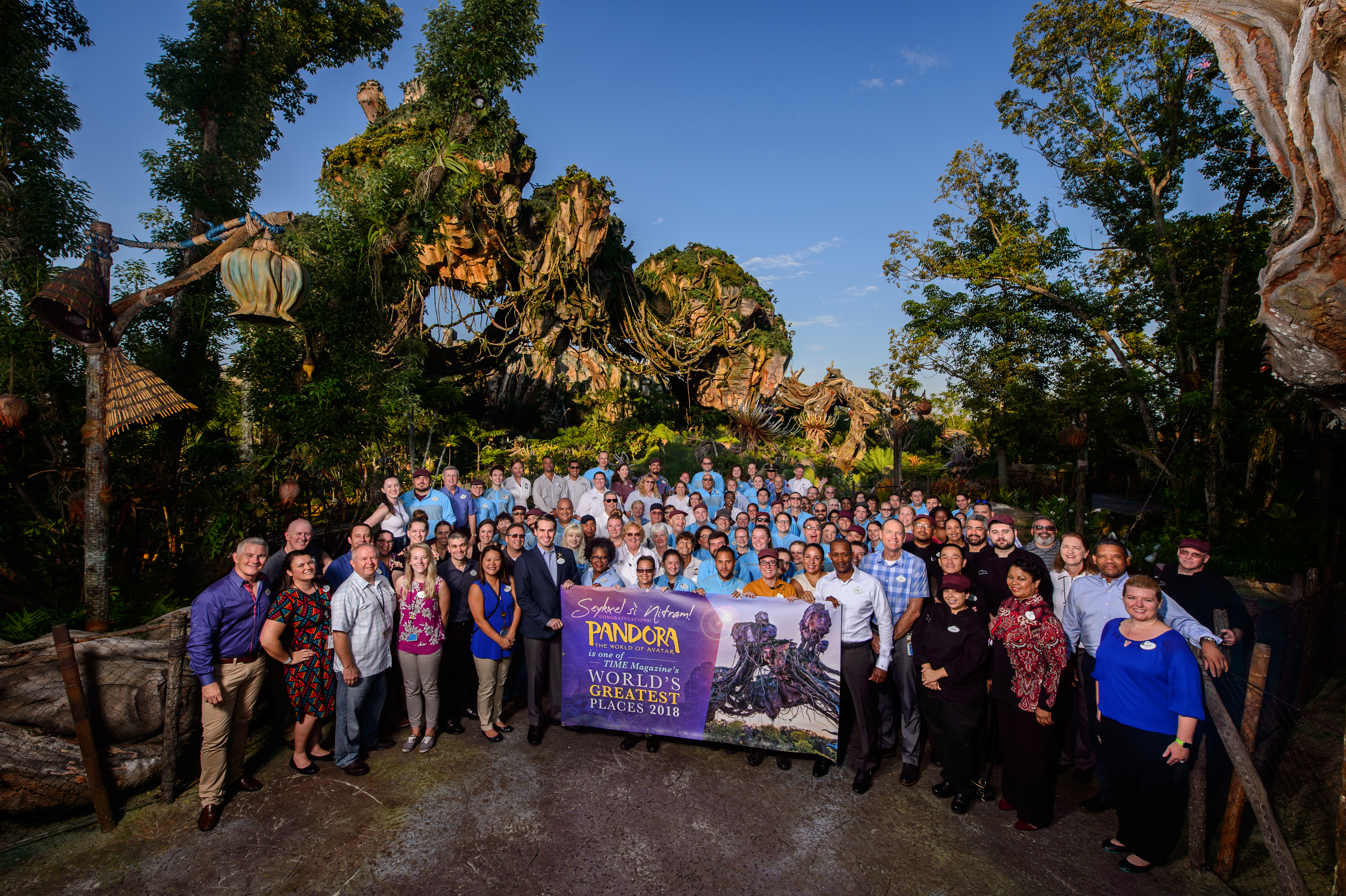
Ma eylan, did you hear that TIME Magazine has recognized our beloved theme park in Orlando, Florida, Pandora—The World of Avatar—as one of the “World’s Greatest Places” for 2018? Meuia atxan leiu, kefyak?  🙂

Here’s a group picture of some of the Pandoran staff, with a congratulatory banner. Seykxel sì Nitram indeed!

Last night I had the pleasure of attending a talk at USC (the University of Southern California, my alma mater) given by Joe Rohde, the dynamic head of Walt Disney Imagineering, the Disney division devoted to the theme parks. As such, he was the major creative force at Disney behind Pandora. His talk was stimulating—I hope it will eventually be available online—and I hope to have some comments relating to what he spoke about in a later post.

For now, here are a few new vocabulary items I hope you’ll find useful.

fpxamo (adj., FPXA.mo) ‘terrible, horrible, awful’

This word allows us to complete the analogy sìltsan : kosman :: fe’ :______.

Mawkrra fko lie soli tìlenur afpxamo fìtxan, tìrey ke lu teng kawkrr.
‘After experiencing such a terrible event, life is never the same.’

Derivation:

tìfpxamo (n., tì.FPXA.mo) ‘horror’

nìfpxamo (adv., nì.FPXA.mo) ‘horribly, terribly, awfully’

Fpängìl oe, txonam oe rolol nìfpxamo.
‘Sadly, I think I sang terribly last night.’

tsyul (vtr.) ‘begin, start’

Tsyul is more or less synonymous with the word for ‘begin’ we’re already familiar with, sngä’i, but its use is a bit different, since it’s transitive.

Pol tìkangkemit tsyolul.
‘He began the work.’

We can use tsyul in an intransitive construction by adding the reflexive infix <äp>:

Tìkangkem tsyäpolul.
‘The work began.’

With the derived noun, however, there’s an important difference in meaning:

tìtsyul (n., tì.TSYUL) ‘beginning, start’

As you know, sngä’i yields two words for ‘beginning,’ one specifically for the time at which something starts, sngä’ikrr, and one specifically for the place at which something starts, sngä’itseng. Tìtsyul, on the other hand, is a general word for ‘beginning’ that’s neutral as to time or place.

Sìtsyul nìwotx lu ngäzìk.
‘All beginnings are difficult.’

nawang (vin., NA.wang, inf. 1, 2) ‘merge, become one with’

Nawang implies that two things have come together to become one, so that the original separateness is lost. We use hu to show that A has merged with B:

Tìmuntxamaw lam Ninatur fwa vitra sneyä nolawang hu pum muntxatuä.
‘After her marriage, it seemed to Ninat that her soul had merged with that of her mate.’

lamaytxa (n., la.may.TXA) ‘flood’

A lamaytxa is a flood or a powerful gathering of water. It’s not clear what the etymology of the word is, although the last syllable may have evolved from txan.

Lamaytxal atxan pxaya kelkut skola’änga.
‘The great flood sadly destroyed many homes.’

(Question: Where does the stress fall in skola’änga? 🙂 )

And finally, a word we’ve lacked for a long time:

oare (n., o.A.re) ‘moon’

Naranawm has fourteen moons revolving around it—including Eywa’eveng!—so it should be possible to see up to thirteen moons in the Pandoran sky. Each of these probably has a specific name in Na’vi, but it’s also clear that there must be a generic term for ‘moon.’ This is oare.

Polpxaya oaret tse’a ngal mì saw pxiset?
‘How many moons do you see in the sky right now?’

By the way, I had an interesting discussion with one of our ayhapxìtu lì’fyaolo’ä about whether or not the Na’vi realize that Pandora is in fact a moon of Naranawm. I hope Neytiri won’t mind my sharing her astute analysis with you:

“As for moon, I wouldn’t be surprised if the Na’vi were aware that Pandora is a moon. They are certainly very aware of the other moons and their patterns, so I don’t think it would be a stretch for them to realise that they orbit Naranawm as well. We know about the ‘circular drums’ whose ‘size and arrangement of the individual drums within the ring reflect Pandora’s solar system.’ And we know that the uses for waytelem ayllis to record history, including astronomy, going back 18,000 years.”

That’s it for now. Hayalovay!

Edit Sept. 1: tirea –> vitra
Posted in General | 17 Comments

Ta sulfätu a aylì’u nì’ul. More words from our experts.

Kaltxì nìmun, ma eylan. Srane, oel mi tok fìtsenget!  🙂 I’m afraid I’ve been preoccupied with other things lately, but I’ve been sitting on some great suggestions from the LEP for some time now, and I wanted to get those words to you without any more delay. In a few cases I’ve made some changes, but the words and examples below are mostly as submitted to me. Tìkangkem atxantsan, ma smuk!

’on si (vin.) ‘shape; give shape (to something)’

This si-verb can be used either for physical shaping or, metaphorically, for giving shape to something abstract like an idea, relationship, etc.

Oe ’on si tskxeru fte na ikran livam.
‘I shape a rock to look like an ikran.’

Olo’ìri poan zusawkrrur ’on soli.
‘He shaped the tribe’s future.’

kxange (vin., KXA.nge, inf. 1,2) ‘yawn’

As on earth, yawning can be a result of fatigue or boredom.

(Note: The original submission had kxange as a noun, with the verb as kxange si, but I thought that the verbal form was more basic.)

Oe kxìmange taluna ’efu ngeyn.
‘I just yawned because I feel tired.’

Keng krra sänumvi eltur tìtxen ke si, nga sweylu txo ke kxivange mì numtseng.
‘Even when the lesson isn’t interesting, you shouldn’t yawn in school.’

säkxange (n., sä.KXA.nge) ‘a yawn’

walew (vin., wa.LEW, inf. 1,2) ‘get over, accept some fact, reconcile oneself, move on’

This verb expresses the psychological state of accepting or reconciling oneself to some negative fact or occurrence.

Furia oe yawne ke lu Va’rur nulkrr, ke tsängun oe wivalew.
‘I can’t get over the fact that Va’ru no longer loves me.’

Tìska’ari Kelutralä Na’vi wayalew pefya?
‘With the destruction of Hometree, how will the Na’vi ever move on?’

nìnew (adv., nì.NEW) ‘voluntarily, willingly, by desire’

This is clearly the adverbial form of new ‘want.’ It indicates something was done willingly or voluntarily, not through coercion. Nìnew is different from nìtkan, which has the sense of doing something on purpose or deliberately as opposed to accidentally.

Nga tsakem soli nìnew srak?!
‘You did that without being asked to?!’

Tsasänumvit oel poru kayeiar nìnew!
‘I’m happy to teach him that lesson!’

Oel pelun ftxalmey nìnew futa srung si skxawngur anafì’u?
‘Why did I choose, of my own free will, to help such a fool?’

tawtxew (n., TAW.txew) ‘horizon, skyline’

The horizon is the “edge (txew) of the sky” where the sky seems to touch the land or water.

Several adpositions can be used with tawtxew to indicate positions right on the horizon (sìnor ro), in front of the horizon, i.e. in the distance almost at the skyline (eo), behind the horizon, i.e. partially visible, partially sunk below the horizon (uo), etc.

Lu ayram sìn tawtxew.
‘There are mountains on the horizon.’ (I.e. exactly on the skyline).

Naranawmä mawl mi lu uo tawtxew.
‘Half of Polyphemus is still behind the horizon.’ (I.e. overlapping the skyline, partially invisible)

frir (n.) ‘layer’

Tskxepayri lu frir aflì sìn ’ora.
‘There’s a thin layer of ice on the lake.’

Fayfrir letskxe lor lu nìtxan.
‘These stone layers are very beautiful.’

Derivations:

lefrir (adj., le.FRIR) ‘layered’

nìfrir (adv., nì.FRIR) ‘in layers’

leyr (adj.) ‘frozen’

Ke tsun ioang rivun syuvet mì hllte aleyr.
‘Animals can’t find food in the frozen ground.’

To say something freezes, use slu ‘become’ along with leyr:

Mì zìsìkrr atxawew slu ayora leyr.
‘In the very cold season, the lakes freeze.’

leyr si (vin.) ‘freeze (something)’

Leyr si, although a si-verb and therefore intransitive, conveys the transitive sense of “freeze” in English:

Txo awnga fìtsnganur leyr sivi, tsun tsat yivom kintrray.
‘If we freeze this meat, we can eat it next week.’

Hayalovay!

Posted in General | 8 Comments

°100a Lì’u Amip! 64 New Words! (Part 2)

Kaltxì, ma eylan! Here’s Part 2 of our Zama Lì’u Amip—°40 (32) more new vocabulary items, at least some of which I hope will be useful to you. Since John and I are leaving for France tomorrow, May 1, to celebrate John’s °120a ftxozä (that looks even more impressive in Na’vi!), and since I want to keep my promise about 64 new words this month, I’m going to make this a briefer post than usual, leaving out examples for items that seem straightforward and self-explanatory.

Here are the mipa aylì’u sì aylì’fyavi, in alphabetical order (except for derivations):

fnelan (n., FNE.lan) ‘male’

fnele (n., FNE.le) ‘female’

We’ve had a number of pairs of words where male and female are distinguished by the endings -an and -e respectively: tutan/tuté, ’itan/’iteevengan/evenge, etc. But up to now we haven’t seen words for ‘male’ and ‘female’ by themselves. These two words, obviously built on fnel ‘kind, type,’ serve that purpose.

The corresponding adjectives are the expected ones:

lefnelan (adj., le.FNE.lan) ‘male’

lefnele (adj., le.FNE.le) ‘female’

fwìng (n.) ‘humiliation, embarrassment, loss of face’

Raluri fwa tìfmetokit ke emzola’u längu fwìng atxan.
‘Ralu’s not passing the test was a great humiliation (to him).’

fwìng si (vin.) ‘humiliate’

fyawìntxuyu (n., fya.wìn.TXU.yu) ‘guide’

A fyawìntxuyu is a person who guides you, not an abstract principle that can serve as a guide. So you can’t use fyawìntxuyu for things like “This rule is a guide to proper behavior.”

han (vtr.) ‘lose’

This important verb fills a long-standing gap. We already have a verb for ‘lose’ as the opposite of ‘win,’ but han is ‘lose’ in the sense of not having something you once had. You can han something out of forgetfulness or through some other process—for example, losing someone who has died.

The noun is:

tìhan (n, tì.HAN) ‘loss’

Maw tìhan sa’nokä, Txewì afpawng sarmängi zìsìto apxay.
‘Sadly, after the loss of his mother, Txewì grieved for many years.’

hipx (vtr.) ‘control’

Karyu asìltsan zene tsivun aynumeyut hivipx mì numtsengvi.
‘A good teacher has to be able to control (his/her) students in the classroom.’

The derived noun is:

tìhipx (n., tì.HIPX) ‘control’

Another related noun is:

snotipx (n., sno.TIPX) ‘self-control’

This is derived from sno+ tìhipx, where the ìh part has become elided over time.

Ke fkeytok tìeyktan atìflänga’ luke snotipx.
‘Successful leadership does not exist without self-control.’

kämunge (vtr., kä.MU.nge, inf. 2, 3) ‘take’

Kämunge is the opposite of zamunge. Munge by itself is neutral as to direction, and can mean either ‘bring’ or ‘take.’ Zamunge is specifically munge towards the speaker; kämunge is munge away from the speaker.

kawnomum (adj., kaw.NO.mum) ‘unknown’

This is derived from ke+ awnomum (omum with the infix <<awn>>, changing ‘know’ to ‘known’).

le’awtu (adj., le.’AW.tu) ‘alone, on one’s own, lone, by oneself; lonely’

From a profitable discussion I had with our own Neytiri:

Le’awtu has a range of meaning. As ‘alone, lone, on one’s own,’ it’s neutral as to positive or negative connotations: it simply means ‘solitary.’ However, it also has the potential to be used negatively to mean ‘lonely.’ Context should tell you the intended meaning, perhaps with the help of <<äng>>.

Oe ‘efu le’awtu.
‘I feel alone.’ (Could be a bad thing, could be ok.)

Oe ‘efängu le’awtu.
‘I feel lonely.’

Oe lu le’awa tute a tsun srung sivi, ulte ‘efu le’awtu nìngay.
‘I’m the only one who can help, and I feel really alone.’

This could also be translated, ‘. . . I feel really lonely,’ since the context shows sadness about the aloneness. <<äng>> would be optional if you wanted to emphasize the sadness/loneliness.

Le’awtua talioangìri lu kifkey tsenge lehrrap.
‘The world is a dangerous place for a lone sturmbeest.’

lie si (vin., LI.e.si) ‘experience’

This has a wide range of objects: you can experience an event, a feeling, even a person. As with other si-verbs, the object is in the dative.

Tute a keftxo frato lu tsapo a tìyawnur lie ke soli kawkrr.
‘The saddest person of all is the one who has never experienced love.’

liswa (n., li.SWA) ‘nourishment’

liswa si (vin. li.SWA si) ‘nourish, provide nourishment’

Fì’ewll liswa si Na’viru.
‘This plant provides nourishment to the People’

meuia si (vin., me.U.i.a si) ‘honor’

Ngeyä faylì’u atìtstunwinga’ oeru meuia soli nìngay.
‘These kind words of yours have honored me greatly.’

meyptu (n., MEYP.tu) ‘weakling’

A meyptu can be either physically weak or have a weak character.

nafpawng (adv., na.FPAWNG) ‘grievingly, with grief’

This word is a contraction of *nìafpawng.

nìt’iluke (adv., nìt.’I.lu.ke) ‘never-endingly, forever’

The derivation here is + tì’iluke ‘never-ending, endless.’ Nari si! Don’t confuse this adverb with nìtxiluke ‘unhurriedly, leisurely’! The two words are not pronounced the same. They provide a good exercise in distinguishing an ejective from a glottal stop.

nongspe’ (vtr., nong.SPE’, inf. 1, 2) ‘pursue with an intent to capture’

Obviously a compound of nong ‘follow’ + spe ’‘capture.’

Taronyul yerikit narmongspe’, slä tsun yerik hivifwo.
‘The hunter was pursuing a hexapede, but the hexapede was able to escape.’

tìsyortsyìp (n., tì.SYOR.tsyìp) ‘break, small rest or relaxation’

From the verb syor ‘relax, chill out’ with the noun-creator – and the diminutive suffix, this word literally means a ‘little relaxation’—i.e., a break.

Tìkangkem soli oe kawl nìtxan, ’efu ngeyn, ulte kin oel tìsyortsyìpit.
‘I’ve worked hard, I’m tired, and I need a break.’

to tìtseri (idiom; to tì.TSE.ri) ‘than is apparent, than you are aware of’

This is a useful idiom, literally meaning ‘than awareness.’ It indicates that something is different from what a person may think or assume, or that something isn’t what it seems.

Lu poe na nga nì’ul to tìtseri.
‘She’s more like you than you think (or: than you know).’

tswal (n.) ‘power’

Although there is some overlap, tswal is different from tìtxur ‘strength, power.’ Tswal can imply not just physical prowess but also psychological, emotional, or political power. There are two related adjectives meaning ‘powerful,’ one for people and one for things.

letswal (adj., le.TSWAL) ‘powerful (ofp)’

tswalnga’ (adj., TSWAL.nga’) ‘powerful (nfp)’

tswesya (n., TSWE.sya) ‘current’

tswesya si (vin., TSWE.sya si) ‘flow’

Nari si, ma ’itan. Kilvan tswesya si nìwin nìtxan.
‘Be careful, son. The river is flowing very swiftly.’

txe’lankong (n., txe’.LAN.kong) ‘heartbeat’

Clearly from txe’lan+ ’ekong.

txurtu (n., TXUR.tu) ‘strongman/woman, brawny person’

Like its opposite meyptu, a txurtu can be either physically strong or have a strong character.

I’m afraid I won’t be able to respond to questions or comments for a while, although I will as soon as I can. But as always, if you spot any typos or other obvious goofs (which aren’t unlikely, since I’ve posted this more quickly than usual), please let me know.

Hayalovay, ma smuk!

ta Pawl

Edit: Fixed problems with lie si. Irayo, ma R One sì SGM!

Posted in General | 12 Comments

°100a Lì’u Amip! 64 New Words! (Part 1)

Kxì nìmun! As promised, here’s a post that should add quite a few new entries to our dictionaries. I have more than 64 new words on my list; I’ll post 32 (°40) now and include the rest in a follow-up post shortly. Sìlpey oe, faylì’u amip sìyevunu ayngar ulte lesar lìyevu nìteng.

First, in keeping with the holiday season (mìftxele, for those who celebrate, Happy Easter and Happy Passover!), here is some new vocabulary specifically related to belief and the spiritual dimension:

aho (vin., a.HO, inf. 1,2) ‘pray’

Eywaru aho, ma ’itan, fte Nawma Sa’nokìl tìyevìng ngar tìtxurit.
‘Pray to Eywa, my son, that Great Mother will give you strength.’

Derivatives:

tìaho (n., tì.a.HO) ‘prayer (in general, abstract idea)

saho (n., sa.HO) ‘a prayer’

Saho is derived from *säaho, where the two vowels have merged.

syawn (n.) ‘blessing’

As in English, syawn can refer to the deity’s conferring favor upon something, or to someone’s sanction or support for a thing or activity.

Newey yawne lu oer ulte new oe muntxa sivi poehu. Rutxe, ma sempul, tìng moer ngeyä syawnit.
‘I love Newey and want to marry her. Please, father, give us your blessing.’

The verbal form is:

tìng syawn (vin.) ‘bless’

The syntax is similar to that of tìng mikyun, tìng nari, etc.

Eywa tivìng syawn ngar, ma ’ite.
‘May Eywa bless you, my daughter.’

 (An alternative and acceptable rendering of the previous example is Eywal tivìng ngar sneyä syawnit.)

parul (n., pa.RUL) ‘miracle’

As in English, a parul is a surprising or extraordinary event with positive consequences that can’t be explained by the laws of nature and is often attributed to divine intervention. Also as in English, its meaning can be extended to events that are highly unusual, extraordinary, or unexpected.

Fwa ayioang apxay fìtxan Na’viru srung soli fte Sawtutet livätxayn lu parul nìngay.
‘That so many animals helped the Na’vi defeat the Sky People was a genuine miracle.’

Derivations:

parulnga’ (adj., pa.RUL.nga’) ‘miraculous’ (nfp)

parultsyìp (n., pa.RUL.tsyìp) ‘term of affection for children’

Txon lefpom, ma parultsyìp. Hivahaw nìmwey.
‘Good night, my dear little one. Sleep peacefully.’

A parul is more than unusual:

keltrrtrr (adj., kel.TRR.trr) ‘unusual’

(The derivation is obviously from ke + letrrtrr.)

It is in fact extraordinary:

txankeltrrtrr (adj., TXAN.kel.TRR.trr) ‘extraordinary’

nìtxankeltrrtrr (adv., nì.TXAN.kel.TRR.trr) ‘extraordinarily’

Oey ’eylan plltxe nìNa’vi na hufwe nìtxankeltrrtrr.
‘My friend speaks Na’vi extraordinarily fluently.’

Next, some vocabulary based on new roots:

hafyon (n., ha.FYON) ‘wisdom’

Note that hafyon is more than just tìomum ‘knowledge’; it implies the mature judgment that comes from experience.

Derivations:

lafyon (adj., la.FYON) ‘wise’ (ofp)

This comes from le + hafyon, where *lehafyon has evolved over time to simply lafyon.

hafyonga’ (adj., ha.FYO.nga’) ‘wise (nfp)’

(Here the n of hafyon has been absorbed by the ng of –nga’.)

So a wise leader is eyktan lafyon, while wise words are aylì’u ahafyonga’.

fkxara (n., FKXA.ra) ‘stress (mental or emotional feeling)’

Krra oe ftxulì’u, pxìm ’efu fkxarat nìtxan.
‘When I give a speech, I often feel a lot of stress.’

fkxaranga’ (n., FKXA.ra.nga’) ‘stressful’

Ngeyä fpomtokxìri fìtìfkeytok afkxaranga’ lu lehrrap.
‘This stressful situation is dangerous to your health.’

afpawng (n., a.FPAWNG) ‘grief’

Maw kxitx sempulä larmängu Peyralä afpawng txewluke.
‘After (her) father’s death, Peyral’s grief was endless.’

afpawng si (vin.) ‘grieve’

keyn (vtr.) ‘put down’

Keyn is the opposite of kxeltek ‘pick up.’

Ngey tskoti kiveyn. Li yerik holifwo.
‘Put down your bow. The hexapede has already run away.’

Some words connected with fire:

palon (vin., PA.lon, inf. 1,2) ‘burn’

We’ve already seen the transitive verb for ‘burn,’ nekx, which typically indicates fire burning or consuming something else. Palon is the intransitive ‘burn’:

Txep ahì’i mì teptseng parmalon.
‘A little fire was burning in the fireplace.’

rem (n.) ‘fuel’

Na’viri lu fìutralä rìn rem letsranten.
‘The wood of this tree is an important fuel for the Na’vi.’

tong (vtr.) ‘put out, quench’

Mawkrra ngal txepit tolong tsun hivum.
‘After you’ve put out the fire you can leave.’

The folks at the Disney theme park asked for some words to use with kids who are engaging in a coloring activity with crayons. First, they needed specific words for red and orange. As you know, the Na’vi words ean and tun cover the blue-green and red-orange parts of the spectrum respectively. Blue specifically is ta’lengean (“skin ean”) while green is rikean (“leaf ean”). But what about red and orange?

reypaytun (adj., REY.pay.tun) ‘red’ (“blood tun”)

(As a reminder, although the Na’vi have blue skin, their blood is red like ours.)

txeptun (adj., TXEP.tun) ‘orange’ (“fire tun”)

As for crayon:

vultsyìp (n., VUL.tsyìp) ‘stick’

’opinvultsyìp (n., ’O.pin.vul.tsyìp) ‘crayon’

A crayon, then, is literally a “color stick.” ’Opinvultsyìp is quite a mouthful for kids, but fortunately there’s a colloquial shortening:

pinvul (n., PIN.vul) ‘crayon’

Here’s a conversational term I think you’ll find useful:

srankehe (part., intj., sran.KE.he) ‘more or less, somewhat, yes and no, kind of’

You’re already very familiar with a compound word from srane + kehe, namely srake/srak. Srankehe comes from the same source but has a very different use. It’s an equivocal response to a yes-no question, when you don’t want to commit yourself—that is, when you want to hedge. You’re not saying yes, you’re not saying no.

A: Srake faysäfpìl lu pum ngey nìwotx?
     ‘Are all these ideas your own?’
B: Srankehe.
    ‘More or less.’

In colloquial speech, this word is usually pronounced srangkehe, although it’s not spelled that way.

tì’ongokx (n., tì.’O.ngokx) ‘birth’

Tì’ongokxìri ngeyä ’itanä seykxel sì nitram!
‘Congratulations on the birth of your son!’

Finally, a few words from my backlog of LEP suggestions:

rìkxi (vin., rì.KXI, inf. 1,2) ‘tremble, shake, shiver’

As the LEP members described it, “The meaning of this verb is ‘tremble, shiver’ as a leaf in the wind, or ‘shake’ as a vigorous, intentional movement. When not intentional, it is best described as a quick, erratic movement caused by the cold or [an] intense emotion.”

Pori mesyokx rìkxi, ha ke tsayun yerikit tivakuk.
‘His hands tremble, so he will not be able to hit the hexapede.’

Ralu rìkxi krra srew, rì’ir si palukanur a lu alaksi fte spivä.
‘Ralu does a shake while dancing, imitating a thanator that’s ready to leap.’

The transitive sense of shake is expressed by the causative <eyk> infix:

Reykìkxi utralti, zup mauti.
‘If you shake the tree, the fruit will fall.’ (That is, actions have consequences.)

Derivation:

nìrìkxi (adv., nì.rì.KXI) ‘shakily, tremblingly’

kawkxan (adj., kaw.KXAN) ‘free, unblocked, unobstructed, clear’

This is derived from ke + ’aw + exkan ‘barricade, obstruction.’

Nga tsun kivä set. Fya’o lu kawkxan.
‘You can go now. The way is clear.’

That’s it for Part 1. Part 2 of the Zama Lì’u Amip is coming soon.

As always, please let me know if you spot any typos or other goofs. And again, Happy Easter, Happy Passover, and Happy Spring ayngaru nìwotx!

Hayalovay!

ta Pawl

P.S. My apologies to all those whose questions and comments I haven’t yet responded to. I will as soon as I can.

Edit 1 April: Repeated entry mawftxele replaced by tì’ongokx; *tìyeving –> tìyevìng. Irayo ma Plumps.
Edit 3 April: Nawma Sa’nok –> Nawma Sa’nokìl, keltxek –> kxeltek, ‘opinvulstyìp –> ‘opinvultsyìp. Irayo ma pxeylan alu Kxrekorikus, Plumps, sì EanaUnil!
Edit 30 Sept: For nìtxankeltrr, adj –> adv. Irayo, ma Eana Elf!
 
Posted in General | 40 Comments

Negative Questions in Na’vi

Kxì (see below) nìmun, ma eylan. I’ve been gone from the blog a long time, and many questions you’ve asked me still remain unanswered—oeru txoa livu mìftxele. But rest assured I haven’t been wasting my time. Kifkeymì Uniltìrantokxä tìkangkem si oe kawl slä nì’o’ nì’aw. 🙂

I’m currently working on a big post with a lot of new vocabulary, which I hope to complete shortly. Tsakrrvay, let me respond to a question that was posed by the LEP last year: how to ask and answer negative questions in Na’vi. The LEPers provided some very interesting examples from German, where “doch” and “nein” are used in the answers to such questions, and asked if there’s anything parallel in Na’vi. This discussion won’t cover every possibility, but it will at least make a start.

Negative questions are a lot more complicated than they might seem—at least that’s what I’m discovering! At first, it appears that a negative question simply turns a negative statement into a question: You aren’t hungry. –> Aren’t you hungry? I didn’t see you yesterday. –> Didn’t I see you yesterday? He has no shame. –> Has he no shame?

But what do those negative questions actually mean? What is the speaker trying to find out—and trying to get across? In other words, even if the syntax is straightforward, what are the semantics of these questions?

Take a simple positive question like “Are you John?” What’s being asked? Well, the speaker is considering the statement “You are John” and asking for confirmation: Is that statement true? In other words, “You are John—true or false?” If it’s true, the other person answers “Yes,” which means “The statement you’re asking about is correct.” A fuller answer would be, “Yes, I’m John.” If the statement is not correct—if the person is in fact David, not John—the answer is “No,” which means “The statement you’re asking about is not correct.” So far so good.

What happens, however, if the statement being turned into a question is negative? For example, “You are not John,” which becomes the negative question “Aren’t you John?” If we follow the analysis in the previous paragraph, the speaker is considering the statement “You are not John” and asking for confirmation: “You are not John—true or false?” A response of “Yes” should then mean, “The statement you’re asking about is correct—I am not John.” And “No” should mean, “The statement you’re asking about is incorrect—I am indeed John.”

But that is not what people usually mean when they ask such questions. When a speaker asks someone, “Aren’t you John?” there’s a pre-existing belief on her part that this person is in fact John, and she’s asking for confirmation of that belief. “I believe you’re John. That’s correct, isn’t it?” An alternative form of the question gets this across more clearly: “You’re John, aren’t you?” In this case, an answer of “Yes” means, “Your pre-existing belief is correct. I am John.” And “No” means “Your pre-existing belief is incorrect. I am not John.” Confused yet?

I’m happy to report that with srak(e) questions Na’vi, such pre-existing beliefs don’t enter the picture, and the situation is more straightforward. That is, a question of the form Srake [X] or [X] srak , where X is some statement, simply asks whether or not X is true. It doesn’t matter whether X is a positive or a negative statement. An answer of “Srane” means that X is true. Kehe means X is not true. The questions do not imply any pre-existing beliefs on the part of the questioner. For example:

  • Nga lu Txewì srak? means: “Please tell me if the statement ‘You are Txewi’ is true or false.” An answer of “Srane” means, “Yes, it’s true.” “Kehe” means “No, it’s not true.”
  • Nga ke lu Txewì srak? means: “Please tell me if the statement ‘You are not Txewi’ is true or false.” Just as above, an answer of “Srane” means, “Yes, it’s true. I am not Txewì.” “Kehe” means “No, it’s not true. I am indeed Txewì.”

How, then, would you convey the idea of the English question “Aren’t you Txewì?” with its pre-existing belief? In Na’vi it would simply be, “Nga lu Txewì, kefyak?” That’s exactly parallel to the English “You’re Txewì, aren’t you?” which is to say, “You’re Txewì–isn’t that true?” And as in English, an answer of “Srane” means “Your pre-existing belief is correct—I am Txewì,” while “Kehe” means “Your pre-existing belief is incorrect—I’m not Txewì.”

There’s more to be said about this subject, but I think that’s quite enough for now.  🙂

Oh, by the way:

kxì (intj.) ‘hi, hiya”

This was a nice suggestion from the LEP members for a more casual greeting than kaltxì, to be used among friends.

Kxì, ma ’eylan! Kempe leren?
‘Hey dude! What’s happenin’?’

Hayalovay!

Posted in General | 24 Comments

Zìsìt Amip Lefpom, ma eylan! Happy New Year, friends!

Hum zìsìt alal, pähem pum amip. Yo’kofya atì’iluke. (See below.) Let’s hope 2018 proves to be a healthy, happy, and fulfilling year for all of us.

To start things off, a few new vocabulary items:

yo’kofya (n., YO’.ko.fya) ‘cycle’

From yo’ko ‘circle’ + fya’o ‘path, way.’

tì’iluke (adj., tì.I.lu.ke) ‘endless, never-ending’

This word is derived from tì’i’a ‘ending, conclusion’ and luke ‘without.’ The original word *tì’i’aluke contracted to tì’iluke over time. As you know, we already have a word meaning endless or boundless, txewluke. Although tì’iluke and txewluke overlap to a certain extent, tì’iluke usually has more of a temporal sense, describing something that goes on and on continually without end. A long, boring speech that seems endless, for example, would be described as tì’iluke.

txanso’hayu (n., txan.SO’.ha.yu) ‘fan, enthusiast’

The derivation is straightforward: txan ‘much’ + so’ha ‘be enthusiastic about’ + -yu ‘agentive suffix.’ A shorter, more colloquial form of the word is simply so’yu.

Lu pxaya txanso’hayu tsarelä arusikx alu Uniltìrantokx kifkeyka nìwotx.
‘There are many fans of Avatar all over the world.’

’oktrr (n., ’OK.trr) ‘day of commemoration’

We already have the familiar, general word ftxozä meaning ‘celebration,’ which can be used in a wide variety of situations. But there are also words for more specific kinds of celebrations. ’Oktrr, literally ‘remembrance day,’ is used for any kind of commemorative anniversary, not necessarily a yearly one. To specifically refer to a yearly anniversary, we have:

zìsìtsaltrr (n., zì.sìt.SAL.trr) ‘(yearly) anniversary’

The derivation is zìsìt + sal(ew) + trr, i.e., ‘year-pass day.’ Colloquially, this becomes:

zìtsaltrr (n., zìt.SAL.trr or zì.TSAL.trr) ‘(yearly) anniversary’

(Note: I’ve hedged on the syllabification here, since I think it’s likely that the original t+s combination, in consecutive syllables, would coalesce into the ts phoneme. In actual speech, I doubt the two possibilities could be distinguished.)

Zìtsaltrrìri tìmuntxayä aylrrtok!
‘Happy anniversary (of your marriage)!’

The following new words and examples are based on some excellent suggestions from the LEP. Irayo nìfrakrr, ma smuk!

tsukx (vtr.) ‘stab’

The LEP members explained: “This word [is] used much the same way as it is in English. Literal usage would be reserved for knives/spears/etc. but poetic/figurative usage is allowable (‘Her words stabbed my heart like a knife).”

Neytiril nantangit tsolukx fte peyä tìsrawti ’eykivi’a.
‘Neytiri stabbed the viperwolf to end its pain.’

ripx (vtr.) ‘pierce’

Lu Neytiriru ’awa mikyun arawnipx nì’aw.
Neytiri has only one pierced ear.

sävll (n., sä.VLL) ‘sign, indication, signal’

This of course is derived from the verb vll ‘indicate, point at.’ As the LEP members pointed out, the difference between sävll and aungia is that the latter word, meaning ‘sign, omen’ and which we’re familiar with from the movie, has more of a mystical or spiritual sense to it, as in aungia a ta Eywa. Sävll, on the other hand, simply says that A indicates B:

Kxener lu sävll txepä.
Smoke is a sign/an indication that there is fire.

Mì sangek a sävllit ngolop eykyul tarponguä.
The sign on the tree trunk was made by the leader of the hunting party.

I have quite a few more excellent suggestions from the LEP. These will be coming in future posts.

Hayalovay!

Edit Jan. o1: mìkyun –> mikyun. Irayo, ma Ney.
Posted in General | 30 Comments

Voice recording added to the previous post

You can now hear Neytiri reading her poem—quite beautifully, I might add. Irayo nìtxan, ma tsmuk!

Posted in General | 2 Comments