Quick Follow-up

Just a couple more conversational expressions.

The usual response when you’re introduced to someone new is, of course, Oel ngati kameie, ma ____. But in addition you can say:

47.  Nice to know you.
Smon nìprrte’.

To ask how to say something in Na’vi:

48.  How do you say X in Na’vi?
X nìNa’vi (slu) pe’u?

Note that slu ‘become’ is used here rather than lu. But it’s frequently omitted in conversation.

Finally, to let someone know there’s no rush, that it’s OK to go slowly and take time (not just in speech but in any activity):

49.  Take your time; don’t rush. Slow is fine.
Ke zene win säpivi. ’Ivong nìk’ong.

In conversation, säpivi is usually pronounced spivi. (The main stress in the sentence, however, is on win.) The second sentence is proverbial—literally, “Let it unfold slowly.”

A word on initial glottal stops:

The comments were perceptive. It’s when something precedes the initial tìftang that you hear it clearly.

Take ’eylan ‘friend’ vs. the short plural eylan. If you say the words in isolation, I doubt there’s much of a distinction, if any. But put them in phrases like (1) oeyä ’eylan and (2) oeyä eylan and you hear the difference. In (1) there’s a sharp break between the words; in (2) the words flow together smoothly with no break.

Sivop nìzawnong, ma aysopyu. 😀

Posted in General | 9 Comments

Getting to Know You, Part 3

Kaltxì nìmun, ma oeyä eylan.

Here’s the third and final part of the conversational material. Ideally I’d space all of this out a bit more, but I wanted to make sure the people would have it who are participating in the Na’vi workshop up in northern California this weekend.

Thanks to everyone for the supportive comments and great questions! Sorry I haven’t yet been able to answer them all.

By the way, if anyone lives in or close to Tulsa, Oklahoma and is free the evening of Thursday, October 7, I’m speaking at the Oklahoma Conference in the Humanities, and it’s open to the public free of charge. Za’u kaltxì si ko!

(If you’re wondering about that structure: Two verbs back-to-back without a conjunction indicates that they’re performed in sequence: come and (then) say hello.)


MORE ON BASIC INFORMATION

To ask someone’s identity (in person, on the phone, etc.):

31.  Hi. Who are you? OR Who is this (that I’m speaking to)?
Kaltxì. Ngenga lu tupe / pesu?

This is one place where the honoric form of the pronoun is standard. Nga lu tupe? could be heard as aggressive and challenging; to make it clear the questioner is being friendly, the honorific is used. The response, however, reverts back to the ordinary pronouns: Oe lu Txewì.

As in many earth languages (although not English), to ask someone’s name you don’t normally say the literal equivalent of “What is your name?” In Na’vi that would be Ngari tstxo lu pelì’u? It’s not wrong, but there’s a more idiomatic way to ask the question:

32.  What’s your name:
Fyape fko syaw ngar?

Literally, this is, of course, “How does one call you?” or “How do they call you?” The answer is:

33.  My name is Txewì.
Oeru syaw (fko) Txewì.

Getting back to age, if someone has asked you how old you are and you’re having trouble calculating it in octal, you can buy a little time with an expression that’s useful in lots of situations:

34.  Just a tiny moment. I’m thinking.
’Awa swawtsyìp. Oe fperìl.

It would be a good idea, though, to have that number pre-calculated, since you don’t want people to think you’re not sure of your age. 😉 (Grammar: If you’re wondering why there’s no case marking on swawtsyìp, it’s because the phrase is short for ’Awa swawtsyìp livu oer rather than ’Awa swawtsyìpit tìng oer.)


LEISURE TIME

I’m indebted to Prrton for the material in this section, which I think is particularly rich.

35.  Who do you typically hang out with / spend time with?
Nga pesuhu teng nìtrrtrr?

  • teng [k••äteng] vi. ‘spend time with, hang out with.’ No implication of dating or romance—simply passing time with friends.

The next example introduces the important intransitive verb ’ìn, which is not only used by itself but also has many derivatives. (We already met one of them, kan’ìn, in Part 1.) ’Ìn means ‘be busy, be occupied’ and is neutral with respect to emotional impact. See below for derivatives of ’ìn that are slanted positively or negatively.

36.  What’s been keeping you busy lately?
’Ìn nga fyape nìfkrr?

Literally, “In what way are you busy lately?”

Some derivatives of ’ìn:

  • sulìn [s•ul•ìn] vi. ‘be busy (positive sense): be engrossed in something one finds especially pleasant and energizing’

37.  He is overly engrossed in his music (and I’m displeased about it).
Pamtseori po sulängìn nìhawng.

  • vrrìn [v•rr•ìn] vi. ‘be busy (negative sense): be tired out and overwhelmed by an activity that’s keeping one busy’

38.  I was completely swamped (overwhelmed) at work.
Tìkangkemìri varmrrìn oe nìwotx.

39.  His work is still completely overwhelming him (and I’m glad).
Peyä tìkangkemìl mi veykrreiyìn pot nìwotx.

  • tìkìn n. ‘free time, the absence of ’ìn

40.  What do you do in your free time?
Tìk’ìnìri kempe si nga?

  • sulìn n. ‘hobby, pleasure-yielding activity’

41.  I practice my hobby, which is archery.
Oe tskxekeng si säsulìnur alu tsko swizaw.

To express the idea of fun, we use the adjective ’o’ ‘bringing fun, exciting’ and its derivatives.

42.  Sports are great fun.
Ayuvan letokx ’o’ lu nìtxan.

Some derivatives of ’o’:

  • ’o’ n. ‘fun, excitement’

43.  What is your favorite way to have fun?
’o’ìri peu sunu ngar frato?

  • ’o’, adv. ‘ ‘funly,’ in a manner that is very enjoyable’’

44.  Studying Na’vi is a ton of fun for me.
Ftia oel lì’fyati leNa’vi nì’o’ nìwotx!

Finally, to say you’re good or bad at something, use the respective transitive verbs fnan ‘be good at’ and wätx ‘be bad at’:

45.  Are you good at Na’vi?
Srake fnan ngal lì’fyati leNa’vi?

46.  No, I totally suck at it, but I still love it to death.
Kehe. Slä hufwa oel (tsat) wätx nì’aw, tsalsungay yawne lu oer nìwotx!

Sìlpey oe, zaya’u trro a tsun awnga nìwotx pivlltxe san fnan oel nìngay lì’fyat leNa’vi sìk! 🙂

Kìyevame, ma eylan.

Posted in General | 22 Comments

Getting to Know You, Part 2

This post continues the conversational theme. Here we’re beyond the introduction stage and beginning to find out things about the person we’re speaking with. Thanks again to Prrton for his great work on this.

First, some useful expressions to help out generally in oral communication:

WHEN YOU’RE STUCK OR DON’T UNDERSTAND

11.  Sorry, I didn’t get that. Could you repeat it, please?
Hìtxoa, ke tslolam. Rutxe liveyn.

The transitive verb leyn means ‘repeat, do again.’ It’s applicable to any action or activity. For example, a mother can say to a naughty child who’s just been chastised for a misdeed, Rä’ä liveyn! ‘Don’t do that again!’ In the context of a conversation, it’s understood that the action in question is speaking, so you’re asking the speaker to repeat the last thing he/she said.

For added politeness:

12.  I didn’t quite understand. OR I may not have understood.
Ke tslolatsam.

The response on the part of the repeater is:

13.  Sure. (Gladly. With pleasure.) What I said was . . .
Nìprrte’. Poltxe san . . .

If you need clarification:

14.  Could you make that a bit clearer? Could you explain that further?
Tsun nga law sivi nì’it srak?

To ask the meaning of something specific:

15.  What does X mean?
Tsa’uri alu X, ral lu ’upe?

This actually means, of course, ‘What does the word X mean?’ If it’s not a word but a phrase you’re after, substitute tsa’fyaviri for tsa’uri.

A shorter and highly colloquial version of 15 is acceptable in informal circumstances:

16.  What does X mean?
X-(ì)ri peral?

Finally, what happens if you’re groping for a word or expression that’s not there, and no circumlocution comes to mind? Assuming you share another language with your audience, rather than having communication come to a screeching halt it’s better to insert the needed word or expression in the language you both know into the Na’vi sentence, preceded by nì’Ìnglìsì, nìFranse, nìToitsye, nìTsyungwen, etc. E.g., Sunu oeru nì’Ìnglìsì basketball nìtxan. (Of course, if you were Na’vi, you’d be more likely to pronounce “basketball” something like päsketpol, so that would be fine in this context as well.)


INITIAL CONVERSATIONS

17.  Tell me a bit more about yourself.
Nga läpivawk nì’it nì’ul ko.

18.  Tell me all about yourself.
Nga läpivawk nìno ko.

The adverb no means ‘in detail, expansively, thoroughly.’ The root on which it’s based, no, conveys the idea of fine detail. It’s not used by itself in modern Na’vi, but certain forms derived from it are found in the lexicon. Examples:

  • no adj.      ‘fine, detailed, precise, intricate–(of things)’
    Pol ngop frakrr sìkenongit a hìno lu nìhawng.
    ‘He always creates excessively detailed examples.’
  • leno adj.      ‘thorough, detail-oriented–(of a person)’
    Leno lu Loak nìtxan.
    ‘Loak is very thorough.’
  • no n.         ‘thoroughness, attention to detail’
    Längu tìkangkem feyä luke tìno.
    ‘Unfortunately there is no attention to detail in their work.’

The polite expression for “may I ask” is Ätxäle si oe pivawm, literally ‘I request to ask.’ (In an early version of the Avatar screenplay, the newly-arrived Norm is talking to a Pandoran for the first time in his overly formal, stilted Na’vi, and says: Ätxäle suyi ohe pivawm, peolo’ luyu pum ngengeyä? ‘May I ask what tribe you belong to?’)

19.  May I ask who the people in your family are?
Ätxäle si oe pivawm, ngari soaiä ayhapxìtu lu supe?

A couple of things to note here: First, the genitive of soaia ‘family’ is irregular: soaiä (not *soaiayä). Also, supe is ‘who (pl.)’—i.e., ‘what people’ as opposed to ‘what person.’

To ask someone’s age:

20.  How old you are?
Ngari solalew polpxaya zìsìt? OR Ngari solalew zìsìt apolpxay?

Literally, this is: ‘As for you, how many years have passed?’ Note that polpxay, ‘how many,’ behaves like an ordinary adjective.

In conversation, the age question may be shortened in several ways. The following are all possible, with decreasing formality as you move down the list:

  • Ngari solalew polpxay?
  • Ngari solew polpxay?
  • Solew polpxay?

As you see, if zìsìt will be understood from the context, it can be omitted. Also, in quick, casual speech, solalew reduces to solew, just as palulukan reduces to palukan. These reduced forms, however, are not used in written Na’vi except when you want to reproduce the effect of casual speech. (Compare “going to” vs. “gonna” in English.)

To answer an age question:

21.  I’m 24 years old.
Oeri solalew zìsìt apxevol.

Shorter, more colloquial versions:

  • Oeri solalew pxevol.
  • Oeri solew pxevol.
  • Solew pxevol.
  • Pxevol.

22.  Where are you from?
Nga z(ol)a’u ftu peseng / ftu tsengpe / pesengeftu / tsengpeftu ?

The choice between za’u and zola’u depends on the context. Zola’u is correct in all cases. However, if the question is a general one—“Where’s your hometown?”—then za’u is sufficient. But if the intention is “Where have you come from (to attend this gathering)?” then zola’u is required.

23.  I was born in a town near the ocean, but I now live in Hometree.
Oe ’olongokx mì sray a txampayìri sim, slä set kelku si mì Helutral.

The intransitive verb ’ongokx [’•ong•okx] means ‘be born.’ It’s a compound of ’ong ‘unfold, blossom’ and nokx ‘give birth to,’ where the internal ngn cluster has reduced to ng:
*’ongnokx > ’ongokx. (Note also that proper nouns are subject to lenition just like common nouns: mì Helutral.)

An example of nokx used by itself:

24.  Mom gave birth to my new sister yesterday.
Sa’nokìl oeyä tsmuket amip nolokx trram.

To ask about someone’s occupation or central activity:

25.  What is your primary role (in society)?
Ngaru lu pefnetxintìn nìtrrtrr?

Nìtrrtrr obviously means ‘on a daily basis, regularly.’ (Compare letrrtrr.) Pefnetxintìn, though, requires some explanation. Its first two morphemes (minimal elements of meaning) are clearly pe ‘what’ and fne ‘kind (of).’ But what about txintìn? It’s a compound noun derived from the adjective txin ‘main, primary’ and the noun tìn, ‘activity that keeps one busy.’ So txintìn could be glossed ‘occupation’ or ‘primary role in society.’

Some possible ways to answer the question:

26.  I am a student / hunter / warrior / teacher / cook.
Oe lu numeyu / taronyu / tsamsiyu / karyu / ’emyu.

27.  My central societal occupation is to catch fish.
Oeyä txintìn lu fwa stä’nì fayoangit.

28.  I look after the infants.
Oel vewng frrnenit.

The transitive verb vewng means ‘look after, take care of, be responsible for.’

29.  I tend to the refuse.
Oel vewng aysngelit.

30.  I see to it that the children learn about the forest plants.
Oel vewng futa ayeveng nivume teri ayewll na’rìngä.
(Note that this person does not necessarily teach the children regarding the flora, but makes sure that the teaching is taken care of whether he/she instructs directly or not.)

Edit 30 Sept.: Two minor typos corrected.

Posted in General | 21 Comments

Getting to Know You, Part 1

Kaltxì, ma oeyä eylan. Greetings from Los Angeles, where for a couple of days now I’ve been trying to overcome jet lag. I had hoped to post something from Paris, but a minor ailment had me out of commission for a while, and when I recovered, there was too much sightseeing to cram in in the remaining time. Pari yawne lu oer nìngay!

This post concerns some practical expressions useful when meeting new people. It represents a collaboration: a large part of the content originated with awngeyä ’eylan alu Prrton, whom I thank for his excellent suggestions and tireless efforts on behalf of tì’ong lì’fyayä leNa’vi.

The next post will continue the conversational theme, dealing with some common topics you might want to talk about with your new acquaintance.

INTRODUCTIONS

Proper Introductions

If you need to get people’s attention first:

1. Your attention, please, everyone!
Rutxe tivìng mikyun, ma frapo.

The general “introduction formula” is easy: You don’t use a verb but simply say, “To you my X,” where X, in the objective (or patientive) case, is the person you’re introducing.

2.  Allow me to introduce my colleague.
Ngaru oeyä lertut.

3. Everybody, please allow me to introduce (to you) my sister, Newey.
Ma frapo, ayngaru oeyä tsmukit alu Newey.

In highly formalized or ceremonial situations, the honorific pronouns are available:

4. Allow me to introduce my sister, Newey te Tskaha Sorewn’ite.
Ayngengaru oheyä tsmukit alu Newey te Tskaha Sorewn’ite.

As in many human languages, knowing a person or a place in Na’vi requires a different expression from the one you use for knowing a fact. So, for example, you cannot say *Oel pot omum for ‘I know him.’ For ‘know’ in the sense of ‘be acquainted with,’ use the verb smon ‘be familiar’: Po smon oer. ‘I know him.’ (Literally: ‘He is familiar to me.’)

5. Do you know my friends Entu and Kamun?
Srake smon ngar oeyä meylan alu Entu sì Kamun?

For ‘Please introduce yourself,’ use the transitive verb lawk, ‘discourse on, talk about, say something concerning.’ Example: Poel oeti larmawk. ‘She was talking about me.’ For ‘introduce oneself,’ just add the reflexive infix:

6. Please talk a little bit about yourself.’
Rutxe läpivawk nì’it.

Note for the record that a reflexive verb does not take an ergative (agentive) subject: For example, ‘He talked about himself’ is Po läpolawk, not *Pol läpolawk.

Casual Introductions

7. This is Ìstaw.
Fìpo lu Ìstaw.
OR
Fìpor syaw fko Ìstaw.

Be careful to distinguish between fìpo and fì’u. The former means ‘this person,’ the latter ‘this thing or concept.’ Using fì’u for a person would be highly insulting.

8. Say hello, Ìstaw.
Kaltxì sivi, ma Ìstaw.

Self-Introductions

9. Hi! Excuse me. May I interrupt a moment? I’m Va’ru from the plains. How about you? Who might you (all) be?
Kaltxì. Hìtxoa. [This can be accompanied with the “I See you” hand gesture in the appropriate context and atmosphere. The gesture increases the level of formality.]
Tsun miväkxu hìkrr srak? Oe lu Va’ru a ftu txayo zola’u. (Ay)Ngari tut?

As you can guess, txoa is a “small forgiveness,” used routinely where politeness is called for: “pardon me,” “excuse me,” etc. Oeru txoa livu is a more serious apology for something you know you did wrong.

Mäkxu [m••äkxu] is a transitive verb meaning ‘interrupt’ or ‘throw out of harmonious balance’ in the context of an ongoing activity. In English it’s possible to ‘interrupt’ a person directly, but in Na’vi mäkxu is only used for activities or established conditions, not people. Pol moläkxu ultxati. ‘He interrupted the meeting.’ It does not necessarily have a negative connotation even though it evolved from a compound containing the component kxu, which in other contexts is clearly ‘harm.’ In contrast, hultstxem [h•ultstx•em] is a transitive verb meaning ‘hinder’ or ‘be an obstacle to.’ Its object can be either an activity or a person, and it usually has a negative connotation. Example: Hìtxoa, ke new oel futa fìtìpängkxot ayngeyä hivultstxem, slä tsun miväkxu hìkrr nì’aw srak? ‘Excuse me. I don’t want to derail your chat, but can I interrupt for just a moment?’

By the way, notice that to say you come from somewhere, you use ftu, not ta. Ftu pairs with ne: they indicate directions from and to a place respectively.

10. Hi. You’re Sorewn, right? I’m Tsenu. Sister Rini over there suggested that I introduce myself. She said you’re really into cooking and that we might share that in common.
Kaltxì. Nga lu Sorewn, kefyak? Oer syaw fko Tsenu. Tsatsmukel alu Rini molok futa oe ngar muwäpivìntxu. Poltxe po san Sorewnìl kan’ìn tì’emit nìtxan ulte kxawm tsatxele mengane za’atsu nì’eng.

This example contains a number of interesting things.

First, note that when two nouns are in apposition with alu, only the main noun—the one before alu—gets the case marking. So in this case it’s Tsatsmukel alu Rini, not *Tsatsmukel alu Rinil.

Next are two useful transitive verbs, mok ‘suggest’ and muwìntxu [muw•ìntx•u] ‘introduce’ or ‘present.’ This latter word can be used not only for introducing a person but also for presenting an idea, report, analysis, etc. Here it has the reflexive infix for ‘introduce oneself.’ Remember, though, that the most usual way to introduce another person omits the verb entirely. See 2 and 3 above.

The transitive verb kan’ìn [k•an’•ìn] means ‘focus on, specialize in, be particularly interested in.’ Example: Entul kan’ìn tìwusemit. ‘Entu specializes in fighting’—that is, fighting is a major interest of his or focus of his activity.

The expression for ‘share an interest in common’ is za’u nì’eng, literally, ‘come in a level or equal manner.’ Example: Tìrusol za’u ne fo nì’eng. ‘They share an interest in singing.’ (Literally, ‘Singing comes to them equally.’)

Finally, note how san works in the last sentence. (Sìk is not required here, since the utterance ends with the quoted material.) Tsenu needs to quote what Rini said exactly, so a less natural but more literal translation would be, ‘She said, “Sorewn is really into cooking, and perhaps the two of you might share that matter in common.”’ That explains the appearance of menga ‘the two of you’ where you might be tempted to use oeng ‘you and I.’

Edit 27 Sept: Sorewn corrected to Sorewnìl in last sentence of #10. Irayo, ma Plumps!

Posted in General, New! | 21 Comments

Kaltxì ta Kopenhan–Hi from Copenhagen

Kaltxì, ma eylan. And hello from Copenhagen, where we’ve spent 4 rainy but very interesting days.

My talk in Stockholm at the Bonnier GRID 2010 conference is already online: if you’re interested, you can find it here. I’m afraid it’s nothing you haven’t already seen. I went way over the time limit, but so did a lot of other presenters, so I don’t feel too bad about that. And I got some nice comments from several attendees.

On another note, I know several of you have already seen this article on how language shapes thought that appeared in the New York Times a few weeks ago. If you haven’t read it, I highly recommend it. There’s a lot there that’s relevant to Na’vi.

We’re off to Paris in a little while, where hopefully I’ll have more time to stay in closer touch.

Makto zong!

ta Pawl

Posted in General | 9 Comments

Mipa ayopin, mipa aylì’u–New colors, new words

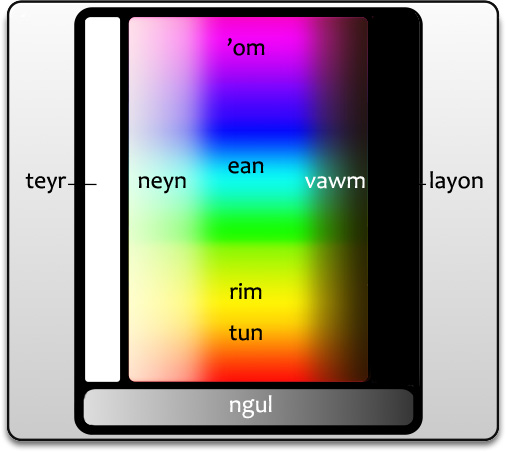
In honor of the re-release of Uniltìrantokx tonight, here’s Part 1 of the Na’vi color system along with a bit of new vocabulary.

Colors

As the graphic indicates, Na’vi has 9 basic or primitive color terms:

TUN: covers the red-to-orange part of the spectrum
RIM: yellow
EAN: green to blue
’OM: violet to purple to magenta
LAYON: black
TEYR: white
VAWM: deep dark colors including browns
NEYN: light colors—“shades of white”
NGUL: gray or drab

To further subdivide the spectrum and name colors more specifically, Na’vi has 3 distinct mechanisms:

(1)    Na-constructions
(2)    Adverbial modification with nì-
(3)    Compounding

Here I’ll discuss the first of these, which is the productive mechanism, and leave the other two for another time.

Before anything else, note that these color terms are regular adjectives–not nouns, not stative verbs. To form color nouns, just add -pin. So for example:

Fìsyulang lu rim. ‘This flower is yellow.’
Fìsyulang arim lu hì’i frato. ‘This yellow flower is the smallest of all.’
Ke sunu oeru rimpin. ‘I don’t like the color yellow.’

Note that when the basic color term ends in -n, the n is pronounced m before the p of pin. (Linguists would call that an instance of regressive nasal assimilation.) And the spelling changes to reflect that. So we have tumpin, eampin, neympin, layompin. This happens in other places in Na’vi (for example: txampay ‘sea, ocean’, a compound of txan ‘much’ + pay ‘water’) and of course in ’Rrtan languages as well (cf. ‘indelicate,’ ‘inadequate,’ ‘inhuman,’ ‘interminable,’ ‘insufficient,’ etc. but ‘impatient,’ ‘imperfect,’ and so on).

For more specific colors, Na’vi uses na-constructions (na = like, as) for comparison to the colors of well-known objects in the environment. For example, to specify that the kind of ean you mean is the blue color of Na’vi skin, you say ean na ta’leng or ta’lengna ean, ‘skin-color blue.’ (Note that “modifying a” is not normally used between na and the basic color term.)

The syntax is straightforward. For ease of reading, hyphens are inserted when na-colors are used attributively (before or after a noun). Examples:

Fìsyulang lu ean na ta’leng. OR Fìsyulang lu ta’lengna ean. ‘This flower is skin-blue.’

To say ‘This skin-blue flower is very beautiful,’ you have 4 choices:

1. Fìsyulang aean-na-ta’leng lor lu nìtxan.
2. Fìsyulang ata’lengna-ean lor lu nìtxan.
3. Ean-na-ta’lenga fìsyulang lor lu nìtxan.
4. Ta’lengna-eana fìsyulang lor lu nìtxan.

The na- process for colors is productive–that is, Na’vi speakers are free to come up with these comparisons on their own, as long as there’s good reason to expect that the listener will understand the comparison and be able to visualize the color. So, for example, if the particular shade of ean you have in mind is the color of the chin of a Great Leonopteryx, you can refer to it as ean na tsuksìm torukä. Here are some more examples:

º1: vawm na nikre–the dark color of Na’vi hair
º2: ’om na mikyun–the purplish color on the inside of a Na’vi ear
º3: layon Note that layon and teyr are not modifiable except in poetry.
Layon is solid black, the total absence of color; teyr is pure white.
º4: rim na nari (Although there are lots of different kinds of eyes on Pandora, in the
absence of further specification it’s understand here that nari means nari leNa’vi.)
º5: ean na ta’leng–skin-blue
º6: ean na pil–facial-stripe blue
º7: neyn na txärem–the light color of bone
º10: tun na eyktan–“leader red,” the reddish color that distinguishes the dress of Na’vi leaders
º11: ean na rìk–leaf-green (as on earth, not all leaves are green, but most are. Ean na rìk and ean na ta’leng are the most common ways to distinguish green from blue.)
º12: neyn na yapay–the light, nondescript color of mist or fog
º13: vawm na uk–dark-shadow color
º14: ngul na tskxe–the drab color of stone

As you might expect, some na-comparisons are idiosyncratic while others are common and universal. Some of the very common ones have developed one-word forms that are part of the standard lexicon. For example:

ta’lengna ean > ta’lengean

rìkna ean > rìkean

kllna vawm > kllvawm ‘brown’

I’ll talk more about these–and the other color-forming mechanisms–in a later post.

Thanks to everyone who provided me with references and links to the fascinating scholarly work on color systems in various Terran languages. And I especially want to thank Prrton for the gorgeous graphics. Irayo nìtxan ayngaru nìwotx!


New vocabulary

Here’s a list of (mostly) new terms I hope you’ll find useful. There’s no rhyme or reason for these right now as opposed to others, except that some of them will help us talk about Avatar more easily:

’evan (n.)
boy (colloquial)
’eve (n.)
girl (colloquial)
’evengan boy
’evenge (n.) girl
fkio (n.) tetrapteron
kenten (n.) fan lizard
’upam (n.) pronunciation
(adv.) on the contrary, conversely
pil (n.) facial stripe
wopx (n.) cloud
ramtsyìp (n.) hill
syaksyuk (n.) prolemuris
tor (adj.) last, ultimate, terminal
txärem (n.) bone
uk (n.) shadow
yapay (n.) mist, fog, steam

Note: tor and syen both mean ‘last,’ and there’s some overlap. The difference is that syen usually refers to the last in series: tìpawm asyen: the last question asked (e.g. Q #5 in a series of 5); tor refers to something that will bring about finality: tìpawm ator: the ultimate question, the answer to which will end all discussion, debate, or contemplation.

Txo mipa Uniltìrantokxit ayngal tsìyeve’a fìtxon fu trray, ma eylan, sìlpey oe tsnì sivunu ayngaru nìwotx!

Posted in General, New! | 37 Comments

A Na’vi alphabet

Kaltxì, ma oeyä eylan. Sunu oeru fwa fìtsengit terok oel nìmun. It’s nice to be back after my hiatus.

In this post it’s my pleasure to convey to you some terrific work of several of our Sulfätu leLì’fya—Language Masters.

Our friends Kemaweyan, Plumps, Prrton, and Tirea Aean have come up with a uniquely Na’vi way of listing and pronouncing the 33 phonemes (distinct sounds) in the language—20 consonants, 7 vowels, 2 “pseudo-vowels” (ll, rr), and 4 diphthongs (aw, ay, ew, ey). Here’s their list:

( ’ ) tìFtang, A, AW, AY, Ä, E, EW, EY, Fä, Hä, I, Ì,

KeK, KxeKx, LeL, ’Ll, MeM, NeN, NgeNg, O, PeP, PxePx,

ReR, ’Rr, Sä, TeT, TxeTx, Tsä, U, Vä, Wä, Yä, Zä

As you see, in reciting this alphabet you pronounce the vowels, pseudo-vowels, and diphthongs exactly as they sound. The consonants, though, are interesting: there’s a distinction between those that can’t come at the end of a syllable and those that can. For the former group, you just add the vowel ä to get the name of the consonant: , , , etc. For the latter group, you use the vowel e but you also put the consonant at the end of the name, keeping it capitalized: KeK, KxeKx, Lel, MeM, etc. I really like how the names of these sounds reflect something about how they’re used. (The exception is the first letter of the alphabet, the glottal stop; if it followed the rule, its name would be ’e’, but that might be a challenge to distinguish from E. Instead, the word tìFtang, meaning “stop,” is used.)

As for the ordering, which largely parallels that of Roman-based alphabets on Earth, Prrton writes: “The order is sadly determined by ‘Rrtan ‘informatics’ conventions that we can’t do much about. This is how Excel et all sort (with the exception of our having Txetx come before Tsä). We’ll just have to manually compensate for that when required.”

How do you ask how a word is spelled? “Spelling” is pamrelfya. (Recall that “writing” is pamrel.)

So, from the most formal way to the most colloquial:

  1. Tsalì’uri fko pamrel si fyape? ‘How is that word written?’ (Literally: ‘As for that word, how does one write (it)?’
  2. Pamrelfyari fyape? ‘How do you spell it?’ (Literally: ‘As for (its) spelling, how?’)
  3. Pamrel fyape? ‘How do you write it?’ (Most colloquial)

Example:

–Lì’uri alu tskxe pamrel fyape? ‘How do you spell the word tskxe?’

Pamrelfya lu na Tsä, KxeKx, E. ‘It’s spelled ts, kx, e.’ (Literally: (Its) spelling is like ts,
kx, e.)

Note that this Na’vi alphabet reflects a phonemic analysis of the language: for example, the word tskxe has 3 phonemes—not 5!—which is paralleled in giving the spelling. And if a Pandoran linguist invented an indigenous alphabetical writing system for Na’vi, it would take only 3 distinct symbols to write that word.

Posted in General, New! | 56 Comments

Tìng Mikyun fte Tslivam: Listening Comprehension #1

Here’s a little two-minute listening comprehension exercise for intermediate and advanced learners that I hope will be fun.

You can use it any way you like, but I’d suggest the following:

First, review the recent vocabulary. Some of the newer terms appear in the passage.

Then listen to the narrative all the way through without stopping, and do that several times. Your goal is simply to follow the gist of the story. It’s likely you won’t get everything, and that’s perfectly OK—the important thing is to understand as much as you can without analysis. Try to avoid translating the passage—do your best to put your own language out of your mind. Just see and feel as much as you can of the story in your head.

After that, if you want to jot down a few things to look up or transcribe anything that’s puzzling for later analysis, that’s OK. Just don’t begin that way.

By the way, there are a couple of new words here (based on ones you already know) and also a new idiom. You should be able to understand all of these from the context.

Sivunu ayngar fìtskxekengtsyìp! Have fun!

P.S.—Continued thanks for all the comments. I owe a lot of people replies, which I’ll try to get to soon.

Posted in General, New! | 22 Comments

Vocabulary update

Today’s post provides some new vocabulary, mostly from the A-priority list of the LEP (Lexical Expansion Project), along with a few usage notes.

In the abbreviations indicating parts of speech, VT and VI refer to transitive and intransitive verbs respectively. As you know, transitive verbs are the ones that take objects; with these, the subject is in the agentive or ergative case (L-family endings) and the object is in the objective or patientive case (T-family endings): Oel ngati kameie. Intransitive verbs don’t take objects, and their subjects are unmarked: Po herahaw.

For verbs of more than one syllable, I’ve used the excellent notation I discovered on learnnavi.org (●) to indicate where the first- and second-position infixes are inserted.

’a’aw ADJ ‘several, a few’
’okrol N ‘history (ancient)’
’okvur N ‘history (non-ancient)
alu CONJ ‘that is, in other words; used for apposition’
fnawe’ ADJ ‘cowardly’
fnawe’tu N ‘coward’
ftxìlor ADJ ‘delicious, good-tasting’
ftxì ADJ ‘bad-tasting’
fyeyn ADJ ‘ripe, mature, adult’
fyeyntu N ‘adult person’
fyeyn N ‘ripeness, maturity, full fruition’
hawngkrr ADV ‘late’
hek VI ‘be curious, odd, strange, unexpected’
hek ADV ‘oddly, strangely’
ki CONJ ‘but rather, but instead’
lìng VI ‘float in the air, hover’
ayRam aLusìng: ‘the Floating Mountains’
muntxatu N ‘spouse’
– muntxatan N ‘husband, male spouse’
– muntxate N ‘wife, female spouse’
netrìp ADV ‘luckily, happily’
newomum VI ‘be curious (want to know)’ [n●●ewomum]
lenomum ADJ ‘curious’
nomum N ‘curiosity’
ngäzìk ADJ ‘difficult, hard
ngäzìk N ‘difficulty, problem’
sung ADV ‘besides, additionally, furthermore’
ram N ‘mountain’
reng ADJ ‘shallow’
Rolun! CONV ‘Eureka! I found it!’
sa’sem N ‘parent’
smar N ‘prey, thing hunted’
starsìm VT ‘gather, collect’ [st●ars●ìm]
sunu VI ‘be pleasing or likeable, bring enjoyment’ [s●un●u]
syayvi N ‘luck, chance’
syayvi ADV ‘by chance or coincidence’
Tolel! CONV ‘Eureka! I got it! I understand!’
txukx ADJ ‘deep’
ve’ VT ‘hate’ [v●e’k●ì]
tìve’ N ‘hatred’
yaymak ADJ ‘foolish, ignorant’
ye’krr ADV ‘early’
sìkrr N ‘season’
zo VI ‘be well, be intact, be as it should be, work correctly or as nature intended’
zoslu VI ‘heal, become well, get fixed’ [zosl●●u]
– zeyko VT ‘heal, fix’ [zeyk●●o]
– frawzo CONV ‘All is well; everything is fine or OK’

Usage Notes

’A’AW
Used only with countable nouns (people, plants, rocks, days, ideas, . . . ), not with uncountables (water, air, time, patience, anger, . . . ). Like numbers, ’a’aw is used with the singular of the noun. Example:

Lu poru ’a’awa ’eylan. OR Lu poru ’eylan a’a’aw. ‘He has several friends.’

(These are good sentences for practicing your glottal stops!)

Don’t confuse ’a’aw ‘several, a few’ with hol ‘(only a) few, not many’:

Oel tse’a ’a’awa tutet. ‘I see several people.’

Oel tse’a hola tutet. ‘I see only a few people.’

Note that pxay ‘many’ is exceptional in that it can be used with either singular or plural nouns: pxaya tute and pxaya sute are both allowable. The form with the singular is appropriate for all contexts, while the one with the plural is mainly used colloquially.

’OKROL and ’OKVUR
’Okrol refers to the ancient tribal history of the Na’vi contained in the First Songs; ’okvur relates to more recent events, e.g. oeyä soaiayä ’okvur ‘my family’s history’ or ’okvur Sawtuteyä mì Eywa’eveng ‘the history of the Sky People on Pandora.’

ALU
Used mainly for nouns or noun phrases in apposition—e.g. ‘my friend Amhul,’ ‘Eytukan, leader of the Omaticaya,’ ‘Eywa, the Great Mother,’ etc. It comes from a + lu, with a fusing of the two words into one and a change in stress to the first syllable. Example:

Tskalepit oel tolìng oeyä tsmukanur alu Ìstaw. ‘I gave the crossbow to my brother Istaw.’

You can also use alu conversationally as an “explainer,” in the sense of “that is to say” or “in other words”:

Txoa livu, yawne lu oer Sorewn . . . alu . . . ke tsun oeng muntxa slivu. ‘Sorry, but I love Sorewn . . . in other words, you and I cannot marry.’

HAWNGKRR and YE’KRR
These are adverbs, not adjectives:

Hawngkrr rä’ä ziva’u! ‘Don’t come late!’

If you need the adjectives, they’re lehawngkrr and leye’krr: tìpähem leye’krr ‘an early arrival’

HEK
This verb conveys the idea of something appearing odd, strange, unexpected, or surprising.

Ngeyä säfpìl Sawtuteteri heiek oer nìtxan. ‘Your idea about the Sky People is very interesting to me (because it seems unusual).’ OR ‘I’m very curious (and delighted) about your idea regarding the Sky People.’

Note that nìhek is a sentence adverbial only, not a manner adverbial . . . alu . . . nìhek is ‘strangely’ in the sense of the speaker making a comment about the situation:

Nìhek fo nìNa’vi plltxe. ‘Strangely, they speak Na’vi.’

If on the other hand you want to say that someone does something in a strange manner, you’d use nìfya’o a hek, ‘in a way that’s strange’:

Fo nìNa’vi plltxe nìfya’o a hek. ‘They speak Na’vi strangely.’

Note the difference between the verb hek and the adjective stxong ‘strange, unfamiliar, unknown.’ Hek is used for something odd, unexpected, or puzzling but not necessarily bad. Stxong is stronger and usually has a negative connotation: it’s applied to something previously unknown or unimagined that appears threatening or dangerous. Example:

Larmu tsatsamsiyuhu tìvawm a lu stxong ayoer. ‘That warrior carried with him a darkness unknown to us.’

KI
Don’t confuse slä and ki. Ki is ‘but’ in the sense of ‘not A but (rather) B.’ (Speakers of German will see the parallel with aber vs. sondern.) Ke and ki form a pair:

Nga plltxe ke nìfyeyntu ki nì’eveng. ‘You speak not like an adult but a child.’

NETRÌP
See SYAYVI.

RENG and TXUKX
These words primarily refer to physical depth: kilvan areng, kilvan atxukx. They can’t be applied to people: *tute areng makes no sense. But as in many languages, they are sometimes applied metaphorically to thoughts, ideas, analyses, etc.: e.g. aysäfpìl atxukx ‘deep thoughts.’

ROLUN
Rolun and tolel are conversational exclamations used for “Eureka!” moments. The difference is that Rolun! means you’ve found something, e.g. a lost object, the answer to a question, the solution to a problem, whereas Tolel! means you’ve had a flash of insight and now you “get it”—you’ve received knowledge or understanding.

SMAR
This word appears in a famous Na’vi proverb:

Ätxäle si palulukanur tsnì smarit livonu. ‘Ask a thanator to release its prey.’ Refers to a futile gesture, an attempt to achieve something that might be desirable but will clearly not happen. In conversation it’s usually shortened to Ätxäle pa(lu)lukanur. (In fast speech, palulukan tends to simplify to palukan, which is acceptable in colloquial style.)

SUNU
This important verb, which works similarly to Spanish gustar, is used to say you like something:

Sunu oeru teylu. ‘I like teylu.’ (Teylu sunu oeru is also possible.)

Sunu and prrte’ lu both mean that the speaker enjoys something. While sunu is ‘like’ in the general sense, prrte’ lu is generally deeper and more heartfelt; it’s often used in social situations, translating to “It’s a pleasure . . .”:

Furia tsolun oe ngahu pivängkxo, oeru prrte’ lu nìngay. ‘It was really a pleasure to be able to speak with you.’

[Digression: The prrte’ construction can be a bit confusing. Prrte’ is an adjective meaning ‘pleasurable,’ so an alternate way of saying the previous sentence is:

Fwa [fì’u a] tsolun oe ngahu pivängkxo oeru prrte’ lu nìngay. Literally: ‘The fact that I was able to speak with you is really pleasurable to me.’

The structure of the original sentences with furia is more like: ‘As for the fact that I was able to speak with you, (it) is really pleasurable to me.’ Either structure is acceptable.]

Mowan implies physical or sensual pleasure, and often has a sexual connotation:

Plltxe fko san ngaru lu mowan Txilte ulte poru nga. ‘I hear you like Txilte and vice versa.’

Mowan is also used slangily as a general term for ‘like’:

Tìtusaron mowan lu oer nìngay. ‘Hunting really turns me on.’

SYAYVI
Syay by itself means ‘fate’ in the sense of one’s destiny—the arc of one’s life:

Tsakrr syay ayngeyä, syay olo’ä oeyä layu teng. ‘Then you will suffer the same fate as my clan.’

Syayvi refers to a “little piece of fate”—that is, chance or luck in a particular situation. For example, the expression for ‘Good luck!’ is Etrìpa syayvi!

Note that nìsyayvi means ‘by chance, by coincidence, as luck would have it’—it does not mean ‘luckily.’ For that you use netrìp.

TOLEL
See ROLUN.

TXUKX
See RENG.

ZO
This stative verb indicates that “all is well” with the subject—something or someone is functioning correctly. Both zo and lu fpom can mean the subject is well, but there’s a difference in usage. Fpom is a noun meaning ‘well-being, peace, happiness.’ Zo is a verb with a narrower scope, usually implying physical health. So contrast these two questions:

Ngaru lu fpom srak? ‘Are you well?’ (Are you experiencing a general sense of happiness and well-being?)

Nga zo srak? ‘Are you well?’ (Have you recovered from your illness? Are you OK after that nasty fall?)

Examples of the derivative verbs zoslu and zeyko:

Oeri nì’i’a tsyokx zoslolu. ‘My hand is finally healed.’

Eywal zeykivo ngat nìwin. ‘May Eywa heal you quickly.’

Frawzo is from fra’u + zo. Compounds with ’u often lose the glottal stop. Here the resulting au combination has changed into a diphthong as well.

Edit 17 July–Two errors corrected: nìhek classed as ADV; glottal stop added to ftxìvä’.

Posted in Discussion, General, New! | 32 Comments

Diminutives; Conversational Expressions

Today’s post introduces some useful things you can add to your written and spoken Na’vi, along with a few new vocabulary items.


The Diminutive Form

Lots of languages have a way of adding something to a word to mark it as “little” version of the original. Na’vi has this too.

The diminutive marker is –tsyìp. It’s a suffix, always unstressed, which you attach to the end of a word—usually a noun, but pronouns can take –tsyìp as well. (This is unusual in Earth languages.) And you can use it productively—that is, you’re free to add it to most nouns, including proper nouns, and pronouns—but see below.

Don’t use the diminutive simply to indicate that something is small—for that you use hì’i. For example, “small tree” is hì’ia utral/utral ahì’i, not utraltsyìp.  What, then, is the diminutive for? Three things:

1. To form new lexical items that originated as small versions of a noun but may have lost the small connotation. Since their meanings are not always predictable, words in this category are listed in the dictionary. Examples:

puk ‘book,’ puktsyìp ‘booklet, pamphlet’

utral ‘tree,’ utraltsyìp ‘bush’

säspxin ‘illness, disease,’ säspxintsyìp ‘minor ailment’

Note that you can modify many of these words with tsawl without contradicting yourself—for example, tsawla utraltsyìp ‘large bush.’

2. To express affection or endearment. Here –tsyìp may or may not be associated with physical smallness. Examples:

Za’u fìtseng, ma ’itetsyìp. ‘Come here, little daughter.’ (Could be said even to an adult daughter.)

[Digression: With verbs of motion, ne can be optionally omitted if the destination comes after the verb. So you can say Po zola’u fìtsengne or Po zola’u fìtseng. But *Po fìtseng zola’u is ungrammatical; it has to be Po fìtsengne (or ne fìtseng) zola’u.]

Kempe si nga, ma sa’nutsyìp? ‘What are you doing, little mommy?’ (This would not be said to an actual mother, which would be disrespectful, but rather to a young girl, in endearing anticipation of her becoming a mother.)

Kamtsyìpìl wutsot yerom. ‘Little Kamun is having dinner.’ (Kamun might be a little boy, but he might also be a huge adult Na’vi, in which case –tsyìp is ironic and/or affectionate. Note that when –tsyìp is added to a proper name of more than one syllable, the name is often shortened. The full form, in this case Kamuntsyìp, can also be used.)

Ngatsyìp yawne lu oer. ‘I love you, little one.’ (Could be said to any loved one, not only to a young child.)

Ngari tswintsyìp sevin nìtxan lu nang! ‘What a pretty little queue you have!’ (tswin ‘queue.’ Note that in sentences like this that involve possession, especially “inalienable possession, the –ri form (i.e. the topic marker) is slightly more idiomatic than the possessive pronoun, although both are correct. So “Ngeyä tswintsyìp . . .” is fine, although many Na’vi would prefer to say “Ngari . . .”)

3. To express disparagement or insult.

Fìtaronyutsyìp ke tsun ke’ut stivä’nì. ‘This (worthless) little hunter can’t catch anything.’

Ngatsyìpìl new peut ta oe? ‘What does little you want from me?’ (Note that while ngatsyìp was endearing in the previous example, here it’s disparaging. To tell which is which, you need to consider the context, facial expressions, and body language.)

Nga nìawnomum to oetsyìp lu txur nìtxan. ‘As everyone knows, you’re a lot stronger than little old me.’ (Here –tsyìp is used ironically, for mock self-deprecation. Also, oetsyìp is pronounced WE.tsyìp.)

Be careful not to confuse –vi and –tsyìp: there are similarities, but they’re not the same. Rather than indicating a small version of the original, the –vi suffix is used for a part or division of a whole, or a “little bit of” something. So atanvi ‘ray’ is a bit of atan, light; txepvi ‘spark’ is a bit of txep ‘fire’ (txeptsyìp would possibly be a ‘dear or cute little fire’); lì’fyavi ‘linguistic expression (word, phrase, sentence)’ is a bit of lì’fya ‘language.’ Also, -vi is not as freely productive as –tsyìp. This is worth some explanation.

Take the English suffix –er that’s added to verbs to get the “agent”—the one who is doing the verb: eater=one who eats, hunter=one who hunts, etc. You can add –er to most verbs, and you’ll get another word whose meaning is predictable. So even if you don’t know what it means to burble, you do know that that a burbler is one who burbles. (This doesn’t always work: people who type or cycle are better called typists and cyclists than typers and cyclers. But it works more often than not.) We say that the –er suffix is productive.

In contrast, adding the suffix –ment to a verb to get a related noun is not freely productive. From govern we get government, which is a body that governs. From replace we get replacement, but that’s not a body that replaces—it’s the thing replaced. And there’s no *eatment, *huntment, *feelment, etc. (I’m not sure about burblement.) So the  –ment suffix is not productive: we can’t add it freely to verbs, and when we can, the meaning isn’t necessarily clear. Words with –ment have to be learned individually, and so they’re listed in the dictionary.

Similar things are true in Na’vi. Certain affixes (prefixes, infixes, and suffixes) are productive, others not. For example, almost all the verb infixes (-er-, -ol-, -iv-, -ay-, -ìm-, etc.) are productive: you can use them with any verb at all, as long as you know the right place to insert them. The agentive suffix –yu is also freely productive. On the other hand, the prefix tì-, which forms nouns out of verbs, adjectives, and other nouns, is not freely productive. You can’t come up with your own tì- words—you need to make sure they’re in the dictionary. And when they are, the meanings won’t always be predictable: tìftang means ‘stopping,’ but tìrol doesn’t mean ‘singing’ but rather ‘song.’ (Note that when you want to talk about an action—as in “Swimming is great exercise”—you can always use the Na’vi gerund, which is a two-affix form: use the tì- prefix along with the –us- infix: tìyusom ‘eating,’ tìtusaron ‘hunting,’ etc., and that process is productive. Example: Tìkusar eltur tìtxen si. ‘Teaching is interesting.’)

Finally, some affixes are midway on the productivity scale. The adverb-former nì- is productive when used with adjectives: nìngay ‘truly,’ nìwin ‘fast,’ nìsti ‘angrily,’ nìftue ‘easily,’ etc. But it’s sometimes also used with other parts of speech—nìtut ‘continually,’ nì’eyng ‘in response,’ nì’awtu ‘alone’—and these words have to be learned as separate lexical items; you can’t take them as patterns on which to base new forms.

And with that I’ll just say: Sìlpey oe, ayngari fìtìpängkxotsyìp eltur tìtxen silvi.


Some Conversational Expressions

Here are some miscellaneous expressions you might find useful in conversation.

1. Responding to thanks

Depending on the situation, there are different ways to respond to someone who thanks you for something:

  • Kea tìkin. Literally: no need. That is, there’s no need to thank me.
  • Nìprrte’. Literally: gladly, with pleasure. That is, what you’ve thanked me for, I did with pleasure.
  • Oeru meuia. Literally: an honor to me. That is, it was an honor to be of help to you.
  • Hayalo ta oe/Hayalo oeta [pronounced WE.ta]. Literally: next time from me. That is, I’ve done something for you and you’ve thanked me, but next time you’ll do something comparable for me, and I’ll thank you. (hayalo ‘next time,’ hamalo ‘last time’)
  • Pum ngeyä. Literally, yours. That is, you’ve thanked me, but I really should be thanking you. The thanks belong to you. [Pronounced pum NGE.yä]

2. Responding to a compliment

It’s not customary to say irayo in response to a compliment. Instead, there are three common responses:

  • Ke pxan. Literally: not worthy. That is, I don’t deserve your praise.
  • Tstunwi. Literally: kind. That is, it’s kind of you to say that. (tstunwi ‘kind, thoughtful, considerate’)
  • Ngaru tsulfä. Literally: to you the mastery. This is said in a situation where the one praising you is better at the activity you’re being praised for than you are yourself. For example, if a native Pandoran says to you, Nga nìNa’vi plltxe nìltsan, you should respond with Ngaru tsul, which implies: When it comes to Na’vi, you’re obviously the master, so you have the right to give me praise, which I humbly accept.

3. Congratulating someone

Upon hearing about someone’s good fortune, the Na’vi say Seykxel sì nitram! Literally: Strong and happy! That is, may you derive strength and happiness from this event, accomplishment, etc. Note: seykxel and txur are both adjectives meaning ‘strong,’ but they aren’t the same: txur refers to physical strength, seykxel to inner strength, a quiet feeling of confidence in one’s own capability. [Pronunciation: sey.KXEL sì nit.RAM]

Hayalovay . . .

Posted in Discussion, General, New! | 15 Comments