Mrra tìpängkxotsyìp    Five little discussions

Kaltxì, ma frapo.

From time to time I receive emails from members of the lì’fyaolo’, asking for clarification about certain aspects of Na’vi. The questions often demonstrate a lot of insight into the language and help me clarify and deepen my own understanding. I’d like to share a few of those more recent inquiries with you here, along with my responses. Sìlpey oe, ayngari faysìpängkxotsyìp eltur tìtxen sìyevi!

’Awvea Tìpängkxotsyìp: Does the modal verb new ‘want’ have a causative form neykew?

(Note: The original version of this discussion was posted to LearnNa’vi on Nov. 29.)

New is a modal, but it’s also a vtr, a transitive verb. There are six such “dual function” verbs in our current dictionaries, labeled either vtrm or (a) vtr and (b) modal:

fmi                  ‘try’
kan                 ‘aim, intend’
may’               ‘try, taste, sample’
new                ‘want’
nulnew          ‘prefer’
sto                  ‘refuse’

In the case of new, how would you say, for example, ‘I want to dance’? The dual nature of this verb means you have a choice:

    1. Oe new srivew. (new used as a modal)
    2. Oel new futa srew. (new used as a vtr)

A is more common, but B is certainly possible. (By the way, B is also the only way to have the “wanter” and the dancer be different: To say, ‘I want you to dance,’ it’s got to be Oel new futa nga srew.) Note that after futa in such constructions, we don’t need <iv> on the verb, although it’s not wrong to have it. (See the next section below!)

So far so good. Now . . . how do we convert this to a causative construction? How would we say, for example, ‘This music makes me want to dance?’

Well first of all, the causative infix <eyk> doesn’t go with modals. So it’s the B version that gets “causativized,” not the A version.

Second, the causer—the one making something happen—is always in the agentive case. Our wonderful Horen Lì’fyayä leNa’vi states the rule clearly:

6.11.2. Causative of Transitive Verb. When a transitive verb is made into a causative, the causee, which had been in the agentive case, goes into the dative. This leaves the original accusative in place.

Applying this rule to B, and realizing that “the original accusative” here is futa, we get:

Fìpamtseol oeru neykew futa srew.
‘This music makes me want to dance.’

The new agent here, with the l case marker, is fìpamtseol ‘this music’: it’s the music that’s making something happen!


Muvea Tìpängkxotsyìp: Is the <iv> infix used with the complements of modal verbs?

This question is related to the previous one.

Recall that for ‘I want to dance,’ we have two equivalent versions:

A. Oe new srivew.                                  (new used as a modal)
B. Oel new futa srew.                             (new used as a vtr)

But is there a third version as well? What about:

C. Oel new futa srivew.              (new used as a vtr)

C is indeed possible, but it merits some explanation.

There was a time in the early days of Na’vi when I would have used the C version exclusively. As my feeling for Na’vi evolved over the years, however, I realized that with fwa and futa, the bare verb will do just fine. For example:

Sunu oer fwa srew.
‘I like to dance.’

That is, literally, ‘The dance-thing brings me enjoyment.’ Today I would judge *Sunu oer fwa srivew as ungrammatical, since it would be saying the equivalent of ‘The might-dance-thing brings me enjoyment.’

With the dual-function verbs, however, the situation is a little different. The A and B versions of our ‘want to dance’ sentence are the most expected versions in Na’vi. But given that the simple version A is much more common than B, there’s “analogical pressure” on B for the verb to conform, and so we get C, a pattern which, for these verbs, is also considered correct.

By the same token, we have both:

D. Oel new futa nga srew.
‘I want you to dance.’

and

E. Oel new futa nga srivew.
‘I want you to dance.’


[EDIT 28 Feb: THIS SECTION NEEDS TO BE REVISED. The Koren stated towards the end is incomplete. Further discussion will appear in a subsequent post.]
Pxeyvea Tìpängkxotsyìp:
What can the pronouns po and sno refer to?

Let’s begin with an English example:

F. John thinks that Bill likes his car.

The question is, whose car is it that Bill likes—John’s car or his own (= Bill’s) car? I think most English speakers would say that without any context, the referent of “his” is ambiguous: it could be either one. But what about this slightly modified version:

G. John thinks that Bill likes his own car.

I think most people would say that G is no longer ambiguous: it has to be Bill’s own car.

In Na’vi, sno, in all its forms, works somewhat like ‘his/her own’ in English. Take a look at these examples:

H. Ateyol fpìl futa Ralul peyä tsmuket ve’kì.
‘Ateyo thinks that Ralu hates his sister.’

I. Ateyol fpìl futa Ralul sneyä tsmuket ve’kì.
‘Ateyo thinks that Ralu hates his sister.’

Although the English translation is ambiguous, the Na’vi sentences are not: In H, it’s Ateyo’s sister. In I, it’s Ralu’s own sister.

For those who like technical linguistic rules, here’s a Koren a teri tsalì’u alu sno, a rule about the word sno:

Sno, in all its forms, can only refer back to a noun phrase within the same clause.

In particular, sno in a subordinate clause can’t refer to a noun phrase in the main clause. This means that in I, sneyä, being in a subordinate clause, can only refer to Ralu, a noun phrase in that clause. It can’t refer to Ateyo, which is in the main clause.


Tsìvea Tìpängkxotsyìp: When are final stops unreleased?

Here’s an interesting pronunciation question:

We know that stops are liable to be unreleased under certain conditions but are wondering about the exact scope of this rule. In particular:

    1. Are they unreleased only at the end of a word, or at the end of every syllable (as seems to be more common in human languages that do this)?
    2. Does this rule include the glottal stop?

First, a little linguistics. 😊

What’s the difference between a consonant sound (C) and a vowel sound (V)?

The answer is that with V’s, the air flow through the vocal tract is not blocked; the air flows freely. With C’s, there’s some blockage that restricts the flow of air. Sometimes the blockage is only partial, as in the case of s, z, f, v, etc. With those sounds, the passage for the airflow is narrowed, creating friction and a characteristic sound. (The sounds I just listed are in fact called fricatives. 😄) Sometimes, however, the blockage is complete, and the airflow is momentarily stopped. And guess what: the C’s that do this are called stops! As you might imagine, there’s more to this story, but that’s the basic idea.

In Na’vi, the stops are k, p, t, kx, px, tx, and ’, the glottal stop.

Now as you know, when three of these stops—namely, k, p, and t—occur at the end of a word, they’re “unreleased.” As I think I’ve mentioned before, this phenomenon occurs optionally in English. If I say, “What’s up?” I can either “explode” the p, releasing the air that’s been trapped, or not release it, keeping my mouth closed. The sound is a bit different in each case. In proper Na’vi, these final stops are unreleased.

With that background, what about question 1? If k, p, and t are non-final (that is, not at the end of a word), can they still be at the end of a syllable? Yes they can, but only if they’re followed by another consonant. For example, k, p, and t are syllable-final in nik.re, txep.mì, and ’ok.trr. They’re not syllable final in a.kum, tsa.po, and nì.teng. When they are syllable-final, as in the first group, they’re unreleased as if they’re word-final.

As for the second question, in my experience I’ve never heard “released” and “unreleased” applied to the glottal stop. Take the word olo’. Do you hear a difference between a released and an unreleased tìftang? I’m not sure what a released glottal stop would sound like. But if there is a difference, it would follow the same rules as for k, p, and t.


Mrrvea Tìpängkxotsyìp: How is fpap used?

Finally, a correction:

In the previous post, I gave this example for the vtr fpap ‘pound’:

J. *Krra sti nìtxan, pol mesyokxit fpap sìn fyanyo.
‘When he’s angry, he pounds his hands on the table.’

Some astute readers asked if it shouldn’t be:

K. Krra sti nìtxan, pol fyanyot fpap fa mesyokx.
‘When he’s angry, he pounds the table with his hands.’

The question is, when you pound something, what exactly are you pounding—your hands, or some external object?

I see in retrospect that that example I gave, J, was clearly influenced by English, since in English we can say both “He pounded the table with his hands” and “He pounded his hands on the table.” But that seems to be unusual; I don’t know of other languages where that happens. (If anyone does, please let me know!) Although I’m not positive, I assume that at some point in the history of English, some kind of semantic shift occurred, where the grammatical object of “pound” could be either the external object that gets pounded or the instrument of pounding. But that’s English, and there’s no reason to think such a shift occurred in Na’vi as well. So K represents the correct use of fpap, and I’ve corrected the example in the previous post.

For this unusual holiday season, ma eylan, I wish you all the best celebrations you can manage lefkrra tìfkeytokmì.

Please stay safe, everyone . . . ulte makto zong.

Posted in General | 8 Comments

Vospxìvopeyä aylì’u amip    November’s new words

Kaltxì, ma frapo.

Krrka lekye’unga faysrr, sìlpey oe, livu ayngaru fpom nìwotx.

It’s been a while since we’ve had any new vocabulary, so here are some lexical items along with a few idiomatic expressions that I hope you’ll find useful.

First, for the record, let me mention three terms you’ve seen already that belong in the dictionary:

nìtstew (adv., nì.TSTEW) ‘bravely, courageously’

txantxewm (adj., TXAN.txewm) ‘terrifying’

sätseri (n., sä.TSE.ri) ’observation, something noticed’

Ngeyä tsasätseriri a eltur tìtxen si irayo.
‘Thank you for that interesting observation of yours.’

Now for some new terms:

voìk (n., VO.ìk) ‘behavior, how one conducts oneself’

Nga sìlmi a tsakem ke lu voìk amuiä!
‘What you just did was not proper behavior!’

voìk si (vin., VO.ìk si) ’behave’

Neytiril Tsyeykur oeyktolìng teyngta fyape zene voìk sivi tsatìfkeytokmì.
’Neytiri explained to Jake how to behave in that situation.’

mu’ni (vtr., MU’.ni) ‘accomplish, achieve’

Although there is some overlap, the difference between mu’ni and hasey si ‘accomplish, bring to a conclusion’ is that hasey si can refer to finishing anything at all, significant or not, while mu’ni is used for achievements that are in some way significant.

Note: Don’t confuse mu’ni with mun’i ‘cut.’ The pronunciations of these two verbs are quite different, both in the position of the tìftang and the stress patterns.

Krrka tìrey ayol, pol molu’ni pxaya ayut a tsranten.
‘During her short life, she accomplished many important things.’

Hasey si fura yom!
‘Finish eating!’ (Do you see why fura is used here? 😊 )

tìmu’ni (n., tì.MU’.ni) ‘achievement, accomplishment’

leha’ (adj., le.HA’) ‘appropriate, suitable, fitting’

This word clearly comes from the verb ha’ ‘fit, suit.’ It differs from muiä ‘proper’ in that muiä has the connotation of honorable, moral, or fair; leha’ simply refers to something that fits or is appropriate to a particular individual or situation.

Fori tsafnetìkusar ke lu leha’.
‘That kind of teaching isn’t appropriate for them.’

swaran (adj., SWA.ran) ‘humble, modest, self-effacing’

Tsamsiyu asìltsan lu tstew släkop swaran.
‘A good warrior is courageous but also humble.’

tìswaran (n., tì.SWA.ran) ‘humility, humbleness’

yewn (vtr.) ‘express, convey (a thought or feeling)’

Oe new oey sì’efut yivewn poeru, slä ke tsängun.
‘I want to express my feelings to her, but, sadly, I can’t.’

tìyewn (n., tì.YEWN) ‘expression’

(Don’t confuse this word with lì’fyavi, which also means ‘expression’ but in the sense of ‘bit of language.’)

Note the idiom:

tìyewn tìyawnä ‘an expression of love.’ It’s a set phrase used when giving a gift to a loved one or making a gesture of affection like a kiss or caress.

leytslam (vtr., LEY.tslam, inf. 2, 2) ‘appreciate’

As you see, this word is a compound of ley ‘have value’ and tslam ‘understand.’ When you appreciate something, you understand or acknowledge its value.

Ngeyä faylì’ut atìtstunwinga’ oel leytslam, ma ’eylan.
‘I appreciate your kind words, friend.’

fpap (vtr.) ‘pound’

The difference between takuk and fpap is that while takuk means ‘strike,’ fpap implies striking heavily and repeatedly.

Krra sti nìtxan, pol fyanyot fpap fa mesyokx.
‘When he’s angry, he pounds the table with his hands.’

syar (vin.) ‘stick, stick to, adhere’

Rìk a’aw syarmar sìn kxemyo.
‘A leaf was sticking to the wall.’

Note that syar is intransitive. For the transitive sense of ‘stick’—that is, to stick something onto something else—simply insert the causative infix <eyk>:

Pol kxumpaysyarit solar syeykar rìkit sìn kxemyo.
‘She stuck the leaf onto the wall with glue.’
(More literally: ‘She used glue (and then) stuck the leaf onto the wall.’)

kxumpaysyar (n., KXUM.pay.syar) ‘glue’

(Recall that kxumpay means ‘viscous liquid.’)

And a word specific to a unique Pandoran experience:

’onglawn (n., ’ONG.lawn) ‘exhiliration of first bonding’

This word, a compound of ’ong ‘blossom’ and lawnol ‘great joy,’ refers to the euphoric feeling of first bonding with something, particularly an ikran, when the first flight seals the bond. (Fìsäfpìlìri akosman seiyi irayo, ma Ney!) It’s used with ’efu:

Kawkrr ke tswaya’ oel krrit a ’efu ’onglawnit.
‘I’ll never forget the time I experienced ’onglawn.’

Lu ’onglawn tì’efu akosman frato mì hifkey.
’Onglawn is the most wonderful feeling in the world.’

Finally, some useful, if straightforward, expressions:

  1. ‘Would you mind if . . . ?’   Srake srätx (ngat) txo . . . _<iv>_ . . . ?
  2. ‘I don’t mind if . . . ’             Ke srätx (oet) txo . . .
  3. ‘Not at all!’                     …… (a) Ke srätx kaw’it!
                                              ……(b) Kea säsrätx kaw’it!
     …………………………………….(c) Kehe kaw’it!

The pronouns in parentheses may be omitted.

A: Srake srätx txo oel ngey fkxilet zasrivìn?
….‘Would you mind if I borrowed your necklace?’
B: Kehe kaw’it!
….‘Not at all!’

By the way, in the combination srätx txo, don’t try to pronounce the two ejectives separately! They merge into one slightly prolonged tx.

And with that, I’ll say kìyevame for now. Hang in there, everyone. Livu Eywa awngahu nìwotx!

ta Pawl

Edit 12/23: Example sentence for fpap corrected. See the following post (Dec. 23). Irayo, ma Plumps!
Posted in General | 20 Comments

Paul in a Polish Podcast!

Well, OK, the podcast is in English, but it does have a Polish introduction. 😄

Back in July, I was interviewed for a podcast by a Polish journalist and language enthusiast, Błażej Grygiel, who’s the content manager for a language services company in Warsaw. It just went out to the public today. You can listen to it here.

Despite all my “uh’s” and “um’s” (I’m astonished at how much I do that!), I was quite happy with how it turned out. You’ve probably heard most of this before, but there may be a few new things toward the end. Ngari txo fì’u ngey eltur tìtxen sivi, rutxe yivune!

Posted in General | 5 Comments

Sätare Akeltrrtrr    An Unusual Relationship [Part 2]

Kxì nìmun, ma frapo!

Apologies for the delay in posting this, but here, finally, is the poignant conclusion of Tekre’s story about an unexpected relationship between a Na’vi and a thanator.

Since it’s been a while, you might want to go back to the previous post to refresh your memory of what’s happened so far. Or you could take a look at my English translation here:

Part 1, English

Part 1

One day a little thanator walked alone through the forest. His mother had wanted him to go to sleep, but he didn’t feel tired, so he left without her noticing. He had no goal in mind, but felt happy that he could explore the great forest.

That same day, a young Na’vi left his village. The other children had said malicious things about him because he was often afraid, so he went to the forest to escape the humiliation. He had no aim, but after a little while he felt happy again because he was free and alone.

While the boy walked through the forest, he didn’t notice that someone was following and watching him. The little thanator was curious, and the Na’vi interested him, so he wanted to know what the boy was up to. Thanators are naturally enemies of the Na’vi, but this thanator was young and didn’t know that.

After walking through the forest a long time, the boy heard an unexpected sound and turned quickly towards it. He saw a little thanator that had been snapping branches. The young Na’vi was familiar with stories about terrifying thanators that killed people, but this youngster didn’t seem like a dangerous animal.

The two of them looked at each other for a long time, curiously and silently. They weren’t afraid. This thanator seemed cute to the boy and the thanator thought he could play with the Na’vi. The young Na’vi seemed to think the same, so the two of them began to chase each other through the forest. At night, the boy said to the thanator, “I have to go, thanator, but I’ll come back.”

[collapse]


As before, I’ve broken the story up into smaller chunks and listed alphabetically some vocabulary relevant to each section that you might want to review before listening.

And as before, once you listen several times to get as much as you can from just the audio, check the spoilers to see the Na’vi text and then listen again as you read along.

Sìlpey oe, fìvur alor zìyevawprrte’ ayngane!

Section 1
Vocabulary: ’awnìm, fnu, fwew, nayeveng [< nì + ayeveng], nong, uk

’Awvea hapxì

Krr salew. Tìtusaronìri sì furia ’awnìm ayfalulukanit ’eveng nume, slä krra po ’efu le’awtu pol palulukanit ahì’i fwew. Frakrr pol fìpalulukanit run ulte mefo uvan si nayeveng. Na‘vi ftang txopu sivi taluna omum futa ’eylanìl sneyä poti nong na uk nìfnu frakrr ulte hawnu poti.

[collapse]


Section 2
Vocabulary: smar, tsamsä’o, tsko, tstal, tsko

Muvea hapxì

Palulukan tsawl slu. Po nume nìteng, set pol omum futa aystal sì aysko Na’viyä lu lehrrap ulte aysute a foru ke lu aysamsä’o smar lu. Tsalsungay palulukanìl Na’viti sneyä nong sì nìn ulte frakrr alaksi lu fte hivawnu ’eylanit sneyä.

[collapse]


Section 3
Vocabulary: Iknimaya, kanom, tätxaw, tsyìl, zerok

Pxeyvea hapxì

Slä trro, Na’vi palulukanur plltxe san ma palulukan, oe ke tsun tivätxaw. Set oe taronyu lu, trray oel Iknimayat tsyìl fte kivanom ikranit oeyä. Fì’uri oe txopu si, slä ngal oeti ke tsun nivong tsatsengne. Oel zayerok ngati a lu ’eylan sì uk oeyä, slä furia taron le’awtu oe zene nivume sìk. Palulukanìl ke tslam aylì’ut, slä tslam ralit aylì’uä. Pol ’efu tìkeftxoti slä omum futa tsmukìl sneyä fya’ot peyä zene rivun.

[collapse]


Section 4
Vocabulary: ftxey, ha’ngir, kin, kllkxem, kxamlä, leym, lok [adp.], nìyey, tsap’alute, tsleng, tsyal, txìng

Tsìvea hapxì

Trr ahay palulukan tìran kxamlä na’rìng le’awtu. Tsaha’ngir pol tìleymit stawm. Po mokrine tul nìyey, fìmokri smon poru! Tsenglok a palulukanìl Na’viti tsole’a alo a’awve pol ’eylanit sneyä run nìmun. Na’vi lrrtok si krra tse’a palulukanit, ulte plltxe san ma ’eylan oeyä, furia oel ngati txolìng, oe tsap’alute si. Sa’nok oeyä plltxe san ngal ikranit kin fte slivu taronyu angay taluna ikran layu mesyal sì tsaheylu ngeyä sìk, slä krra oe kllkxìmem ayikraneo, oe txopu si ulte ’efu futa fwa tsaheyl si ikranhu tsleng lu. Kea ikranìl oeti ke ftxeiey. Aysute alahe plltxe san kawkrr nga taronyu ke slayu sìk, slä omum oel futa ke kin kea ikranit oel taluna oeru lu uk a hawnu oeti. Oel omum futa ngal oeti kameie ulte oel ngati kameie, ma tsmuk sìk.

[collapse]


Section 5
Vocabulary: meuia

Mrrvea hapxì

Tsatrr palulukanhu tsaheyl si taronyu a txopu si, ulte slu taronyu a por frapo meuia si.

[collapse]


Posted in General | 3 Comments

Sätare Akeltrrtrr    An Unusual Relationship   [Part 1]

Kxì, ma frapo!

For the next installment in our series of author-read Na’vi compositions, I’m delighted to present Part 1 of an affecting story by Tsm. Tekre about an unusual relationship on Pandora. Fpìl oel futa tsaw sayunu ayngar.

I thought it would be helpful to break the story up into smaller chunks. As before, I’ve listed (in alphabetical order) some vocabulary relevant to each section that you might want to review before listening. Keep in mind that the actual forms of these words in the story, with appropriate prefixes, infixes, or suffixes, may differ from the “citation forms” I’ve listed.

Once you’ve listened several times, check the spoilers to see the Na’vi text, and listen again as you read along.

Part 2 will be coming soon.

Enjoy!

Section 1
Vocabulary: lang, ngeyn, tseri

Spoiler

Trro palulukan ahì’i tìran kxamlä na’rìng nì’awtu. Sa’nokìl sneyä nolew futa po hìyevahaw slä palulukan ngeyn ke ’efu, ha holum luke fwa sa’nok tseri. Poru ke lu kea tìkan, slä ’efu nitram taluna pol tsun livang na’rìngit apxa.

[collapse]


Section 2
Vocabulary: fwìng, hifwo, kawkxan, kawnglan, tsray

Spoiler

Trr ateng ’ewana Na’vi holum ftu tsray sneyä. Lahea ayevengìl kawnglana aylì’ut poteri poleng taluna po txopu si pxìm, ha po kä na’rìngne fte hivifwo fwìngftu. Poru ke lu kea tìkan, slä hìkrrmaw ’efu nitram nìmun taluna lu kawkxan sì le’awtu.

[collapse]


Section 3
Vocabulary: kxutu, lenomum, nìn, nìyrr, nong

Spoiler

Tengkrr ’eveng tìran kxamlä na’rìng, pol ke tseri futa ’uol poti nerong sì nerìn. Palulukan ahì’i lenomum lu ulte pori Na’vi eltur tìtxen si, ha pol new ivomum teyngta pehem si ’eveng. Ayfalulukan lu kxutu Na’viyä nìyrr, slä fìpalulukan ’ewan lu ulte ke omum tsa’ut.

[collapse]


Section 4
Vocabulary: hawmpam, kxakx, lini, mìn, txewm, vul

Spoiler

Mawkrra tìran na’rìngkxamlä txankrr, ’evengìl hawmpamit stawm ulte mìn nìwin. Pol hì’ia palulukanit a kxeykolakx vulit tse’a. Na’viru a’ewan smon ayvur teri txewma ayfalulukan a tspang aysute, slä fìlini poru ke lam ioangna lehrrap.

[collapse]


Section 5
Vocabulary: fewi, hona, kaym, nìlam, tätxaw

Spoiler

Mefo näpìn fìtsap txankrr, nìlnomum sì nìfnu. Mefo txopu ke si. ’Evengur fìpalulukan lam hona ulte palulukanìl fpìl futa po tsun uvan sivi Na’vihu. Na’vil a’ewan tsa’ut fpìl nìteng nìlam, ha mefo sngä’i fäpivewi fìtsap kxamlä na’rìng. Kaym ’eveng palulukanur plltxe san ma palulukan, oe zene kivä, slä oe tasyätxaw sìk.

[collapse]


Mawkrra ngal vurit yolune, fìtìpawmìri rutxe ’iveyng: Fìsätareri tì’efumì ngeyä kempe layen? 

Posted in General | 5 Comments

Pelie sunu ngar frato?  What’s your favorite experience?

Kaltxì nìmun!

Continuing with our series of stories, essays, and poetry written by ayhapxìtu li’fyaolo’ä awngeyä and recorded by the authors for listening, I’m pleased to present this brief essay by Tsm. Mako about one of his favorite experiences.

You’ll be familiar with most of the vocabulary, but be aware of two different derivational forms of rangal ‘wish’—reykangal and nìrangal—which require different syntax. Also, the subject of the essay, which you’ll hear in the first sentence, is a nice example of the tì___us___ structure, which turns a verb into a gerund—that is, a noun you can talk about, like “singing,” “hunting,” “swimming,” etc.

I especially like Mako’s last, evocative sentence, which contains an unusual form of a very familiar word.

I’d suggest listening to the reading several times, and then checking against the Na’vi text, which is under the spoiler.


Spoiler

’Awa lie a txasunu oer lu tìtswusayon. Ke lu ke’u na kem a nerìn futa ftem atxkxe ayfìwopxsì. Tengkrr tswerayon, lu oeru tì’efu a kifkeyä wotxit fko tsun tsive’a. Fìtì’eful oeti reykangal tsnì tsivun oe ikranti mivakto. Nìrangal tsirvun ’ivefu hufweti mì hey ulte nekll nivìn kifkeyti fa kusamea menari.

[collapse]


Posted in General | 2 Comments

Hì’ia vur a teri mefalukantsyìp    A little story about two cats

Kaltxì, ma frapo!

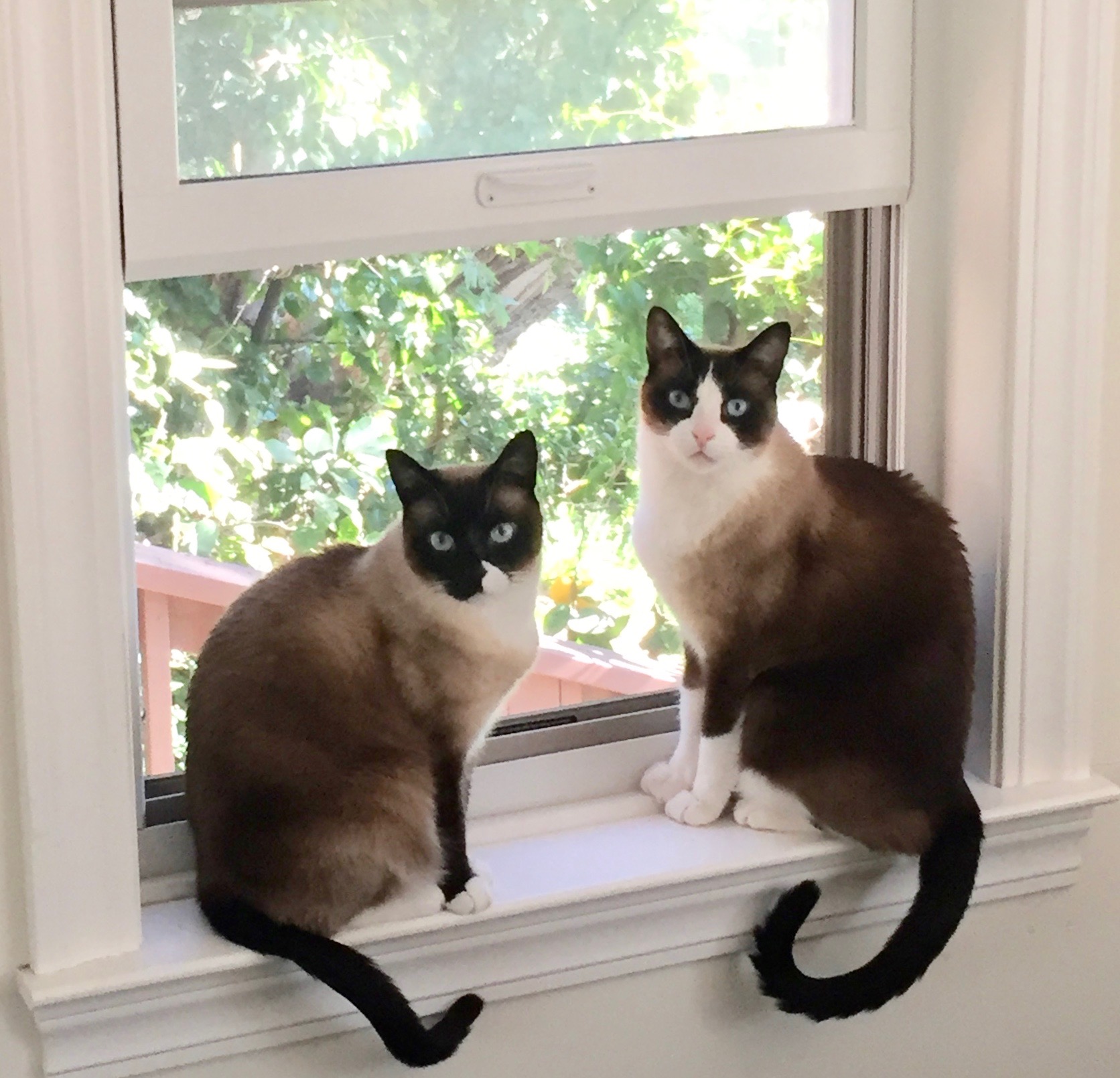
It’s my pleasure to present to you a little story, written by our Tsm. Tsyili, about two cats—but not just any two cats: our two beloved kitties, Palu and Lukan! John and I have had them—or they’ve had us—for almost five years, since they were tiny. They’re Snowshoe Siamese, brother and sister from the same litter. Lukan, the male (on the right in the photo), is big, brave, and boisterous. His sister Palu is smaller and bit on the shy side, although she’s come a long way. We think they’re both gorgeous.

Tsyili’s charming story is short and simple, the kind that even beginners with only a few months of Na’vi should be able to grasp without too much difficulty.

Before you listen, you might want to refresh your memory on these words, listed in alphabetical order:

fewi
hangham
hasey
laro si
lätxayn
leym
pxi
pxìm
sto
swirä
tìng tseng
tsin
tstew
uvan si
velek
wan
wok

There’s also a new vocabulary item you need to know:

pxul (adj.) ‘formidable, imposing’

Derivations:

tìpxul (n., tì.PXUL) ‘formidableness, imposingness’ (two rare and awkward words in English!)

nìpxul (adv., nì.PXUL) ‘formidably, imposingly’

Unlike nawm ‘great, noble,’ pxul can refer to things either good or bad, as long they’re treated seriously and not taken lightly.

Fìsäwemìri zene awnga kawl häpivawl. Lu Sawtute wätu apxul.
‘We must prepare diligently for this fight. The Skypeople are formidable opponents.’

säwem (n., sä.WEM) ‘fight’

You’ll hear three voices in the recording, those of Tsyili, Tirea Aean, and Pawl.


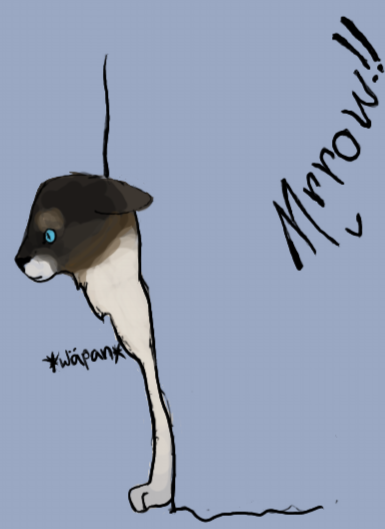
And here’s a delightful illustration, also by Tsyili:

Mawkrra ngal vurit yolune, fìtìpawmìri rutxe ’iveyng: Tsaswirä apxul lu peu? 😊

Hayalovay!

Edit 24 Aug.: aywätu –> wätu.  Irayo, ma Zángtsuva!
Posted in General | 14 Comments

Vospxìvol Lefpom! Happy August!

Kaltxì nìmun, ma eylan!

Happy August to you all. I hope you’re doing well—or, as it’s become customary to add these days, as well as can be expected under the circumstances. After some personal and professional distractions, it’s nice to be back here!

Here are a few new vocabulary items that should fill in some gaps. Most of these, as you’ll see, are action verbs, some of which came from the lì’fyaolo’. You’ll also find a few conversational expressions to use when you speak or write.

he’a (vin., HE.’a, inf. 1,2) ’cough’

I don’t actually recall if I saw any of the Na’vi cough in Avatar, but since their physiology is similar to ours in many ways (their vocal tract, for example), I’m assuming they do.

Ngari krra he’a, sweylu txo kxaru lew sivi.
‘When you cough, it’s best to cover your mouth.’

Derived noun:

sähe’a (n., sä.HE.’a) ‘a cough, instance of coughing’

fwal (vtr.) ‘wipe’

Yoti fwal rutxe. Mei slolu maw tompa.
‘Please wipe the table. It’s gotten wet after the rain.’

pìtìk (vtr., PÌ.tìk, inf. 1,2) ‘scratch non-harmfully, as an itch’

tsupx (vtr.) ‘scratch harmfully, as with a claw’

Na’vi has two different words for ‘scratch.’ For scratching that’s pleasurable or relieves an itch, use pìtìk. For the kind of scratching that’s painful, draws blood, or does other harm, such as scratching yourself with a pin or being scratched by the claws of an animal, use tsupx.

Sran, sran, oeri pìtìk tsatsenget a mì tal! Fkxake nìftxan kuma terkup!
’Yeah, yeah, scratch that place on my back! It itches like crazy!’

Note a couple of things about the previous example. First, fkxake ‘itch’ is an intransitive verb whose subject is the body part or place that itches. Also, you’ll see the colloquial idiom [Verb] nìftxan kuma terkup, which has been translated above as ‘like crazy.’ Literally, it’s saying that an action is so intense that it results in dying. We have similar exaggerations in English, e.g. “That movie bored me to death.”

Palukanìl oeyä poti fa tsin tsolängupx.
‘Unfortunately my cat scratched her with its claw.’

ngungung (vtr., NGU.ngung, inf. 1,2) ‘rub’

Ngari pxunti ngungung pelun? Srake tìsraw si?
’Why are you rubbing your arm? Does it hurt?’

lonusye (vin., lo.NU.sye, inf. 1,2) ‘exhale; blow’

This is clearly a compound from lonu ‘release, let go’ and syeha ‘breath.’

Txo syuve som livu nìhawng, lonusye tsane.
‘If the food is too hot, blow on it.’

Note the use of ne in the above example, since blowing on something is really directing a stream of air towards it.

mungsye (vin., MUNG.sye, inf. 1,1) ’inhale’

Another clear compound, this one from munge ‘take’ and syeha.

txeptsyìp (n., TXEP.tsyìp) ’flame’

Tong txeptsyìpit.
’Extinguish the flame.’

Lonusye tong txeptsyìpit.
’Blow out the flame.’

In the above example, note the two adjacent verbs indicating consecutive action. “Blowing out” a flame is to release breath and thereby extinguish it.

Finally, some colloquial and conversational expressions:

Colloquial forms of ‘push’ and ‘pull’:

kärìp (vtr., KÄ.rìp, inf. 1,2) ‘push’  (Cf. kä’ärìp)

zärìp (vtr., ZÄ.rìp, inf. 1,2) ‘pull’  (Cf. za’ärìp)

These colloquial forms are more common in speech than the full forms.

Conversational expressions:

’Uo ke zo srak?
‘Is something wrong?’

(In very colloquial speech, this can be shortened to ’Uk zo srak?)

’Upe ke zo?
‘What’s the matter?’ ‘What’s wrong?’

Responses:

Frawzo.
‘Everything’s OK.’

Fraw mì la’ang.
‘Everything is screwed up.’

la’ang (n., LA.’ang) ‘pile of stinking, rotting animal matter’

The above expression, as you might guess, is very strong and rather coarse, more so than the English translation. Nowadays, unfortunately, there seem to be plenty of occasions to use it.

Hayalovay, ma smuk.

Edit 01 Aug.: Palukan –> Palukanìl. ’Ä’! Irayo, ma Marlon!
Posted in General | 16 Comments

’Okvur Ikran Maktoä—The Story of the Ikran Rider

Kaltxì, ma eylan.

It’s my pleasure to present to you the fourth and last winner of our recent Na’vi writing contest, Marloncori’s accomplished story, “Okvur Ikran Maktoä—The Story of the Ikran Rider.” Since it’s of considerable length, I thought it best to leave it in PDF form so that you can download it and enjoy it at your leisure. It’s a great Na’vi-reading experience that will keep you interested and intrigued for a substantial time.

‘Okvur Ikran Maktoä—Marloncori

Soleia, ma Marloncori! Plltxe ayoe ngaru nìmun san Seykxel sì Nitram!

Posted in General | 3 Comments

Mì tanlokxe oeyä, srr afpxamo     Terrible days in my country

Ma oeyä eylan ayawne,

Kezemplltxe lu fìpìlokä tìkan fwa pängkxo teri lì’fya leNa’vi. Krro krro ngian ’efu oel futa zene oe pamrel sivi teri tele alahe.

Kintrram ayoe a tok Amerikat tarmìng nari tengkrr ’awa horenleykekyul tutanit a’aw tsperang—lunluke nìwotx, nìk’ong, nìzevakx. Tsatutanur a fkol tspolang lolu ta’leng akllvawm; tspangyur lu pum ateyr. Kawnga hem anafì’u lolängen alo apxay mì okvur ayoeyä, slä pum alu fì’u lolen eo menari. Fpxamoa fìkemìl afpxamo ayoeti tsngeykolawvìk, tsakrr leykoleymkem. Fratrr ’erul a faysäleymkem ayll muiä lu nìwotx.

Slä set tängok kop tantsawtsrayti ayoeyä ’uol alahe: tsaktap. Lu sute a fpìl san oeri tìrey tìsraw si, ha tìreyti ngeyä oel tìsraw seykasyi nìteng. Oeri ke lu tìmwiä, ha ngati oel ngeykasyä’än nìteng sìk. Fo fmong, fo nekx, fo ska’a. ’Efu oel futa txanlokxe oeyä pxeror.

Ulte tengkrr fayhem afpxamo verar liven, säspxin lehrrap var vivirä.

Nìrangal lirvu ayoeru eyktan a tsivun srung sivi, pum a livu por aylì’u azuseyko. Nìkeftxo ke lu ayoer eyktan anafì’u. Tìeyktanìri eyktan a fkeytok ke lu pxan kaw’it. Nìfya’o a pamrel soli oe kam ’a’awa zìsìt, fìtutan ayaymak yawne lu snor nì’aw; fpom txanlokxeyä ke tsranten por. Fpìl pol futa tsaktapìri ’umtsa aswey lu tsaktap nì’ul.

Srake tsayun fko fìtìfkeytokit a Amerikamì zeykivo? Oe ke omum. Slä law lu ’u a’aw nìwotx:

Kam puzama zìsìt wum fìatxkxemì, fkol yolem nemfa kllte utralit akawng ulte tsat peykolaw. Tsautral tsawl slolu. Tolìng ayoer mautit asyä’ä. Ulte yerom ayoel tsamautit fìtrr.

ta Pawl


New vocabulary:

koren ayll ‘law, societal rule’

leykek (vtr., ley.KEK) ‘enforce’ (from lek ‘obey’ with the causative infix <eyk>: i.e., ‘make obey’)

[NOTE: Remember how the causative structure works with transitive verbs:

Awngal horenit ayll lek.
‘We obey the laws.’

Pol awngaru horenit ayll leykek.
‘He makes us obey the laws.’

If we remove the “causee,” we simply get:

Pol horenit ayll leykek.
‘He enforces the laws.’]

horenleykekyu (n., ho.REN.ley.KEK.yu) ‘law enforcer, police officer’

This is often shortened colloquially to leykekyu.

zevakx (adj., ZE.vakx, ofp) ‘cruel’

tìzevakx (n., tì.ZE.vakx) ‘cruelty’

tìzevakxnga’ (n., tì.ZE.vakx.nga’, nfp) ‘cruel’

So: tute azevakx ‘cruel person,’ but aylì’u atìzevakxnga’, ‘cruel words.’

nìzevakx (adv., nì.ZE.vakx) ‘cruelly’

fmong (vtr.) ‘steal, rob’

tìfmong (n., tì.FMONG) ‘theft’

fmongyu (n., FMONG.yu) ‘thief’

Edits 3 June: horenleykekyu tutanit –> horenleykekyul tutanit; tìmwia –> tìmwiä; tisraw –> tìsraw; ley –> lek; HO.ren –> ho.REN. Ma Mako, ma Plumps, irayo.
Edit 6 June: tìzevakxnga’ (n., . . .) –> tìzevakxnga’ (adj., . . .). Irayo, ma Marlon.
Posted in General | 7 Comments