Reef Na’vi part 1: Phonetics and Phonology

Kxì nìmun, ma frapo! Sìlpey oe, ayngari fìzìsìt alu °3747 sngilvä’i nìltsan.

It’s finally time for us to start talking in detail about RN, the Reef Na’vi dialect heard for the first time in TWOW. (So far I’ve been referring to RN vs. FN, “Forest Na’vi,” but at times I’ll switch to the proper Na’vi names and abbreviations for these dialects, Lì’fya Na’rìngä (LN) vs. Lì’fya Wionä (LW).)

This post will be about the LW sound system. Later we’ll talk about the differences in LW morphology, syntax, and semantics as compared to LN.

First, however, let me mention a few things in general about dialects.

In common usage, “dialect” is often a pejorative term. (“I speak proper English” or French or Spanish or German or Chinese . . . ; “You speak a dialect.”) That’s not how linguists use the word. For us, “dialect” simply means a variety of a language. In that sense, we all speak a dialect. Dialects often correlate with geography. In the case of English, we have, broadly speaking, American English, British English, Australian English, New Zealand English, Indian English . . . all different “Englishes.” And of course there are dialects within dialects. Dialects can also be based on ethnicity, on social class, on generation, even on occupation. Dialectology is a rich subfield of linguistics in which you can take whole courses.

Are all dialects of a language equal? Yes and no. Yes, in that they’re all rule-governed systems of communication, all equally valid, all worthy of study. No, in that although there may be no objective reasons for saying one dialect is “better” than another, people’s attitudes about dialects can be judgmental. In some societies, a particular dialect, referred to as standard, can have prestige and high status, and is generally considered correct, proper, and desirable. Other dialects might be the opposite, with stigma and low status. It’s important to keep in mind that such societal judgments have nothing to do with the intrinsic merits of the dialects themselves! They arise from history, from social hierarchies, and from attitudes passed on from generation to generation.

Finally, how do different dialects develop in the first place? The most frequent way is based on the following observations:

    • Living languages are constantly changing.
    • Language change is in general unpredictable.
    • When speakers of the same language divide into groups and locate in different places, with reduced communication between the groups, their language continues to change, but not necessarily in parallel ways.

In such a situation, we wind up with different dialects. If the differences become great enough so that there’s no longer mutual comprehension, we say we now have two different languages rather than two dialects of the same language.

What I’ve mentioned above is just the barest outline of a complicated subject, and there’s a lot more to say. But cutting to the chase, how does all of this relate to the situation on Pandora?

What we now know is that there are different dialects of the Na’vi language there. We have a LOT more information on one of these, LN, but we’re beginning to learn something about another dialect, LW. There’s no reason to believe that one or the other of these is considered “standard,” but our focus will continue to be on LN, simply because that’s the dialect we first met and the one we know the most about. Nevertheless, we’ll explore, to the extent we can, what LW is like and how it differs from LN, keeping in mind that since these two dialects are mutually comprehensible, the differences won’t be too great.

Thinking historically, a crucial assumption we’ll make is that LN and LW stem from the same parent language spoken by both groups in the past (just how far in the past is as yet unknown); when the groups separated, their languages began to separate as well. LN preserved certain things from the parent language and changed others; the same is true for LW. But each language variety preserved and changed different things.

Whew! That was a lot of introduction! But I hope it helps you see the big picture before we dive into the details. Alaksi srak? Here we go!

Phonetic/Phonological characteristics of Reef Na’vi

The combination sy is pronounced sh ( [ ʃ ] in IPA, the International Phonetic Alphabet).

LN                                LW
syaw                            shaw                ‘call’
tsìsyì                            tsìshì                ‘whisper’

The combination tsy is pronounced like the ch in “church” (IPA  [tʃ ] ):

Some of you guessed this already. 🙂

LN                   LW
tsyal                chal                 ‘wing’
tsyeytsyìp      cheychìp          ‘tiny bite’

The glottal stop is lost between non-identical vowels. Between identical vowels, the loss is optional.

LN                   LW
fra’u                frau                 ‘everything’
Lo’ak               Loak                ‘Lo’ak’
rä’ä                  rää OR rä’ä     ‘do not’

(Note that this can happen as well in colloquial LN, where, for example, Lo’ak and Mo’at are often pronounced Loak and Moat respectively.)

In the case of two identical vowels, the missing tìftang does not cause the vowels to coalesce into one; we retain them both in the spelling. So in LW it’s rää, rììr, and meem rather than , rìr, and mem. These are pronounced not as one long vowel but as two vowels, which is made clear by intonation—or some might say, by tone. (Think of saying “Aha!” in English but leaving out the h.)

And now it gets interesting! 🙂

At the beginning of a syllable (and therefore at the beginning of a word), the ejectives px, tx, and kx are pronounced b, d, and g respectively.

LN                    LW
txon                 don                  ‘night’
holpxay           holbay             ‘number’
kxitx                gitx                  ‘death’
skxawng         skxawng          ‘moron’  (no change)

Note that this sound change is a “surfacy” one. That is to say, a word like don is underlyingly txon, with the ejective. Other phonological rules apply to this underlying form. In particular, lenition applies to it, which results (at an intermediate stage!) in the familiar singular / short plural pair txon / ton. After that rule has applied, the tx-to-d change takes place, so the pair in LW winds up being pronounced don (sg.) / ton (pl.).

U vs. Ù.

This requires some explanation.

As you know, LN has 7 vowels (not counting the pseudo-vowels), which appear on a standard vowel chart like this:

                                                   i   ì                     u

                                                         e                  o

                                                             ä         a

Notice something interesting? The chart is asymmetrical! In the upper left corner (these are the high front vowels), there are two different vowels, i (often called tense) and ì (often called lax). As we all know, these vowels sound different and can change the meaning of a word, as in mi ‘still’ vs. ‘in.’ English, of course, has the same distinction: seat vs. sit, beach or beech vs. bitch, etc.

Unlike Na’vi, however . . . and now we have to change that to: unlike Forest Na’vi 🙂 . . . English makes a similar tense/lax distinction in the upper right, where we have the high back vowels. So suit (IPA [ u ] ) contrasts with soot (IPA [ ʊ ] ), and the vowel sounds in good and food are not the same. (I sometimes wonder how anybody learns the English spelling system!)

What we’re now discovering is that the parent language of both LN and LW had the tense/lax distinction for the high back vowels. That is, it had two distinct vowel sounds,
[ u ] and [ ʊ ], which we can write as u and ù respectively. In LN, the distinction was lost: the two sounds merged, and now there’s only one u, which can be pronounced [ u ] or [ ʊ ] or something in between. The important thing is that you can’t distinguish words in LN by going from one of these vowels to the other. Linguists would say that these vowels do not contrast; the difference between them (in LN!) is not distinctive.

LW, however, has retained the distinction from the parent language. So it has two high back vowels, u (tense) and ù (lax), and the difference IS distinctive. For example, LW has the two words tsun ‘heel’ and tsùn ‘can,’ which are NOT pronounced the same! Those two distinct words have merged in LN, so that tsun is ambiguous. Not so in LW.

In summary, then, LW has an 8-vowel system:

                                                     i   ì                    u  ù

                                                          e                    o

                                                             ä         a

By this point you’re probably jumping ahead with some alarm and anticipating what this means for our dictionaries. I admit it’s a bit startling: every word in LN containing a u has to be checked to see whether that u is u or ù in LW! It’s not quite as bad as it sounds, however, since u predominates over ù. Eventually we’ll have a list of LN words where u changes to ù in LW. (Example: pum would be on the list, since LN pum corresponds to LW pùm, but lun would not, since LN lun corresponds to LW lun.)

If you’re writing a story with reef characters, how should you transcribe their dialog? This is somewhat of a judgment call, since it’s not necessary to indicate all the differences in pronunciation in the spelling. The same written sentence can be pronounced in different ways by the forest and reef clans. For an English analogy, a phrase like “dance on the water” is pronounced differently in British and American English: the vowel in “dance” is different, the quality of the t in “water” is different, and the Brits do not pronounce the final r while the Yanks do. Nevertheless, the written form is the same.

Here’s what I’d suggest as a guideline:

For LW spelling, include ù when appropriate. Change px, tx, and kx to b, d, g optionally; do so if you want to emphasize the difference between LN and LW. But there’s no need to change sy to sh or tsy to ch: simply retain the original spellings and pronounce the words in the appropriate way for each dialect.

As an example, here’s a line in Reef Na’vi from A2. It’s from the scene where Quaritch is demanding to know Jake’s whereabouts, and the Reef Olo’eyktan is explaining what Quaritch needs to do to find him:

Pori do new fìtutanti rivun, zene ftu fayspono hivùm,
kivä nìdukx nemfa na’rìng.
‘He needs to leave these islands and go deep into the forest if he is to find this man.’

There are a few more sound changes to discuss—minor ones—but this is plenty for now, so I’ll stop here. One more thing, though, before I go:

It’s easy to imagine that these sound differences are somehow appropriate to the different environments in which the forest and reef clans live. For example, perhaps you might think that the loss of initial ejectives had something to do with the water culture of the reef people . . . that the smoother sounds (b, d, g) are more in keeping with the smoothness of water than the popping ejective sounds (px, tx, kx). Don’t fall into that trap. The sound changes that take place in the history of a language have nothing to do with “appropriateness.” Although they typically occur in a systematic and organized way (the ejective change, for example, affects all the ejectives, not just one or two), just which changes occur is a matter of chance.

Siva ko, ma smuk!

Hayalovay!

ta P.

Posted in General | 20 Comments

Na’vi in The Atlantic!

Kaltxì nìmun, ma frapo!

One more thing before the year changes:

This article about constructed languages in Hollywood films just appeared online, and Na’vi is featured prominently in it!

In case you’re not familiar with the magazine, The Atlantic is a sophisticated and well-thought-of publication, founded in 1857. The author of the article interviewed me by phone for almost an hour and then ran the Na’vi sections by me to check for accuracy. I’m very pleased with how it turned out!

Nìmun, MZL!

Posted in General | 7 Comments

Neytiriyä Waytelem   Neytiri’s Songcord

Ma eylan ayawne,

I imagine that everyone reading this post has now seen “Uniltìrantokx: Fya’o Payä” at least once. 🙂 From what I can tell, the reaction of the lì’fyaolo’ has been overwhelmingly positive. Although the amount of Na’vi heard in UFP is somewhat limited, there’s still a lot there for us to discuss. So in this final post of 2022, let’s begin.

The major innovation, needless to say, is the Reef Na’vi (RN) dialect that’s heard briefly in the film. From the comments in the last post, I gathered that people wanted some time to discover as many aspects of the dialect as they could on their own, which is why I haven’t said much (or anything?) about it yet. I’ll remedy that situation after the first of the year. For now, though, let me just mention that those of you who identified a “sh” sound in RN are correct! That sound, of course, doesn’t exist in the Forest Na’vi (FN) that we’re familiar with.

The correspondence is simply that sy in FN is pronounced “sh” in RN. So, for example, syaw ‘call’ sounds like shaw, and syeha ‘breath’ sounds like sheha. This is a very common and natural sound change. It’s why English words like “sugar” and “sure” are pronounced with the “sh” sound, and why in some dialects, “assume” is pronounced “ashoom.” (Question: How would tsyal be pronounced in RN? 🙂 )

It’s likely the word you heard with the sh sound in RN was syawm, pronounced “shawm.”

syawm (vtr.) ‘know’

Syawm exists in FN as a synonym for omum, but it’s rarely used. The situation in RN is the reverse: although the reef people understand omum (keep in mind that the two dialects are mutually comprehensible!), they’re much more likely to say syawm themselves.

There’s a lot more to say about RN, which we’ll get to soon. Right now, though, let me give you the official lyrics to Neytiri’s Songcord, which has received glowing reviews. (Simon and Zoe did a beautiful job, didn’t they!) This is going to come as something of an anticlimax, since a number of you (irayo, ma Tekre!) were able to transcribe 99 percent of it accurately. Seysonìltsan! The problem was in line 15 (see below), where there was a new vocabulary item you couldn’t be expected to know:

huta (adj., HU.ta) ‘unexpected (usually for positive outcomes)’

This word is related semantically to the verb hek ‘be curious, odd, strange, unexpected’ but is generally for positive outcomes, similar to how the adverb ti’a is used. So ‘an unexpected birth’ that you’re happy about would be tì’ongokx ahuta.

A few words about the language style of this Waytelem. You’ll have noticed that Zoe pronounces some of the words a bit differently from what we’re used to in spoken FN. There are several possible reasons for this. One is that the language used may, in places, be more ancient than current FN. Another is that singers in many language traditions will modify certain sounds—most often, vowels—to make them more “singable.” You’ll hear that in some of Zoe’s vowels. You’ll also notice that the glottal stop is largely missing—that’s another change that makes for smoother singing. Finally, the strongly trilled pseudovowel rr is pronounced more like ur.

Let me leave you with another question. Can you identify any syntactic differences in these song lyrics that distinguish them from what you’d expect in ordinary spoken FN?

And with that . . .

MIPA ZÌSÌT LEFPOM, MA FRAPO!!!

ta Pawl

Neytiriyä Waytelem   Neytiri’s Songcord

Verse 1:

  1. Lie si oe Neteyamur,                       I experience Neteyam,
  2. Nawma Sa’nokur mìfa oeyä.       (And) Great Mother, within me.
  3. Atanti ngal molunge,                      You brought light,
  4. Mipa tìreyti, mipa ’itanti.             New life, a new son.
  5. Lawnol a mì te’lan.                          Joy within my heart.
  6. Lawnol a mì te’lan.                          Joy within my heart.

Chorus:

  1. Ngaru irayo seiyi ayoe                   We thank you
  2. Tonìri tìreyä,                                      For the nights of (our) life,
  3. Ngaru irayo seiyi ayoe                   We thank you
  4. Srrìri tìreyä,                                       For the days of (our) life,
  5. Ma Eywa, ma Eywa.                      Oh Eywa, oh Eywa.

Verse 2:

  1. Zola’u nìprrte’, ma Kiri.              Welcome, Kiri.
  2. Ngati oel munge soaiane.            I bring you to the family.
  3. Lie si oe atanur,                               I experience the light,
  4. Pähem parul, tì’ongokx ahuta. A miracle arrives, an unexpected birth.
  5. Lawnol a mì te’lan.                        Joy within my heart.
  6. Lawnol a mì te’lan.                        Joy within my heart.

Chorus repeats

Edit 30 Dec.: tireyä –> tìreyä (2X)  Irayo, ma Vawmataw!
Posted in General | 28 Comments

Trr anawm poläheiem! The great day has arrived!

Ma eylan,

Relìl arusikx alu “Fya’o Payä” tok nì’i’a fìtsenget! “The Way of Water” is finally here!

More accurately, for those of us in the USA, it’s almost here. As I don’t have to tell you, our long-anticipated Avatar sequel debuts tonight at midnight. If you’re in Europe or other parts of the world, though, you may have already seen it. One way or another, I hope you find it a worthy successor to the first film.

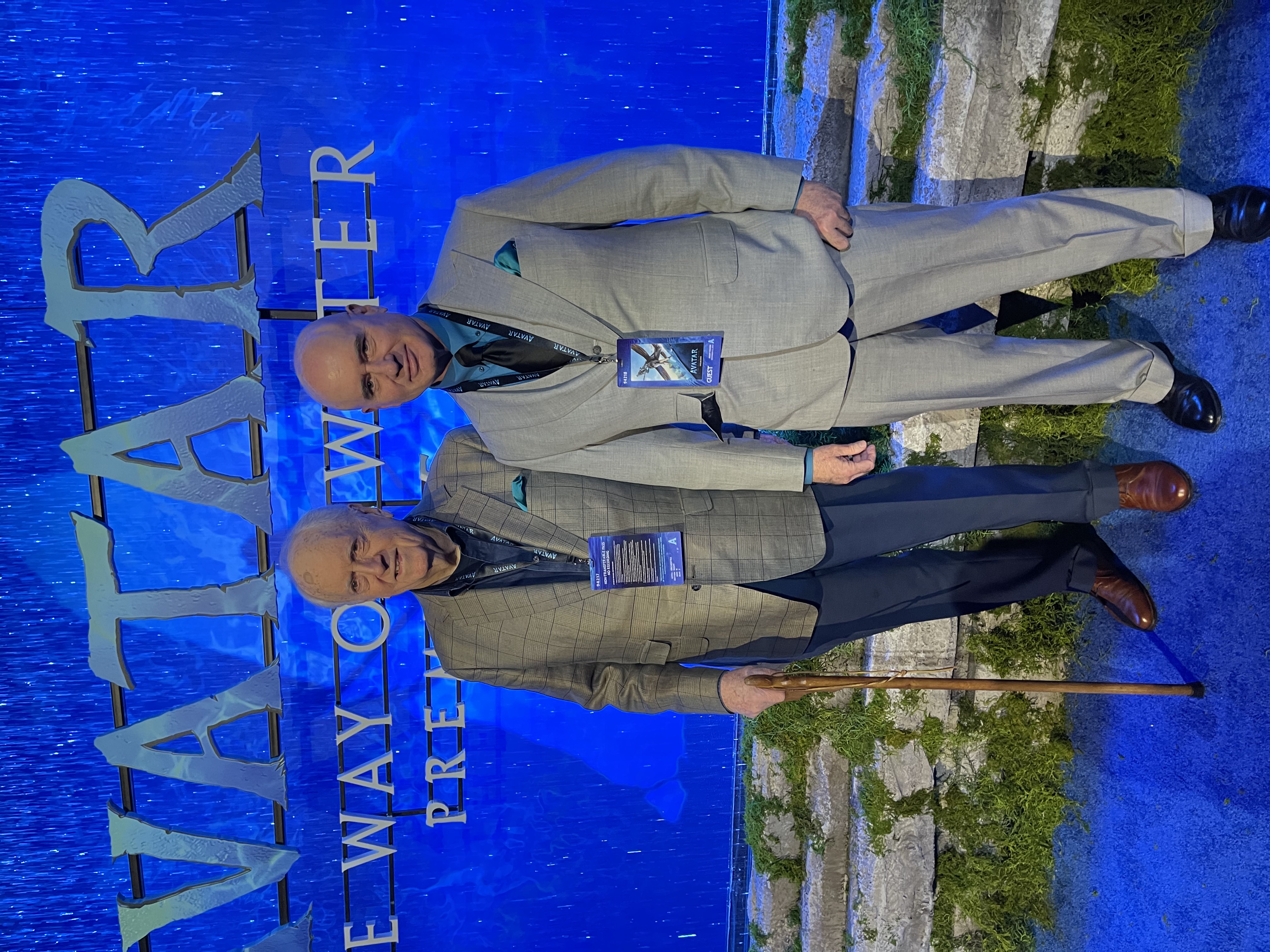
John and I had the privilege of attending the star-studded U.S. premiere Monday night in Hollywood. What a memorable event! The only sad note was that James Cameron was absent, having tested positive for Covid. But everyone else was there.

Here’s our official premiere portrait. When they saw us, the photographers naturally abandoned Sam and Zoe and Sigourney and rushed over to take our picture. 😉

In honor of the premiere, here are some new words I hope you’ll find useful. And let me tease you by saying that you’ll hear one of them—I won’t say which—in a key scene. Also, I’ll have a major announcement at the end of this post, so make sure you don’t miss it.

val (adv.) ‘diligently, hard, with effort’

Makto val!
‘Ride hard!’

Po tìkangkem soli val nìtxan fte tsatsonur hasey sivi.
‘She worked very hard to complete the task.’

Note: To encourage someone to work hard, you could say, “Tìkangkem si val!” But a shorter and more colloquial expression is simply “Kangkem val!”

kangkem: (n., KANG.kem) ‘work, colloquial form of tìkangkem

txotsafya (adv., TXO.tsa.fya) ‘if that’s the case, if that’s so’

Note that the stress is on the first syllable.

Ke sunu ngar teylu srak? Txotsafya, tìng oer pumit ngeyä!
‘You don’t like teylu? If that’s the case, give me yours!’

nìtrea (adv., nìt.RE.a) ‘in spirit’

Ke tsängun Tsyìm ziva’u ftxozäne, slä tok nìtrea.
‘Sadly, Jim couldn’t come to the celebration, but he was there in spirit.’

tìhangham (n, tì.HANG.ham) ‘laughter’

Txasunu oer fwa stawm ngeyä tìhanghamit.
‘I love to hear your laughter.’

lapx (vtr.) ‘regret’

Kemit a oe soli oel längapx.
‘I regret what I did.’

tìlapx (n., tì.LAPX) ‘regret’

Tsatìpe’unìri ke lu oeru kea tìlapx.
‘I have no regret(s) about that decision.’

uturu (n., u.TU.ru) ‘sanctuary, place of refuge’

Vuyin ohel uturut.
‘I respectfully request sanctuary.’

Nga ke tsun wäpivan; ngari ke lu kea uturu kawtseng.
‘You cannot hide; there is no sanctuary for you anywhere.’

txukxefu (vin., txu.KXE.fu, inf. 2, 3) ‘care, be concerned about, have deep feelings for’

This is clearly derived from txukx ‘deep’ + ’efu ‘feel.’ Recall that txukx not only indicates physical depth but can also refer to feelings, thoughts, and ideas, just as “deep” can in English.

The thing you care about is indicated either by the topical or with teri:

Ngari po ke txukxefu kaw’it.
‘He doesn’t care a bit about you.’

Furia teri lì’fya awngeyä nga txukxefu nìftxan, seiyi irayo.
‘Thank you for caring so much about our language.’

tìtxukxefu (n., tì.txu.KXE.fu) ‘care, concern’

tsun (n.) ‘heel’

This and the familiar word tsun ‘can’ are homonyms—words with the same spelling or pronunciation (in this case, both are the same) that mean different things. Since one is a noun and the other a verb, they fit into different slots in a sentence and shouldn’t cause confusion.

Oeri tengkrr terul mì na’rìng, tsunit askien tìsraw seykoli.
‘While I was running in the forest, I hurt my right heel.’

And finally,

lì’fyafnel (n., LÌ’.fya.fnel) ‘dialect, variety of a language’

I’m introducing this word at this time because . . .

Lu mì “Fya’o Payä” mipa lì’fyafnel lì’fyayä leNa’vi!!!

There’s a new variety of Na’vi in “The Way of Water”!!!

I haven’t been able to say anything up to now, but with the sequel upon us, I can finally reveal this to you. I’ll be describing the dialect in future posts, the first of which is coming soon. In the meantime, when you watch the film, see if you can determine when, where, and by whom this new dialect is spoken. There’s only a small bit of it, and you’ll have to listen closely. But even with the limited data, you may be able to detect something that’s different from the Na’vi you’re used to.

“Fya’o Payä” zìyevawprrte’ ayngane nìwotx!

Posted in General | 33 Comments

Krr a’o’!  An exciting time!

Kaltxì, ma eylan ayawne!

Fìkrr ’o’ lu nìtxan nang! What an exciting time this is! Uniltìrantokx: Fya’o Payä is just around the corner, and the official trailer has everyone electrified. Also, in just a few days, members of our community, include yours truly, will be arriving in Cambridge, Massachusetts to participate in the research study on constructed languages being conducted at MIT, the Massachusetts Institute of Technology. (Nìfkeytongay, I’m writing the draft of this post on the plane to Boston! 🙂 )

Speaking of which . . .

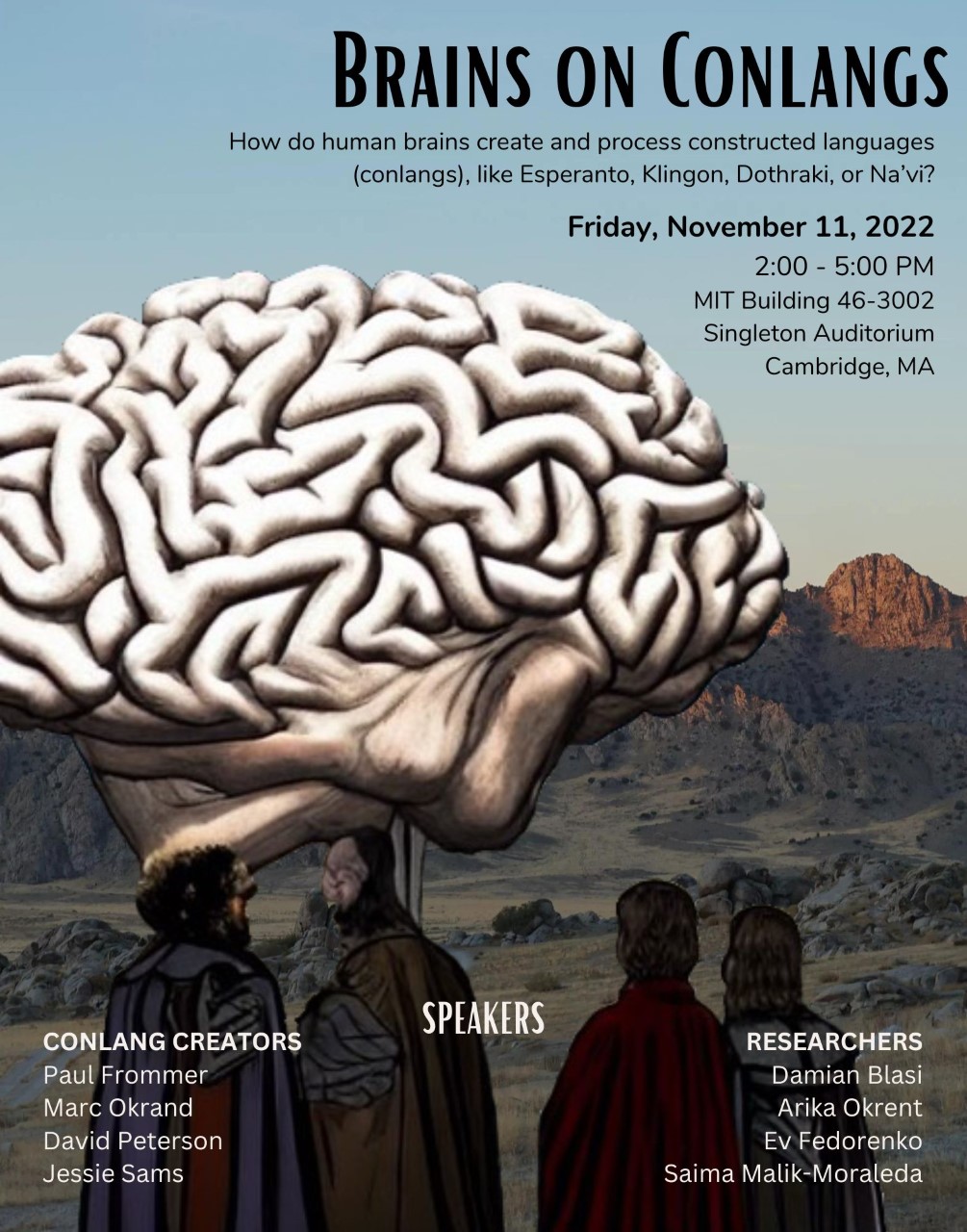
If you can’t make it to the conlang conference in person on Friday, 11 November, it’s still possible for you to attend . . . online, via Zoom! But you need to register. Here’s the official information, including the registration link. Once you’ve officially registered, you’ll receive a Zoom link that will allow you to attend virtually.

The McGovern Institute presents:

November 11, 2:00 – 5:30 pm EST in Singleton Auditorium (46-3002)

Followed by a reception with food and drink in 3rd floor atrium

Registration link (for both in person and virtual attendees): https://www.eventbrite.com/e/brains-on-conlang-tickets-427467255067

Contact: [email protected]

A network of regions in the left hemisphere of our brain responds robustly when we read or listen to language, but not when we solve arithmetic or logic problems, listen to music, or observe others’ facial expressions or gestures. But what precise features of language drive this network remains debated. One way to tackle this question is to test the “limits” of the language network by examining how it responds to artificially created languages—conlangs. Like natural languages, conlangs can express any idea. However, although these languages are typically modeled on natural languages, they have not undergone thousands of years of evolution and have not been optimized by communicative pressures and learning constraints. So, does listening to Esperanto, Klingon, or Dothraki activate the brain network that processes natural languages?

To explore this question, McGovern Investigator Ev Fedorenko with her graduate student Saima Malik-Moraleda will scan the brains of proficient speakers of five conlangs (Esperanto, Klingon, Dothraki, High Valyrian, and Na’vi) while they listen to sentences spoken in the language of interest. Four conlang creators — Marc Okrand (Klingon), David Peterson and Jessie Sams (Dothraki and High Valyrian), and Paul Frommer (Na’vi) — will discuss the process of language creation. Linguists Damián Blasi and Arika Okrent will talk about their research relevant to conlangs, linguistic creativity, and linguistic diversity. And Fedorenko and Malik-Moraleda will present some preliminary findings from their research. There will also be language games organized by Duolingo.

And a personal request:

I’m very much looking forward to meeting some of you “in the flesh” whom I’ve only known so far via posts and emails, and often only with your Na’vi name. If you’re planning to be there in person, could you do me favor? Send me an email with (1) your Na’vi name, (2) your full ’Rrta name, and (3) (optionally) a photo of your handsome/beautiful face so I can recognize you immediately. My email address is my last name at marshall.usc.edu. Irayo!

And now for a few new words and expressions:

sätsawn (n., sä.TSAWN) ‘harvest (particular instance)’

Fìzìsìtä sätsawn txantsan leiu.
‘I’m pleased to say that this year’s harvest was excellent.’

(By the way, if you’re wondering: Yes, there is agriculture on Pandora! 😉 )

’eylyong (n., ’EYL.yong) ‘pet’

You can probably guess the derivation: ’eylan ‘friend’ + ioang ‘animal.’

Tìkan fìpayoangä ke lu fwa tsun fko pot yivom; lu oeyä ’eylyong.
‘This fish is not meant to be eaten; it’s my pet.’

(Since it’s a pet, it would be more natural here to say pot rather than tsat. A pet is usually more like a person than a thing.)

tsefta (n., TSE.fta) ‘vengeance, revenge’

Omum oel futa ngal pot ve’kì, slä tsefta ke lu tì’eyng amuiä.
‘I know you hate him, but vengeance is not a proper response.

tsefta si (vin., TSE.fta si) ‘take revenge’

Tutanur a eyktanayti tspolang oeyä sempul tsefta sayi.
‘My father will take revenge on the man who killed the deputy.’

tseftanga’ (adj., TSE.fta.nga’) ‘vengeful’

This word can be used for both people and things: tute atseftanga’ ‘vengeful person,’ aylì’u atseftanga’ ‘vengeful words.’

layro (adj., LAY.ro) ‘free (from oppression)’

tìlayro (n., tì.LAY.ro) ‘freedom’

These words refer to not being under anyone’s control, able to act as you like without oppression.

Aysutel nìwotx new tìlayrot.
‘All people want freedom.’

And finally, two adverbs that express different kinds of surprise:

ti’a (adv., TI.’a) ‘surprisingly (for unexpectedly positive outcomes)’

um’a (adv., UM.’a) ‘surprisingly (for unexpectedly negative outcomes)’

These words are more specific than nìloho ‘surprisingly,’ which is neutral as to outcome.

Ramu ke lu txur nìtxan, slä uvanit yolora’, ti’a.
‘Ramu isn’t very strong, but surprisingly, he won the game.’

Pol tìkangkemit tsyolul nìso’ha, slä tsa’ur hasey ke soli, um’a.
He began the work enthusiastically, but surprisingly, he didn’t finish it.

That’s it for now. Hayalovay!

Edit 21 Nov.: spolang –> tspolang
Edit 29 Dec.: amuia–> amuiä, ke hasey soli –> hasey ke soli  Irayo, ma Zángtsuva!
Posted in General | 11 Comments

Letsranten! Important!  A conlang study you might be part of!

Kaltxì, ma frapo!

I wanted to let you know about a linguistic study concerning constructed languages taking place in November at MIT, the Massachusetts Institute of Technology, that some of you could take part in!

Here’s a brief description:

We are researchers in the McGovern Institute for Brain Research and the Brain and Cognitive Sciences department at MIT and we are interested in how the human brain processes language (evlab.mit.edu).

One research question we would like to ask is whether the processing of constructed languages (conlangs) recruits the same mechanisms as those supporting the processing of natural languages. To do this, we need to test (in an fMRI scanner) speakers / learners of conlangs. The testing would take place in Boston in November 2022 (exact dates TBD) and will likely be combined with an MIT-CONLANG event (with special guests, like the creators of some of the languages and/or famous users). We will also subsidize travel expenses for those selected for participation.

The date of the MIT Conlang event has now been set: Friday, November 11. And Na’vi will be part of the study!

If you’re an intermediate-to-advanced Na’vi learner/speaker and you’d like to come to Boston, with travel expenses subsidized, to participate in the event, fill out this form online:

https://mit.co1.qualtrics.com/jfe/form/SV_aaDQw3jpWRyOmN0

Don’t be concerned that Na’vi isn’t mentioned on the form; we were added later. Just check the Other box and fill in Na’vi.

The original announcement about this study was made on Twitter, and a few members of the Na’vi community heard about it and have already applied. It would be great if we could get more participants!

I’ll be there myself on Nov. 11 to participate in a panel discussion. Nìsìlpey tsìyevun oe hu eylan a ta lì’fyaolo’ awngeyä ultxa sivi tsatseng!!

Hayalovay!

ta Pawl

UPDATE: Just to be clear, if you’re chosen to participate in the study, you will not be asked to produce Na’vi, either in oral or written form! Rather, you’ll listen to some recorded material and simply be asked to comprehend it, while your brain is being monitored. That might be encouraging to people whose comprehension of spoken Na’vi is good but who feel less confident about speaking themselves.

Posted in General | 11 Comments

Solalew mawl zìsìtä! Half the year is over!

Kaltxì, ma eylan,

Hard to believe that half of 2022 is now history. Krr tswayon pesengne? (Which reminds me of a saying that used to be popular with linguistics students when I was doing my graduate work, illustrating that sentences that seem similar on the surface can have very different underlying structures: “Time flies like an arrow. Fruit flies like a banana.” 🙂  )

In any event, the second half of this year is sure to be an exciting period for everyone in Kifkey Uniltìrantokxä! I’ve been more than busy with a lot of Na’vi-related things and haven’t been as involved with the blog or responsive to your comments as I would like. But for now, let me at least offer one response and a few new vocabulary items.

There were a number of comments expressing concern about the term olo’eykte, presumably meaning ‘female clan leader.’ The question was whether the term is canon, and if so, whether olo’eyktan, which prior to this was considered gender-neutral, actually referred to a specifically male clan leader.

My correspondence regarding this term goes back over a year. In a nutshell, olo’eykte arose in a natural and understandable way. Since we have such triples as eveng ‘child,’ evengan ‘boy,’ evenge ‘girl’; tsmuk ‘sibling,’ tsmukan ‘brother,’ tsmuke ‘sister’; po ‘he/she,’ poan ‘he,’ poe ‘she,’ etc., olo’eykte arose based on that pattern. (To fit in with these triples, there should be a third, neutral term such as *olo’eyktu, but that doesn’t exist.) However, there is a second pattern, where words in –an are gender-neutral. The obvious example is ’eylan ‘friend.’

Since olo’eykte is attested in a lot of official documentation, it is canon and will appear in our dictionaries. The best way to think of it is somewhat like “actor” vs. “actress” in current English. If there is a good reason to distinguish between male and female thespians, then you can use “actor” for males and “actress” for females. (In the Academy Award presentations, otherwise known as the Oscars, there are separate categories for “Actor in a Leading Role” and “Actress in a Leading Role.”) But nowadays, many if not most females who act prefer to refer to themselves as actors, not actresses.

In somewhat the same fashion, olo’eyktan can definitely still be used in a gender-neutral way to refer to both males and females. However, if for any reason you want to distinguish between male and female clan leaders, you can use olo’eyktan for a male and olo’eykte for a female. Context should be able to differentiate between these two uses of olo’eyktan.

One more thing: Although gender-neutral terms are preferable when gender is not an issue, it’s sometimes useful in narratives to be able to distinguish gender. For example, suppose you’re relating a conversation between two Na’vi, one male and one female: “He said . . .” “She said . . .” “Then she said . . .” “Then he said . . .” You can use po for both people, of course, but it might be easier to track the conversation in terms of who said what if you distinguish between Poan poltxe and Poe poltxe.

Now for a handful of new words. Most of these are straightforward and don’t require example sentences.

’eng (n.) ‘beak of a bird or animal’

wion (n., WI.on) ‘reef’

Two words for body types, used for people and animals:

ompu (adj., OM.pu) ‘fat, corpulent’

litsi (adj., LI.tsi) ‘thin, lean, lithe’

These terms are objective and nonjudgmental. Also, don’t confuse litsi with flì. Flì is used for things, not people: frir aflì ‘thin layer,’ flìa vul ‘thin branch.’

tsukmong (adj., tsuk.MONG) ‘reliable, dependable’

This word derives from mong ‘depend on, rely on’ and can be used for both people and things: tute atsukmong ‘dependable person,’ aysìoeyktìng atsukmong ‘reliable explanations.’

And finally:

man (vin.) ‘belong’

This is ‘belong’ in the sense of fitting in; feeling comfortable as part of a group; being in a place, position, or relationship where one belongs. (Note that you can’t use man in a possessive sense, as in “This bow belongs to me.”) Man is often accompanied by a place expression or one with hu:

Man po fìpongumì nìlaw.
‘He clearly belongs in this group.’

Nga man oehu, ma paskalin.
‘You belong with me, honey.’

Krro krro fpìl oel futa ke man oe kawtseng.
‘Sometimes I think I don’t belong anywhere.’

Rolun oel olo’ti a ’efu fta oe man tsatsengmì.
‘I’ve found a community where I feel I belong.’

And that’s what I truly hope both newcomers and old timers will be able to say, and continue to say, about our united lì’fyaolo’ as the days, months, and years go by.

Hayalovay.

Posted in General | 20 Comments

Results of the TTTC!

Kxì ma frapo,

Maw fpxamoa kintrr afpxamo mì tanlokxe oeyä, fula tsun lefkrra sìlenit tswiva’ hìkrr ulte livawk nìmun lì’fyati awngeyä oeti ’eykefu nitram nìtxan.

To all who responded to the T3C (Teaser Trailer Translation Challenge), thanks so much! I was impressed and delighted—although not surprised—by the creativity, nuance, and linguistic sensitivity that went into your responses. Oeri leiu fìlì’fyaolo’ lawnoltsim.

lawnoltsim (n., LAW.nol.tsim; colloquially, LAW.no.tsim) ‘source of (great) joy’

Obviously there’s no “correct answer” here, and the responses contained a lot of viable options. Although everyone had something useful to say, let me comment on a few things that particularly struck me.

Translation of “fortress”

Lots of good options. The most popular seemed to be the existing word zongtseng, which is glossed in the dictionary as ‘safe place’ or ‘refuge.’ That can certainly be the function of a fortress.

I’m not sure, though, that zongtseng fully conveys the idea of strength, of something impervious to attack. We can’t know what was actually in Jake’s mind, but as a former military guy, he may have been picturing “fortress” in its original sense in English, i.e., as a military fortification or stronghold, and using it metaphorically. With that in mind, I myself, like some of you as well, had come up with txurtseng—a place of strength, or as was mentioned in the comments, a bulwark. What we don’t know is whether this concept already existed in Na’vi culture. Did the Omatikaya think of Kelutral as both a zongtseng and a txurtseng? Or were there other physical structures in their culture and experience that were more clearly txurtseng? Hard to say at this point.

Some other ideas I liked:

  • zongku (zong ‘defend’+ kelku ‘home’)
  • kelhawn (kelku + hawnu ‘protect, shelter’ = ‘house of protection’)
  • hawntseng (‘place of protection’)
  • ekxakxemyo (ekxan ‘barricade’ + kxemyo ‘wall’)—nice, although a bit challenging to pronounce!
  • tìslan aseykxel (tìslan ‘support’ + seykxel ‘confidently strong’)
  • tìtxur (‘strength’)—the simplest of all, but it might very well be that “fortress” in the sense of a physical structure used metaphorically is an ’Rrta concept and not part of Na’vi thinking, in which case “strength” could best convey Jake’s intent.

In the end, I’m going to add txurtseng to the dictionary, and reserve zongtseng for ‘refuge’:

txurtseng (n., TXUR.tseng) ‘fortification, fortress, bulwark’

Translation of Jake’s complete statement

I thought there were three main considerations here: Jake’s statement should—

  • Be concise
  • Be idiomatic and true to the spirit of Na’vi
  • Have good rhythm, flow, and emphasis

(It’s true that conciseness isn’t a necessary requirement, and I appreciated the spirited defense of a wordier version. 🙂  But I think this is a case where less is more.)

There was broad agreement about how this should go, but also some interesting differences.

“I know one thing . . .”

The question here is whether “one thing” should be translated literally. For those who did it that way (I was among them—at first!), it comes out:

Omum oel (or: Oel omum—there’s no difference) fì’ut a’aw (or: ’awa fì’ut) . . .

Why not just ’ut(i) a’aw, without the fì-? I don’t believe we’ve had a hard and fast rule about this, but ’u ‘thing’ isn’t used much by itself; instead, it usually has some modifier: fì’u, tsa’u, ’uo . . . So a more literal, although still idiomatic, English parallel would be, ‘I know this one thing:’

However, what does “one thing” here really mean? Jake can’t be saying he knows just one thing in his life! He may not be an intellectual giant, but his knowledge base is wider than that! Rather, he’s saying: “I am completely certain of what I am about to say.” That’s why I really liked the suggestion to use the idiomatic Na’vi word nì’pxi, which is glossed as ‘pointedly, especially, unambiguously.’ That is, Omum oel fì’ut ni’pxi . . .

“Wherever we go . . .”

Most everyone realized this was a perfect place to use the conjunction ketsran, which means ‘no matter’: ketsran tsengne kivä . . .

Note that we use the subjunctive (-iv-) form of the verb with ketsran. It’s like saying in English: “no matter where we may go.”

Someone submitted a wordier structure that’s perfectly grammatical: ketsrana tseng a kivä tsawne, which is closer to ‘whatever place we may go to.’ (Here ketsran is not a conjunction but an adjective.) But in the present context, I think the more concise version wins.

Related to the above construction, I was intrigued by the suggestion that ketsrana tseng ‘whatever place’ might contract to *ketsreng ‘wherever.’ Some parallels might be:

ketsrana tute ‘whatever person’ à *ketsrute ??? ‘whoever’

ketsrana krr ‘whatever time’ à *ketskrr ??? ‘whenever’

ketsrana ’u ‘whatever thing’ à *ketsru ??? ‘whatever’

These contractions, of course, aren’t necessary. The question is, would they have arisen naturally, and if so, are they useful? I’d be interested in your thoughts about this!

“this family is our fortress.”

Several of you noticed something important about how Na’vi likes to handle personal pronouns.

Here’s an iconic sentence (well, part of a sentence) from American history, the last words of the Declaration of Independence (1776):

“[W]e mutually pledge to each other our Lives, our Fortunes, and our sacred Honor.” (It’s interesting that English used to capitalize common nouns the way German does today!)

How would you translate that into Na’vi? In particular, what would you do with “we,” “our,” “our,” and “our”? If you use ayoe once and ayoeyä three times, you’ll get a grammatical but awkward and repetitive-sounding sentence. English gets away with this kind of repetition because English pronouns are so short and sweet. But personal pronouns in Na’vi are often two and three syllables.

Instead, idiomatic Na’vi does something different: It uses the topical to “set the stage,” so to speak, in this case placing the whole sentence in the context “as for us . . .” Once that’s established, the related personal pronouns can generally be omitted. So for Jake’s statement, we need only say awngari once; after that, we don’t need further pronouns for we and our:

Awngari ketsran tsengne kivä, fìsoaia lu txurtseng.

Finally, there was the question of what word would be the most impactful at the end, “family” or “fortress”? In English, Jake wound up with “fortress.” But he could have said, “. . . our fortress is this family.” Likewise, the Na’vi version could be either fìsoaia lu txurtseng or txurtseng lu fìsoaia. I’m not sure which one I like better. Part of the decision would rest on the prior context of the statement. Has Jake already mentioned soaia? If so, it’s “old information,” in which case the “new information” (txurtseng) is better at the end of the sentence.

Thank you all again for your ideas! If I didn’t mention your particular contribution, it’s not because I didn’t value it. It’s just that this post has already gotten longer than I anticipated.  🙂

One last thing: Regarding the question about the future of the Na’vi language, although I can’t tell you anything specific about the upcoming movies, I’m happy to reassure you all that Na’vi will remain a vital part of the Avatar canon and the story world going forward.

Zusawkrr lì’fyayä leNa’vi leiu txur!

Hayalovay!

Posted in General | 17 Comments

About that trailer . . .

Kaltxì, ma frapo!

Kezemplltxe, the excitement has begun to build, big time! I’m sure everyone reading this has now seen the teaser trailer for Uniltìrantokx: Fya’o Payä more than once.

As we’ve seen, there’s little dialog in the trailer. Only Jake speaks, and he says the following:

“I know one thing: Wherever we go, this family is our fortress.”

I suspect that members of the lì’fyaolo’ are all asking themselves the same question: What was the original Na’vi of this statement? 🙂

I was about to post my own answer to the question. But then I thought it would be interesting and fun to see what YOU all thought about it!

What do you think would be the most natural and idiomatic way to express in Na’vi what Jake has said? Feel free to post your answers in the comments, along with any explanation you’d like to share about how and why you came up with your version. In a subsequent blog post, we’ll discuss the results.

Note that you’ll need to use a new vocabulary item, since we haven’t yet seen the word for ‘fortress.’ This could be an entirely new root, or it could be derived from existing terms in the dictionary. (I have a simple word in mind, but I’d be interested to see what you think.)

Ayngeyä aysìralpengit ngop nì’o’!

Hayalovay . . .

ta Pawl

Posted in General | 26 Comments

Lì’fyengteri      Concerning honorific language

Kaltxì, ma smuk. Ayngaru nìwotx, sìlpey oe, lu fpom.

This post has been completed for quite a while, but it’s only now that I’m getting it up on the blog. I hope it will come as a little bit of welcome distraction from things that are going on in the world.

The topic is honorific language: the kind of formal—and, in the wrong circumstances, overly polite and stilted—language exemplified by Norm when he’s first speaking Na’vi:

Ätxäle suyi ohe pivawm, peolo’ luyu pum ngengeyä?
‘May I ask what tribe you belong to?

That sentence (which didn’t make it into the final cut of A1) contains the special elements of honorific language we’re familiar with:

    • The first-person pronoun oe ‘I’ becomes ohe.
    • The second-person pronoun nga ‘you’ becomes ngenga.
    • Verbs contain the honorific infix <uy>.

(Note: ‹uy› is not always required with the honorific pronoun forms, and vice versa, Using honorific pronouns along with <uy> constitutes the most formal register. Using the pronouns without <uy>, or <uy> without the pronouns, is possible and somewhat less formal.)

But there’s more we can say about this style of speech, which is an example of what linguists call a register. (“Register” is different from “dialect.” In brief, dialects are varieties of a language used by different people. Registers are varieties of a language used by the same people in different circumstances.)

For one thing, there are a few more honorific pronouns. These are relatively rare, which is why we’re only seeing them now.

    • The third-person pronoun po ‘he, she’ becomes poho [PO.ho].
    • The third-person pronoun poe ‘she’ becomes pohe [po.HE].
    • The third-person pronoun poan ‘he’ becomes pohan [po.HAN].

Example:

Ätxäle suyi ohe pivawm, muntxatul ngengeyä tuyok pesenget? Srake luyu poho set ro helku?
‘If I may ask, where is your spouse? Is he/she at home now?’

In addition to acting in a formally polite way, however, the Na’vi can talk about this kind of behavior as well. For that, some vocabulary is needed.

The word for formal politeness in general, not just with respect to language, is:

henga (n., HE.nga) ‘formally polite behavior’

We’re not absolutely sure where this word comes from, but a possible derivation is from the two most familiar honorific pronouns, where PN + PN > N:

ohe + ngenga = ohengenga > hengenga > hengnga > henga

The associated verb is:

henga si (vin.) ‘act in a formally polite or honorific way’

Krra ultxa si nga tsatxanro’tuhu, zerok futa zene henga sivi, ma ’eveng.
‘When you meet that famous person, remember that you have to be formally polite, child.’

txanro’tu (n., txan.RO’.tu) ‘famous person, celebrity’

A txanro’tu is a tute a txanro’a.

The adjective is:

leheng (adj., le.HENG) ‘formally polite’

(NOTE: Leheng is not the opposite of räptum ‘coarse, vulgar.’ You can be the opposite of “coarse and vulgar”—i.e., polite, considerate, and socially acceptable—without using the formally polite, honorific language.)

Here the final unstressed a has dropped over time.

For formally polite or honorific language, however, there are different words:

lì’fyeng (n., lì’.FYENG) ‘honorific language’

The derivation is:

lì’fya + leheng = lì’fyaleheng > lì’fyalheng > lì’fyaheng > lì’fyeng

Note that lì’fyeng, with stress on the second syllable, breaks the pattern of the other lì’-containing words, where the stress is on lì’. The reason is that the stress in the source word is clearly on heng: lì’.fya.le.HENG, and it has remained there.

And as you would expect, the verb is:

lì’fyeng si (vin.) ‘use honorific language’

Now what if you’re in a situation when someone is being overly polite with you, and you want to tell them to just relax and chill out? How do you respond?

One thing you can say is:

Henga rä’ä si, ma tsmuk.
‘Don’t be so formal, bro/sis.’

You can also say:

Henga kelkin.
‘Formality isn’t necessary.’

When it comes to formal language specifically, there are a variety of things you can say. (Note: These are all considered friendly.)

  1. Lì’fyeng rä’ä si.
    ‘Don’t use honorific language.’
    .
  2. Fwa lì’fyeng si lu kelkin.
    ‘It’s not necessary to use honorific language.’

Shorter, more colloquial versions of 2 are:

  1. Lì’fyeng kelkin.
    ‘No need to speak so formally.’
    .
  2. Lì’fyeng kelkin ko.
    ‘Let’s not speak so formally with each other.’

And the most colloquial of all:

  1. Fyengkekin.
    ‘Don’t be so stiff, dude.’

fyengkekin (conv., FYENG.ke.kin) ‘no need to use honorific language’

The derivation is:

lì’fyeng + kelkin = lì’fyengkelkin > fyengkelkin > fyengkekin

Hayalovay, ma eylan.

Posted in General | 16 Comments