You probably won’t find anything here that you haven’t heard or seen before, but I think it’s a nice summary of certain considerations that were important in the creation of Na’vi.
I’ve also done an interview—along with David Peterson, creator of the Dothraki and Valyrian languages for “Game of Thrones”—for the humor/information web site Cracked.com. It’s titled “6 Things You Never Knew About Inventing Languages For Game Of Thrones And Avatar.” It should be appearing shortly. When it does, I’ll let you know.
Also, let me take this opportunity to thank everyone who commented so positively on the last post. Seiyi irayo, ma smuk. Aylì’u ayngeyä oeru teya si. And let me respond to the questions and comments.
Tanri asked about the pronunciation of soleia. The careful, “correct” pronunciation, as you know, has four syllables: so.le.i.A. But in ordinary conversation, people will almost certainly reduce it to three. Would it then be so.ley.A or so.le.YA? In terms of pronunciation, I don’t think it matters: there’s very little difference between the two, at least to my ears. 🙂 By the way, something similar happens with kameie in Oel ngati kameie. The last word is “correctly” four syllables, but almost always pronounced in three.
Plumps asked what happens to a verb like ue’ if we try to add the honorific, second-position infix <uy>. You can see the problem: we get uuye’, which is not allowable, since in Na’vi we don’t have two identical vowels in sequence. A similar problem arises, much more familiarly, when we add the positive-attitude infix <ei> to si: we should get seii. Well, you all know what happens in the latter case: seii becomes seiyi, where a y intervenes between the two i’s. If we tried to do the same thing with uuye’, we’d get uwuye’, where w is the natural sound to interpose between the two u’s. But another possibility is simply to have the two u’s coalesce into one: uuye’ > uye’. For some reason, this feels like the more natural solution; uwuye’ just looks odd to me. I’d be interested in how other people feel about this.
And now a question for Plumps: Could you please come up with a context in which you would add the honorific infix to ue’? I’d be very interested in that story! 🙂
Blue Elf and Vawmataw discussed how the word Skype should appear in Na’vi. When it comes to foreign terms adapted into Na’vi phonology, there’s often room for variation. The question we need to ask ourselves is how a native Pandoran, hearing (rather than seeing) the English (or French or German or whatever) word, would pronounce it. In the case of Skype, if Neytiri or Eytukan heard the English word “Skype,” there’s no reason they would give it two syllables, since the English word has one syllable and a Na’vi word can end with a p-sound perfectly well. So they would probably just say Skayp. Might they say Skxayp? I suppose so. To be honest, the reason I chose that form is that I saw it used that way in the lì’fyaolo’ and I said to myself, “Well, why not?” I’d be happy to have two alternate forms that can be used interchangeably: Skayp and Skxayp.
Finally, Vawmataw commented that the word paskalin ‘sweet berry, sweetheart’ sounds just like the French word Pascaline. Irayo, ma ’eylan! I was completely unaware of that. I’ve since learned from Wikipedia that a Pascaline is a mechanical calculator invented by Pascal in the 17th century. Imagine that!
This is a nice example of what has been called a “bilingualism”—a sequence of sounds that exists meaningfully in two languages, where the meanings are generally very different. Let me give you my two favorite examples.
The first comes from the great pianist Artur Schnabel, as related by Abram Chasins in his 1957 book Speaking of Pianists: “I once mentioned a pianist who was about to give an all-Mozart concert. ‘Oh,’ said Schnabel, ‘when he plays it, it isn’t Mozart. It’s Nozart.’ Particularly ingenious, I think is the bilingualism: the English ‘notes-art’ implying the pianist’s inexpressivity, and the German ‘no-zart,’ (zart meaning tender or delicate).” Sìlronsem nìngay, kefyak?
The second takes a particular phrase and tries to “hear” it in both French and Yiddish. The phrase in French would be gai avec un fils, which I suppose means “happy with a son,” although I don’t know if this is really idiomatic. In any event, if you alter the pronunciation slightly and put it into Yiddish, you get “Go away without feet.”
We now have voice recordings for all the examples in the last post, beautifully read by a tsulfätu lì’fyayä, our own Neytiri. Seiyi irayo, ma Ney. Ngeyä lì’upam lor lu nìngay.
Kaltxì nìmun, ma eylan! And hello again. Tse . . . it’s been a while. 🙂 I hope you’ve all been healthy and happy during my temporary absence from the blog. And I hope you’ll find the approximately 40 new words and expressions below useful.
Before anything else, though, I want to congratulate the organizers of AvatarMeet 2016. John and I returned from Pittsburgh a few days ago with very happy memories. Facilitating the move to a new city in such a short time was a daunting task, but the organizers really rose to the occasion. Soleia, ma smuk! (See below.) The guidebook to Pittsburgh and the Meet-up was, as usual, beautifully put together and extremely useful. The hotel was great, literally right next door to the arena where the Cirque du Soleil performance was held. I thought my Na’vi class—this time based on the Na’vi dialog in the show we were all going to see that night, TORUK: The First Flight—went pretty well; it was a special honor to welcome nine or ten cast members from the show who opted to sit in on the class! Their enthusiasm was infectious. And after the show, we were all treated to a Q&A session with cast members followed by a backstage tour to see how some of the Cirque magic was created. All in all, a very successful meet-up.
Here’s a little interview I did for the Cirque du Soleil Facebook page, from my seat in the arena, five minutes before the show began. (The video is currently first in the “All Videos” section.)
Looking forward to next year, I’m very excited about our meet-up in Orlando, Florida, during which we’ll visit the new Disney theme park, Pandora: The World of AVATAR, due to open next year. I’ve been working with the Disney folks on the Na’vi language elements of the park, of which there will be quite a few! 🙂 In particular, you’ll hear Na’vi spoken while you’re on the “e-ticket” ride. It’s being developed here in Glendale, California, and a few weeks ago I had the privilege of riding the prototype! Wou! I can’t say much about it right now except that it’s VERY exciting, and I know you’re going to love it! Zìsìtayri srefereiey nìprrte’!
OK, on to the new vocabulary. Nìfrakrr, I want to thank all the members of the lì’fyaolo’ who contributed ideas and suggestions. Irayo nìtxan ayngaru nìwotx, ma smuk. Some of the words and expressions below are direct consequences of their contributions. You’ll find the new items in more-or-less random order. Voice recordings of the examples will be coming soon. [UPDATE 7/07: We now have recordings for all the examples, beautifully read by our own Neytiri. Irayo nìtxan, ma tsmuk!]
ler (adj.) ‘steady, smooth (for motion)’
nìler (adv., nì.LER) ‘steadily’
Ler refers to smooth, steady motion as opposed to motion that’s jerky or chaotic.
You may remember that we already have a word meaning steadily, nìk’ärìp as in fyep nìk’ärìp ‘hold steadily,’ but that’s different. Nìk’ärìp refers to stillness—keeping something from moving. Nìler refers to smooth movement. Nìler may also be extended metaphorically beyond the realm of physical movement to a more general idea of smooth, unbroken action, as is the case in English: tìkangkem si nìler ‘to work steadily (without stopping)’.
lo’a (n., LO.’a) ‘totem’
Totems are large structures built by the Na’vi for various symbolic and ritual purposes.
Naranawm (n., nar.a.NAWM) ‘Polyphemus’
From Nari anawm, ‘Great eye.’ (And if anyone is wondering, srane, this term has been officially approved at the highest level. 🙂 )
From vozam ‘512, equivalent in use to 1,000’ + pasuk + ut(ral)
One of the prominent features of the grinch tree is its edible fruit, which looks rather like a raspberry—that is, made up of many little round components, almost like tiny little berries themselves. Hence the “thousand-berry tree.”
paskalin (n., pa.ska.LIN) ‘sweet berry (term of endearment)’
Hivahaw nìmwey, ma paskalin. ‘Sleep well, honey.’ (Father to little daughter.)
fngä’tseng (n., FNGÄ’.tseng) ‘restroom (on earth)’
mo a fngä’ (n., MO a FNGÄ’) ‘restroom (on earth)’
Both of these terms mean ‘restroom’ and can be used interchangeably on Earth. Fngä’tseng is more general, not necessarily implying an enclosed area, so it’s also used among the Na’vi for any “place of elimination.” In contrast, mo a fngä’ is always an enclosed private structure or room.
sa (vin.) ‘rise to a challenge’
This simple verb yields some important related expressions:
Siva ko! (si.VA ko)
‘Rise to the challenge! Courage! You can do it!’
Siva ko indicates encouragement before or while attempting a challenge.
Soleia! (so.le.i.A, or usually simply so.ley.A—just make sure the stress is on the final syllable!) ‘Congratulations! Nice going! You met the challenge! You did it!’
Soleia is used for congratulating someone after successfully meeting a challenge.
Sasya! (sa.SYA)
‘I’ll rise to the challenge! I can do it!’
Sasya is used for self-encouragement before attempting a challenge. Recall that the <asy> version of the future infix indicates intention as opposed to a mere prediction about the future.
You can also use sasya as a friendly and somewhat humorous response to a request:
Q: Ätxäle si, oer syivaw trray ha’ngir fa Skxayp? ‘Could you [literally, may I ask you to] call me on Skype tomorrow afternoon?’
A: Sasya!
‘Yup, I’ll rise to the challenge!’ OR ‘Sure will!’ OR ‘Will do!’
An idiomatic expression:
Tsun pehem?
This is short for Tsun fko pehem sivi? ‘What can one do?’ It’s used in a somewhat fatalistic way, when you throw up your hands in an unpleasant situation or when something doesn’t turn out well, and you say, “What are you gonna do? That’s life.”
A. Rini yawne lu oer, slä oe yawne ke längu por kaw’it. ‘I’m in love with Rini, but she doesn’t love me one bit.’ B. Tsun pehem?
‘What are you gonna do? That’s life.’
Ngeyä kewan pìmtxan? = Ngari solew polpxay?
‘How old are you?’
But the form with kewan is a bit formal and stiff; the one with solew is more common and colloquial. Recall that solew is colloquial for solalew.
Proverb: Koakturi kewanti keyìl ke wan.
‘An old person’s face doesn’t hide their age.’
That is, Some things can’t be covered up.
tìnvi (n., TÌN.vi) ‘task, errand, step (in an instruction)’
tìnvi si ‘perform a task, run an errand’
Oer txoa livu, ke tsun oe kivä ngahu. Zene pxaya tìnvi sivi.
‘Sorry, I can’t go with you. I have a lot of errands to run.’
txanwetseng (n., txan.WE.tseng) ‘personally significant or beloved place, heimat’
From txanwawea tseng. txanwawea tseng > txanwea tseng > txanwetseng
Txanwetseng is close in spirit to the German word heimat. Here’s what Wiktionary says about it. (And thank you to the LEP for pointing this out.)
“Heimat refers to a place towards which one has a strong feeling of belonging, and (usually) a deep-rooted fondness. Most commonly this is one’s native region, but it may also be where one has lived for long, where one’s family is, or where one feels at home for whatever reason. Heimat may be the whole of one’s native country, but more often it is a relatively narrow region (typically with its particular traditions, landscape, dialect, and so on). Even if it refers to a country, it is always defined exclusively by a person’s emotional ties with it.” [Slightly edited.]
penghrr (vin., peng.HRR—inf. 1, 1) ‘warn’
Tsyeyk Na’viru polenghrr teri Sawtute. ‘Jake warned the Na’vi about the Skypeople.’
säpenghrr (n., sä.peng.HRR) ‘warning’
This word is often pronounced spenghrr colloquially, although the spelling remains säpenghrr.
Somwewä tì’ul a ka ’Rrta säpenghrr lu awngaru nìwotx.
‘Global warming (literally, the increase in temperature across the Earth) is a warning to us all.’
tì’ul (n., tì.’UL) ‘increase’
eyawrfya (n., e.YAWR.fya) ‘right way (of doing something), correct path’
Neytiril Tsyeykur kolar eyawrfyat a fyep tskoti. ‘Neytiri taught Jake the right way to hold a bow.’
Eyawrfyari zene tslivam fya’ot a mìn kifkey. ‘To know the right way, you have to understand how the world turns.’ (From Cirque du Soleil’s TORUK: The First Flight.)
stiwi (n., STI.wi) ‘mischief’
stiwi si (vin.) ‘be naughty, do mischief’
Stiwi rä’ä si, ma ’eveng! Uvan si mì sengo alahe. ‘Don’t be naughty, child! Play somewhere else.’
stiwinga’ (adj, STI.wi.nga’) ‘mischievous’
stiwisiyu (n., STI.wi.si.yu) ‘mischief-maker’
Note: In nouns ending in –siyu that are derived from si-verbs, the –siyu element is often pronounced –syu in colloquial speech: tsamsyu, stiwisyu. Except when we want to mimic colloquial pronunciation, however (as we do in English when we write gonna instead of going to), the spelling remains –siyu.
rawng (n.) ‘entrance, doorway’
Fpxoläkìm fo ìlä rawng ahì’i. ‘They entered through (or via) a small doorway.’
syewe (n., SYE.we) ‘fat (substance in meat)’
syewenga’ (adj., SYE.we.nga’) ‘fatty’
Poanur sunu tsngan asyewenga’; poeru ke sunu kaw’it. ‘He likes fatty meat; she doesn’t like it at all.’
laro si (vin., LA.ro si) ‘clean, make free of dirt’
This is a general term. In contrast, yur means ‘wash’—that is, with water.
Txo ke livu pay, tsun mesyokxur laro sivi fa srä. ‘If water isn’t available, you can clean your hands with a cloth.’
slukx (n.) ‘horn of an animal’
Nari si! Tsaioangur lu pxia meslukx!
‘Careful! That animal has two sharp horns!’
It’s been quite a while, I know. Takrra postì asok frato solalängew txana krr. I’ve had a lot of distractions recently, some good, some bad. But things are settling down, and I hope to post some useful new vocabulary before the year is out. This brief post is a start.
Thanks, as always, to the LEP contributors for their creativity. Some of the words below derive from their suggestions.
zum (n.) ‘object, thing (physical or tangible)’
We already have the familiar word ’u, of course, which means ‘thing’ in a number of different senses: a physical object, a fact, or an abstraction. So ’u can refer to a rock, or to bravery, or to the fact that Jake loves Neytiri. In contrast, zum is exclusively a physical or tangible object—something you can see or feel.
A. Fayzum lu peu? ‘What are these things?’ B. Ke omum, slä rä’ä tìng zekwä! Lam lehrrap. ‘I don’t know, but don’t touch them! They look dangerous.’
hìpey (vin., HÌ.pey—inf. 2,2) ‘hesitate, hold back for a short time’
This verb derives from hì’i ‘small’ + pey ‘wait.’ It differs from fpak in that fpak refers to suspending an action that’s already in progress, while hìpey is deferring the start of an action.
Hìpey taronyu, hifwo yerik.
‘The hunter hesitates and the hexapede escapes.’
(Proverbial expression. Cf.: “He who hesitates is lost.”)
Note the syntax for ‘hesitate to do something.’ Also note that as in English, hìpey can imply a reluctance to begin or accomplish an action, for whatever reason.
Furia peng fmawnit Eytukanur po hìpoley.
He hesitated to tell Eytukan the news.
Derivations:
tìhìpey (n., tì.HÌ.pey) ‘hesitation’
Tìhìpey tsun krro krro lesar livu. ‘Hesitation can sometimes be useful.’
Sar tsalìʼut a fìʼuri lu oeru tìhìpey nìʼit. ‘I’m a bit hesitant about using that word.’
lehìpey (adj., le.HÌ.pey) ‘hesitant, in a state of hesitation’
Taronyul lehìpey kan smarit nìlkeftang slä ke takuk kawkrr. ‘A hesitant hunter will aim at a prey forever but never hit it.’
nìhìpey (adv., nì.HÌ.pey) ‘hesitantly’
snäm (vin.) ‘rot, decay, degrade over time’
Snäm can refer both to the physical decaying of an object—say, a piece of meat—and also to the degrading of something abstract, like a skill.
Fìtsnganur a snoläm längu fahew akxänäng. ‘This rotten meat has a putrid smell.’
Zene fko tsko swizawit sivar nìtrrtrr fteke fìtsu’o sniväm. ‘One must use a bow and arrow regularly to prevent this ability degrading over time.’
kllrikx (n., kll.RIKX) ‘earthquake’
Txewì plltxe san kllrikx txewm lamu sìk. ‘Txewì says that the earthquake was frightening.’
Pxaya suteri, tìlatem lu ngäzìk. ‘For many people, change is difficult.’
txatx (n.) ‘bubble’
Yosìn kilvanä lu tatx. ‘There are bubbles on the surface of the river.’
Finally, I never provided the text and translation for the little listening exercise in the last post. Here they are:
Kaltxì, ma eylan. Sìlpey oe, ayngaru livu fpom nìwotx.
Narmew oe piveng ayngar teri mehapxìtu amip soaiä Tsyanä sì oeyä. Lu hì’ia mefalukantsyìp a syaw fko mefor Palu sì Lukan. Mefo lu tsmukan sì tsmuke. Fpìl oel futa tsun aynga tslivam teyngta tsamestxo za’u ftu pesim. Lu law, kefyak?
Lukan (alu tsmukantsyìp) sì Palu (alu tsmuketsyìp) mi lu prrnen, ulte leiu lor sì hona nìtxan. Slä längu kop nim, stum loreyu ’awnampi. Polähem ne kelku moeyä txonam, ulte kezemplltxe fìtsenge amip sì mesutan amip nìteng lu meforu stxong nìtxan nì’aw. Fitrr mì tampxì krrä wäperan. Sìlpey moe tsnì slìyevu ye’rìn tstew fìtxan kuma tsun wrrziva’u uvan sivi moehu. Fwa ’efu mawey sì nitram mì pawngip amip krrnekx, ha moe zene maweypivey.
Hayalovay, ma smuk.
Hello, friends. I hope you’re all well.
I wanted to tell you about two new members of John’s and my family. They’re two little cats named Palu and Lukan. They’re brother and sister. I think you can understand what source those two names come from. It’s clear, isn’t it?
Lukan, the little brother, and Palu, the little sister, are still babies, and I’m happy to say they’re very beautiful and cute. But unfortunately they’re also shy, almost like a touched helicoradian. They arrived at our house last night, and needless to say the new place and likewise the two new men are very strange to them. For most of the time today they were hiding. We hope they’ll soon become brave enough to come out and play with us. Feeling calm and happy in a new environment takes time, so we have to be patient.
Until next time, brothers and sisters.
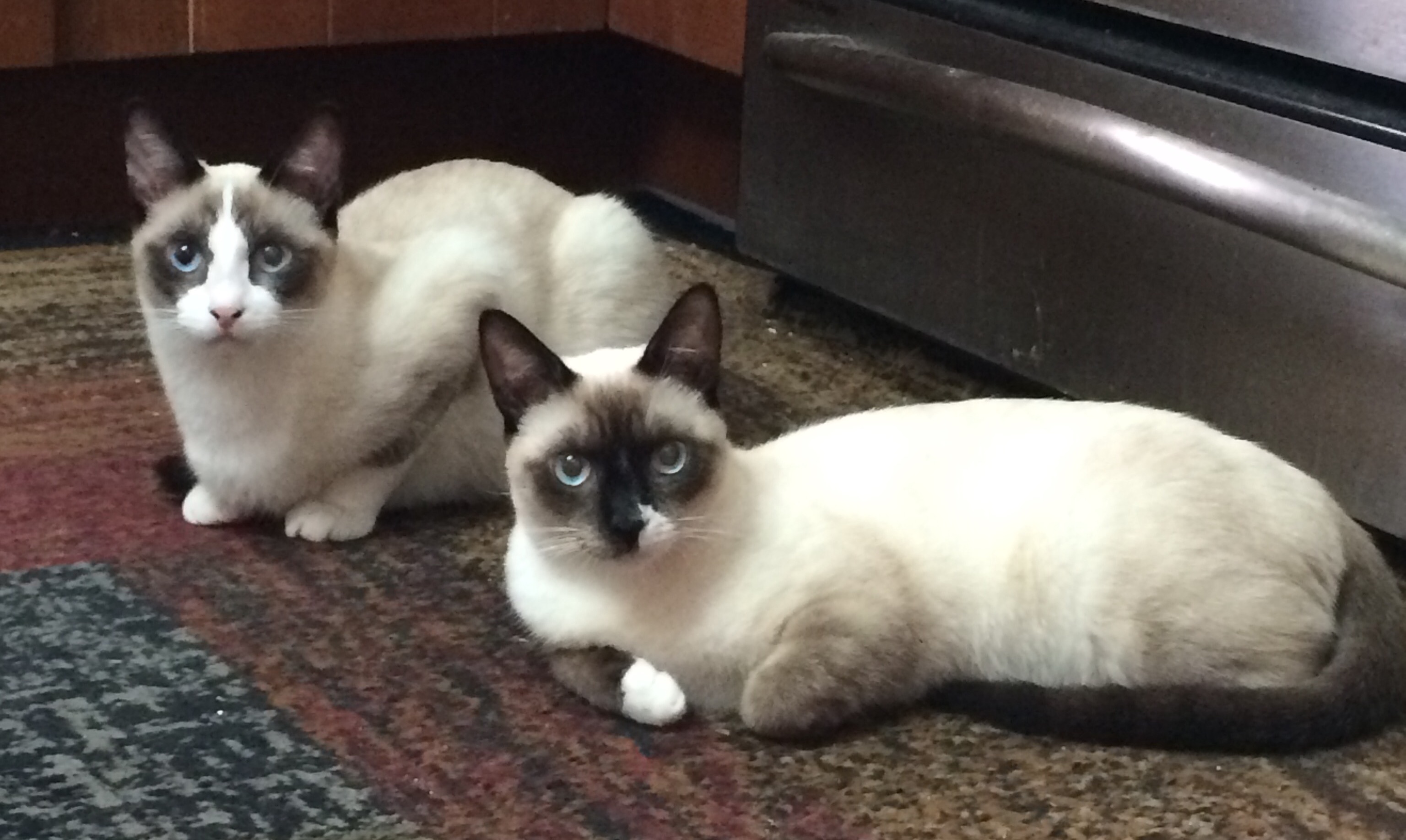
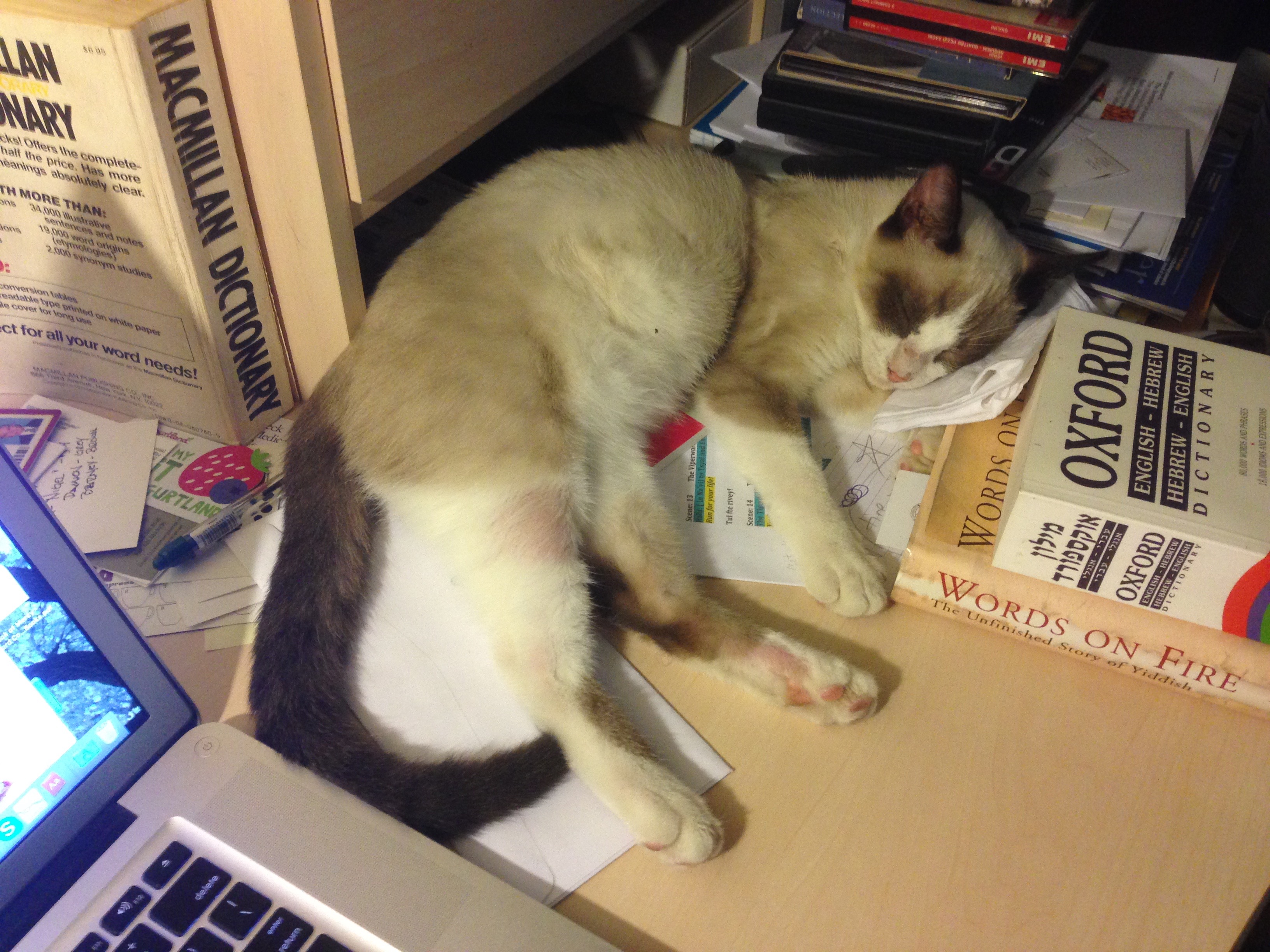
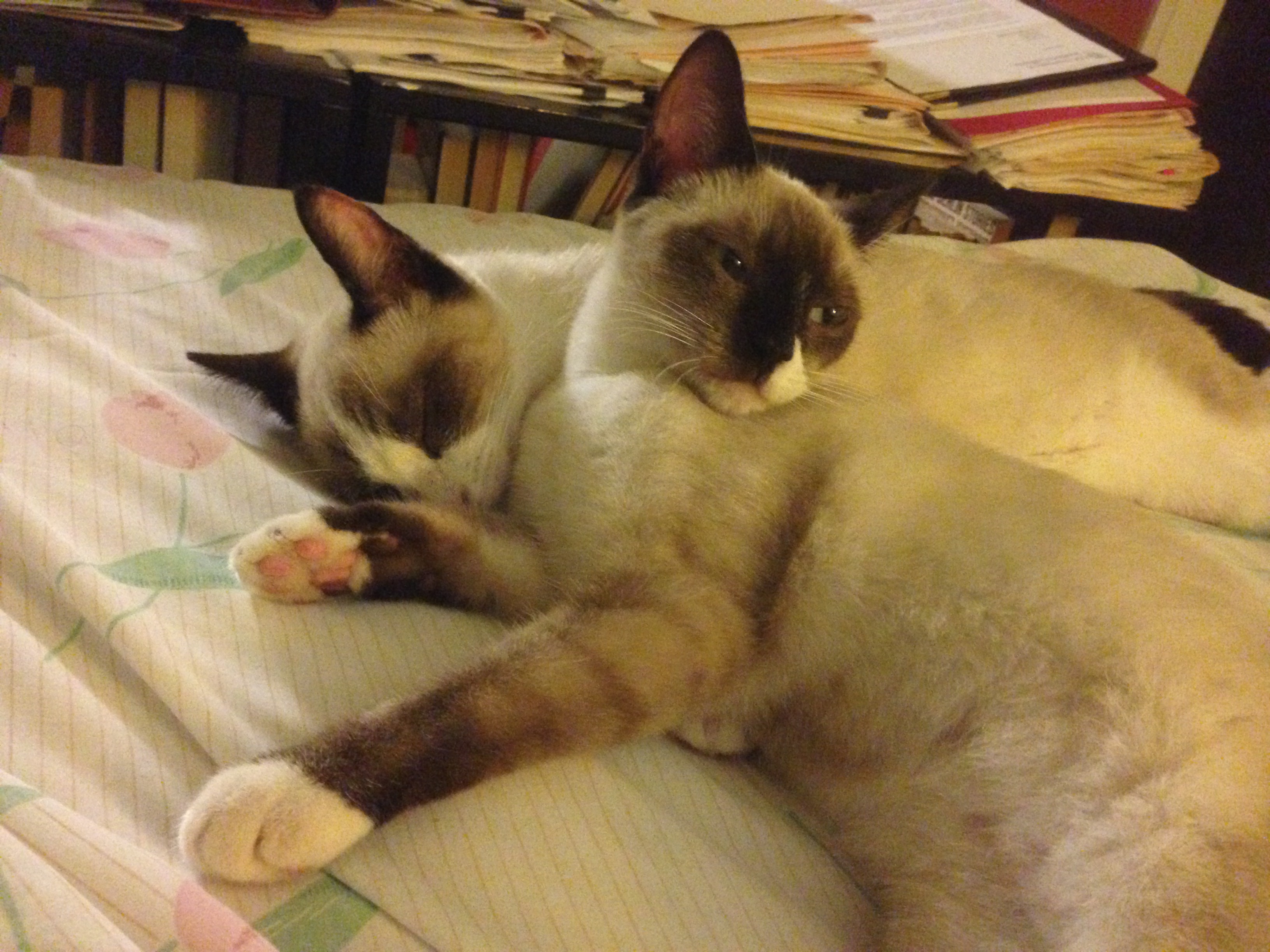
Mìftxele, I’m pleased to say that Palu is now much less shy than she used to be, and Lukan is bold and fearless! They’re both doing beautifully and are very happy to accept all the love we’re bestowing on them. Here they are. (Lukan, the male, is the one with white between his eyes; Palu, the female, has black in the same place.)
This post adds to the cultural terminology in the previous one and hopefully fills a few important gaps in our lexicon as well. Irayo nìfrakrr to the LEP and other members of the Na’vi community for some very useful discussions, suggestions, and examples. And a special irayo to two of our sulfätu lì’fyayä, Prrton and Stefan, who very kindly and beautifully recorded the example sentences below. Seysonìltsan, ma mesmuk!
seyn (n.) ‘chair, stool, bench; any tool or device to facilitate sitting’
This word derives from sä’o ‘tool’ and heyn ‘sit’:
sä’o + heyn > säheyn > seyn
Since chairs can be comfortable or uncomfortable:
hoan (n., HO.an) ‘comfort’
lehoan (adj., le.HO.an) ‘comfortable’
nìhoan (adv., nì.HO.an) ‘comfortably’
kelhoan (adj., kel.HO.an) ‘uncomfortable’
Sko frrtu, frakrr mì helku ngeyä lu oeru hoan nìtxan, ma tsmuk.
‘I always feel very comfortable as a guest in your home, brother.’
Längu fìseyn kelhoan nìngay. Tsun oe hiveyn tsawsìn ’a’awa swawtsyìp nì’aw. ‘This chair is really uncomfortable. I can only sit on it a few seconds.’
Where there are chairs, there are tables. So:
fyan (n.) ‘constructed device for keeping something off the ground and clean’
kurfyavi (n., KUR.fya.vi) ‘hook (for hanging or suspending an item)
These last two terms developed as follows:
sno + kurfyan > snokurfyan > snokfyan
kurfyan + vi > kurfyanvi > kurfyavi
seyto (vtr., sey.TO) ‘butcher (in the sense of separating or processing the carcass of a dead animal)
Seyto is not to be confused with ‘butcher’ in the sense of killing an animal. There is some overlap with pxìmun’i ‘divide, cut into parts,’ but that word is more general and can be used for cutting up anything; seyto refers specifically to cutting up an animal. Also note the stress on the final syllable.
Awngal fìyerikit nìwin siveyto ko. ‘Let’s cut up this hexapede quickly.’
säseyto (n., sä.sey.TO) ‘butchering tool’
yaney (n., ya.NEY) ‘canoe’
spulyaney (n., spul.ya.NEY) ‘canoe paddle’
This word obviously derives from spule ‘propel’ + yaney.
lal (adj.) ‘old (opposite of mip, nfp)’
txanlal (adj., TXAN.lal) ‘ancient, very old’
Poleng ayoeru koaktel vurit atxanlal. ‘The old woman told us an ancient story.’
A word about lal vs. spuwin: Both mean ‘old’ and are generally not for people (i.e., neither one can be used for ‘elderly’—that word is koak). So there is some overlap, but there are also some differences. Spuwin has the connotation of ‘old’ in the sense of ‘former’ as opposed to ‘current,’ where an older entity has been replaced by another one. In a blog post from 2011, I gave the example, Tsatsko lu spuwin ulte ke lu mi txur, which was translated as ‘That bow is old and no longer strong.’ The implication was that the bow had been replaced by a new one: it was the owner’s former bow rather than his current one. By the same token, if we were to translate into Na’vi the last line of the Who’s “Won’t Get Fooled Again,” (does anyone younger than I still listen to the Who? J )—namely, “Meet the new boss, same as the old boss”—“old” in this case would definitely be spuwin.
On the other hand, lal indicates something that is not new and has been around for a long time, whether or not it’s been replaced. For tangible objects, it often has the implication of ‘worn out,’ ‘broken,’ ‘tattered,’ ‘no longer usable,’ etc. (Calling a person lal would be very insulting.) But for non-tangibles, it simply indicates long existence, as in lala säfpìl, ‘old idea.’
Fwa tawtute slu Na’viyä hapxì lolu tìmungwrr apxa. ‘It was a great exception for a human to become part of the People.’
tìmungwrr si (vin.) ‘make an exception’
Ninat tìmungwrr sìlmi fte Ralu tsivun kivä hu tarpongu. ‘Ninat just made an exception so that Ralu can go with the hunting party.’
tarpongu (n., TAR.po.ngu) ‘hunting party’
nawfwe (adj., naw.FWE) ‘fluent, (for speech)’
This useful word requires some explanation.
You’re familiar with the expression nìwin na hufwe ‘as fast as the wind,’ which can be used in any situation to express rapidity. The shortened version na hufwe has become specialized as an adverbial expression for the fluent (not just rapid) use of language.
Fteria oel lì’fyati leNa’vi, slä mi ke tsängun pivlltxe na hufwe.
‘I’m studying Na’vi, but I’m afraid I still can’t speak it fluently.’
Na hufwe can contract further to nawfwe, which is a full-fledged adjective:
Toitsyeri lu poe plltxeyu anawfwe nìtxan. ‘She’s a very fluent speaker of German.’
Finally, a question has arisen regarding time expressions like tsakrr. As you know, tsakrr is listed in the dictionary as an adverb meaning ‘then, at that time.’ The question is: Since krr is a noun, can tsakrr also be a noun meaning ‘that time,’ as in Muntrram oe koläteng hu Ralu ulte sunu oer tsakrr, ‘I spent last weekend with Ralu and had a good time (literally, that time was pleasant to me)’? The answer is: absolutely! Many time expressions double as adverbs and also as nouns or noun phrases. You can tell from the context which usage is relevant. (The stress does not change.)
North American Avatar Meet 2015 is now history. The setting was beautiful Estes Park, Colorado, where the lì’fyaolo’ and Uniltìrantokxolo’ got together again to celebrate all things Avatar. This year’s tsawlultxa included seeing the film on a big screen in a real theater; an astronomical evening at the Estes Park Memorial Observatory; a great presentation and Q&A session with Brooks Brown, VP of Digital Development at Lightstorm Entertainment; a pineapple-themed raffle; a clan meal generously hosted by LEI; and enjoyment of the breathtaking Colorado mountain environment. As for lì’fya leNa’vi, I didn’t teach a new class this time but instead held an informal session to review the material in the 101, 102, and 103 classes from previous meet-ups.
For those of you who made it to the meet-up, seeing you again was a tìprrte’ angay; for the aylomtu who couldn’t be there, nìsìlpey zìsìtay!
And now some new vocabulary.
In this and subsequent posts, I’ll present some terms that specifically relate to Na’vi life and culture and to the Pandoran environment. I hope you’ll find them useful in talking about the world of Avatar.
Note: For those of you who may have seen different versions of these terms: At the time the Activist Survival Guide was submitted for publication, understanding of the Na’vi language was still developing. As a result, the publication and Pandorapedia do not always reflect the agreed-upon definitions and usage. Please consider the following the most current approved versions.
Also, I haven’t gone into detail about how some of these objects are constructed or used, or how they fit into Na’vi culture. See the ASG or Pandorapedia for more information.
lereyfya (adj., le.REY.fya) ‘cultural’
Terms related to food and drink
huru (n., HU.ru) ‘cooking pot’
sey (n.) ‘cup or bowl minimally modified from naturally occurring resources’
’e’in (n., ’e.’IN) ‘pod, gourd’
’e’insey (n., ’e.’IN.sey) ‘drinking gourd’
sum (n.) ‘shell (from the ocean)’
sumsey (n., SUM.sey) ‘drinking vessel made of shell’
swoasey (n., SWO.a.sey) ‘kava bowl (constructed from seed pods, used for drinking intoxicating beverages), hand-sized’
swoaseyayll (n., SWO.a.sey a.YLL) ‘large social kava bowl’
tsyey (n.) ‘snack, light meal’
Ke ’efu oe ohakx nìhawng; tam tsyey. ‘I’m not too hungry; a snack will do.’
tsyeytsyìp (n., TSYEY.tsyìp) ‘tiny bite’
nik (adj.) ‘convenient, usable without much expenditure of effort’
niktsyey (n., NIK.tsyey) ‘food wrap (food items wrapped in edible leaves and vines)’
ikut (n., I.kut) ‘large pestle (grinding tool); meal-mashing pole’
sämunge (n., sä.MU.nge) ‘transportation tool or device’
This is the general term (derived from munge ‘bring’) for any object used to carry or transport something else. In compounds, the ä and e drop, yielding –smung.
Txo tìkeftxonga’a fmawnit ke stilvawm ayngal, zene oe piveng san Uniltìrantokxä pamtseongopyu ayawne alu Tsyeymzì Horner tolerkängup.
James Horner, who composed the musical score for Avatar and so many other films, has died at the age of 61. He was killed in a plane crash in California.
While working on the film, it was my privilege to meet James, get to know him a bit, learn from him. I was so looking forward to seeing him again and hopefully working with him on the Avatar sequels. That is not to be, but at least we all have his wonderful music, and it will go on . . .
Tolerkup tute; pamtseo peyä tì’i’avay krrä rayey.
ta Pawl
tìkeftxo (n., tì.ke.FTXO) ‘sadness’
tìkeftxonga’ (adj., tì.ke.FTXO.nga’) ‘sad (not for people)’
I see that some of you have already discovered this video online. It’s a brief “teaser,” whetting appetites for Cirque du Soleil’s newest production, “Toruk: The First Flight,” based on an Avatar theme. And it has some spoken Na’vi in it!
As you’ve probably guessed, I was involved in this project. I translated the needed text and worked closely with the professional voiceover artist in Montreal to coach him on the pronunciation. I think he did a fine job.
I was delighted to see the discussion about this on learnnavi.org. Several of you did beautifully in figuring out exactly what the Na’vi was! Seykxel sì nitram, ma eylan!
If I can figure out how to do a spoiler here on the blog, I’ll edit this post and add the text and translation. Otherwise I’ll include it soon in a separate post.
In the meantime, if you haven’t already listened to the Na’vi and attempted to figure it out, please do! I bet you’ll get a lot of it.
A couple of hints:
There’s one word you’re not familiar with: the Anurai are a Na’vi clan.
Also, keep in mind the adposition wä ‘against.’
Sìlpey oe tsnì hì’ia fìrel arusikx sì mì saw a lì’fya leNa’vi zivawprrte’ ayngane! 🙂
EDIT May 03: Well, I did some research and discovered I needed to add a new plugin to WordPress to allow me to do a spoiler. I did that, but for some reason it’s not working. So rather than fiddle with it further, I’ll just give you the Na’vi text below. If you don’t want to see it yet, don’t scroll down. 🙂
The well-known saying “April showers bring May flowers” has for several years now been far from true in California. I only wish we had had some April showers here! But we’re in the midst of a drought of historic proportions, and it’s been dry as a bone. So I don’t know about the May flowers. Rutxe, ma eylan, ayoeru fpe’ payti! 🙂
Here in no particular order is some new vocabulary, some of which is related to the above. As always, a big thank-you to the LEP contributors for their excellent suggestions.
tìkelu (n., tì.KE.lu) ‘lack’
The derivation, I think, is obvious.
The particular lack you’re talking about is indicated by a noun in the genitive, just as we say in English, “a lack of ____.”
Tìkelu tìeyktanä asìltsan längu mì olo’ awngeyä tìngäzìk.
‘Unfortunately, the lack of good leadership in our clan is a problem.’
Certain important lacks, however, have become lexicalized. For these, “lack” is indicated by the suffix –kel. It’s not productive, which is to say you’re not free to construct your own –kel words; you just have to learn them. Two examples are:
tompakel (n., TOM.pa.kel) ‘drought’
syuvekel (n., SYU.ve.kel) ‘famine’
Tompakeltalun zene tute Kälìforniayä payit sivar nìnän.
‘Because of the drought, Californians have to use less water.’
This word derives from za’u + nìprrte’, that is, ‘come pleasurably.’
As with the related word sunu, the syntax here is not “I enjoy X” but rather “X is enjoyable to me.” Because of the underlying za’u, however, the experiencer is not indicated by the dative but rather by ne, which we use with verbs of motion.
Tsafnepamtseo ke zawprrte’ oene. ‘I don’t enjoy that kind of music.’
(Note that oene is pronounced in two syllables [ˈwɛ.nɛ]. The other way around, ne oe, it’s three [nɛ ˈo.ɛ]. This is exactly parallel to oeta vs. ta oe.)
You’re probably wondering if there’s any difference in meaning between sunu and zawprrte’. The two overlap quite a bit and can often be used interchangeably. Zawprrte’, however, has somewhat more of a sense of deriving physical or emotional pleasure from something, while sunu is ‘like’ more generally.
nawri (adj, NAW.ri) ‘talented’
Nga lu rolyu anawri slä Ninat lu pum aswey. ‘You’re a talented singer but Ninat is the best (one).’
Derivation:
tìnawri (n., tì.NAW.ri) ‘talent’
Tìrusolìri ke lu oeru kea tìnawri kaw’it.
‘I have absolutely no talent for singing.’
(Note that this does NOT mean what the literal English translation might indicate!)
Rä’ä tìng zekwä oer!
‘Don’t touch me!’
susyang (adj., su.SYANG) ‘fragile, delicate’
Lu fìvul susyang nìtxan. Txo fko tivìng zekwä kxakx. ‘This branch is very fragile. If you touch it, it’ll break.’
Rey’eng lu susyang. ‘The balance of life is fragile.’
reym (n.) ‘dry land’
The difference between reym and atxkxe is that atxkxe is the general word for land or territory, which includes waterways and oceans; reym refers specifically to dry land as distinct from water.
Peioang tsun mì tampay kop mì reym rivey? ‘What animal can live both in the sea and on the land?’
In the above sentence, note the use of kop:
kop (conj.) ‘and also’
tuvom (adj., tu.VOM) ‘greatest of all, exceedingly great’
Entu lu tuvoma taronyu. Kawtut na po ke tsole’a oel mì sìrey. ‘Entu is an incredible hunter. I’ve never seen anyone like him before.’
yengwal (n., yeng.WAL) ‘sorrow’
Sa’semìri lu ’evengä kxitx yengwal atuvom. ‘For a parent, the greatest sorrow is the death of a child.’
nip (vin.) ‘become stuck, get caught in something’
Rini fmarmi hivifwo slä venu nolip äo tskxe. ‘Rini tried to escape but her foot got caught under a rock.’
Members of the LEP noted that as with fyep, we can use already existing adverbs to further describe the scale of nip:
nip nìklonu ‘stuck tightly’
nip nìsyep ‘stuck irremovably’
nip nìmeyp ‘weakly, loosely stuck’
hän (n.) ‘net; web’
Tsun fko sivar hänit fte payoangit stivä’nì. ‘One can use a net to catch a fish.’
Fìhì’angìl txula hänti fte smarit syivep. ‘This insect constructs a web to trap its prey.’
’rrko (vin., ’RR.ko—inf. 1,2) ‘roll’
As with frrfen, the Imperfect Aspect (<er>) form of ’rrko is simply ’rrko.
In its root form, ’rrko indicates that something, usually an inanimate object, is rolling involuntarily:
Rum ’olrrko oene klltesìn. ‘The ball rolled towards me on the ground.’
For transitive ‘roll,’ that is, when you roll something, use the causative infix <eyk>:
’Evengìl skxevit ’eykrrko sko uvan. ‘Children roll pebbles as a game.’
And if you yourself are rolling—i.e., causing yourself to roll—use <eyk> along with the reflexive infix <äp>:
Tseyk ’äpeykamrrko äo utral a zolup fte hivifwo ftu aysre’ palulukanä. ‘Jake rolled under the fallen tree to escape from the thanator’s teeth.’
tsngem (n.) ‘muscle’
Lu pa’lir sngem atxur. ‘A direhorse has strong muscles.’
Derivation:
tsawsngem (adj., tsaw.SNGEM) ‘muscular’
This is derived from tsawl ‘big’ + sngem ‘muscles.’ Tsawsngem is irregular, since it’s an adjective coming from a noun phrase without the use of le– or –nga’.
Akwey ke lu tsawsngem kaw’it slä lu sayrìp nìtxan. ‘Akwey isn’t at all muscular but he’s very handsome.’
wìngay (vtr., wì.NGAY—inf. 1,1) ‘prove’
This is derived from wìntxu ‘show’ + ngay ‘true.’ (Compare pllngay ‘admit’ from plltxe + ngay.)
Fa fwa tsyìl kxemyot akxayl frato, pol ayoer wolìngay futa tsyìltswo tsan’olul. ‘By scaling the highest wall, he proved to us that his climbing ability had improved.’