
Kaltxì, ma frapo!
The projects I’ve been working on seem to have slowed down a bit, at least temporarily, which provides more time for me to get to my big backlog of Na’vi contributions and comments. For right now, let me say a few things about two recent comments that I thought might be of general interest.
The first concerns Varang’s line to her warriors, ’Ur fkivan tstew! ‘Do not show fear!’ which I discussed last time. As I mentioned, ’ur is a noun having to do with how something comes across to you—the sight, look, or appearance of someone or something. So this brief sentence is an idiomatic way of saying, “Let your appearance look brave.” However, Zángtsuva pointed out that tstew ‘brave’ is an adjective marked “for people.” The corresponding word for things is tìtstewnga’. Since ’ur is a quality or thing, not a person, why isn’t the sentence ’Ur fkivan tìtstewnga’?
Good question. In fact, the version with tìtstewnga’ is grammatically correct. However, in the context in which Varang speaks it, the original version is justified, even if it bends the rules. She wants to say something sharp and punchy, with good rhythm. ’Ur fkivan tstew! is much stronger than ’Ur fkivan tìtstewnga’. And it’s perfectly understandable.
More than that, however, the distinction between words that are ofp—only for people—and those that are nfp—not for people—can blur and change over time. The example that always comes to my mind is English healthy vs. healthful. (I see I first mentioned this in an October 2014 blog post.) When I was in school all those many years ago, I remember being taught that healthy is for living things that can experience good health. I am healthy, my son is healthy, my cat is healthy, this tree is healthy. Healthful refers to something that provides good health: healthful food, healthful exercise, a healthful mental attitude. There’s a clear distinction! Saying “These tomatoes are very healthy” only makes sense if you’re talking about tomatoes on the vine in your backyard that are growing beautifully.
Well, that distinction seems to be ancient history. “Healthful” is rarely used now, and people have no problem saying, “This restaurant serves healthy food,” not realizing that this way of speaking was once frowned upon. Language changes! So it’s not out of the question to think that tstew in Na’vi might be evolving in a similar direction, where the ofp form widens its scope and the formerly nfp form is used less and less often.
The other comment I wanted to address concerns sru, the adposition I introduced last time which means a particular kind of ‘through.’ Is it legitimate to have a Na’vi word that sounds close to a word in an Earth language that means the same thing?
I’d divide this question into two components. First, how close, really, are through [θɹu] and sru [sɾu ]? When you transcribe their pronunciations in IPA, you see only one phoneme in the two words, the vowel, that’s identical. The others—the initial consonant and the r-like one—are not. It’s certainly true that the common [s] sound and the much rarer [θ] one are phonetically similar, with [θ] sometimes replaced by [s]. For example, when Persian borrows Arabic words, the letter representing the [θ] sound in standard Arabic, ث , is always pronounced [s] in Persian. And as Plumps pointed out, you hear that substitution as well in strongly German-accented English. (I may have referenced this before, but there’s an old TV commercial for the Berlitz language school that I’ve always loved. I find its humor gentle and delightful, and I hope no one will be offended.)
That said, for most English speakers, [s] and [θ] are totally different phonemes, and think and sink are just as different from each other psychologically as are link and pink. I have to confess that when I was first considering sru, it didn’t even occur to me it might be too close in sound to through. 🙂
But there’s a more general question here: Does it ever happen that two words in completely unrelated languages are very similar, or even identical, and mean the same thing? Well, yes. Irayo to Yätù’aw for the information about the Australian language in which “dog” is dog! The example I myself always think of is mahi. In Persian, it means ‘fish.’ In Hawaiian, mahi-mahi is a certain kind of fish. Persian and Hawaiian are completely unrelated. Cue the Twilight Zone music? Nope. It’s a coincidence.
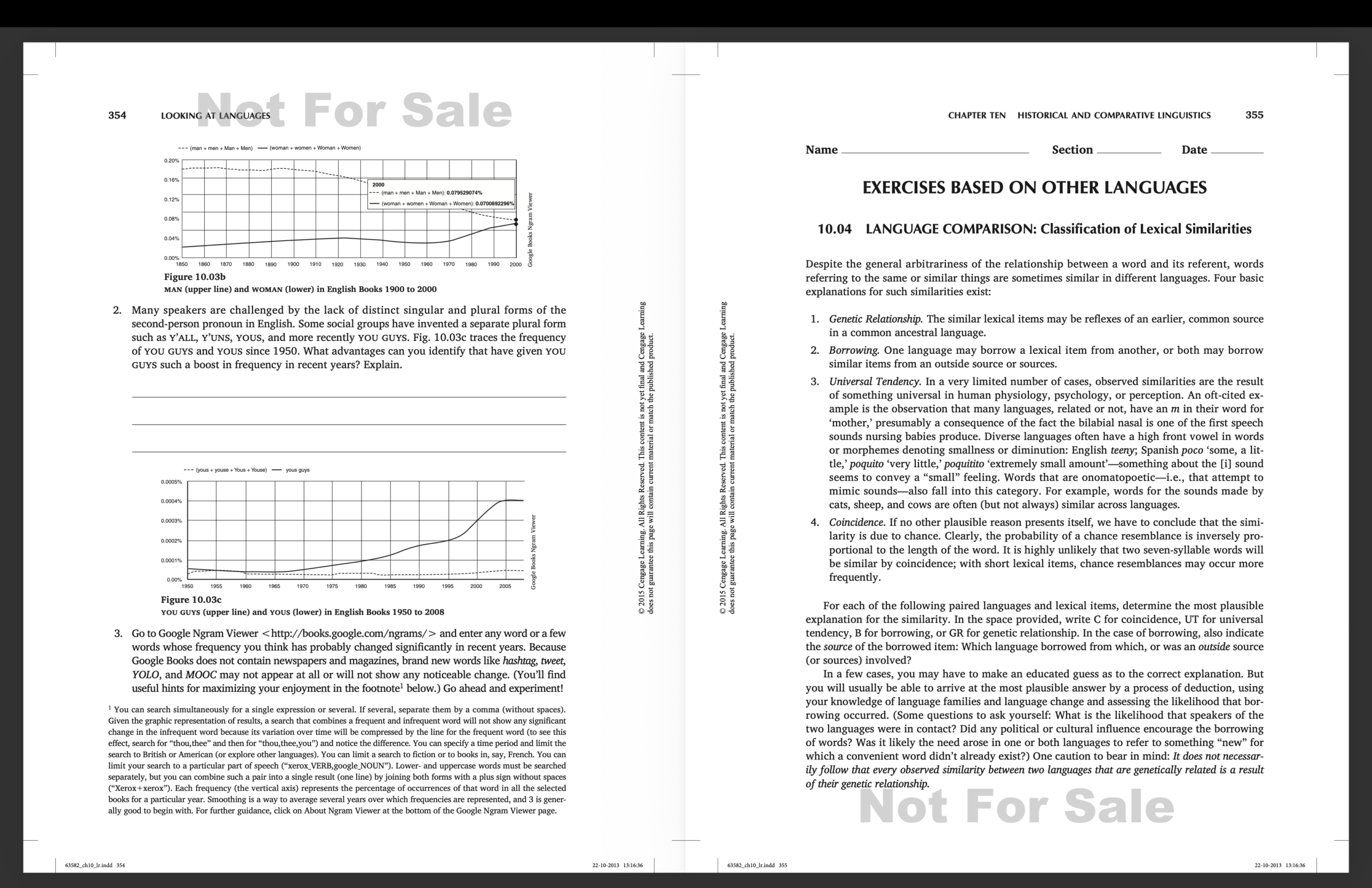
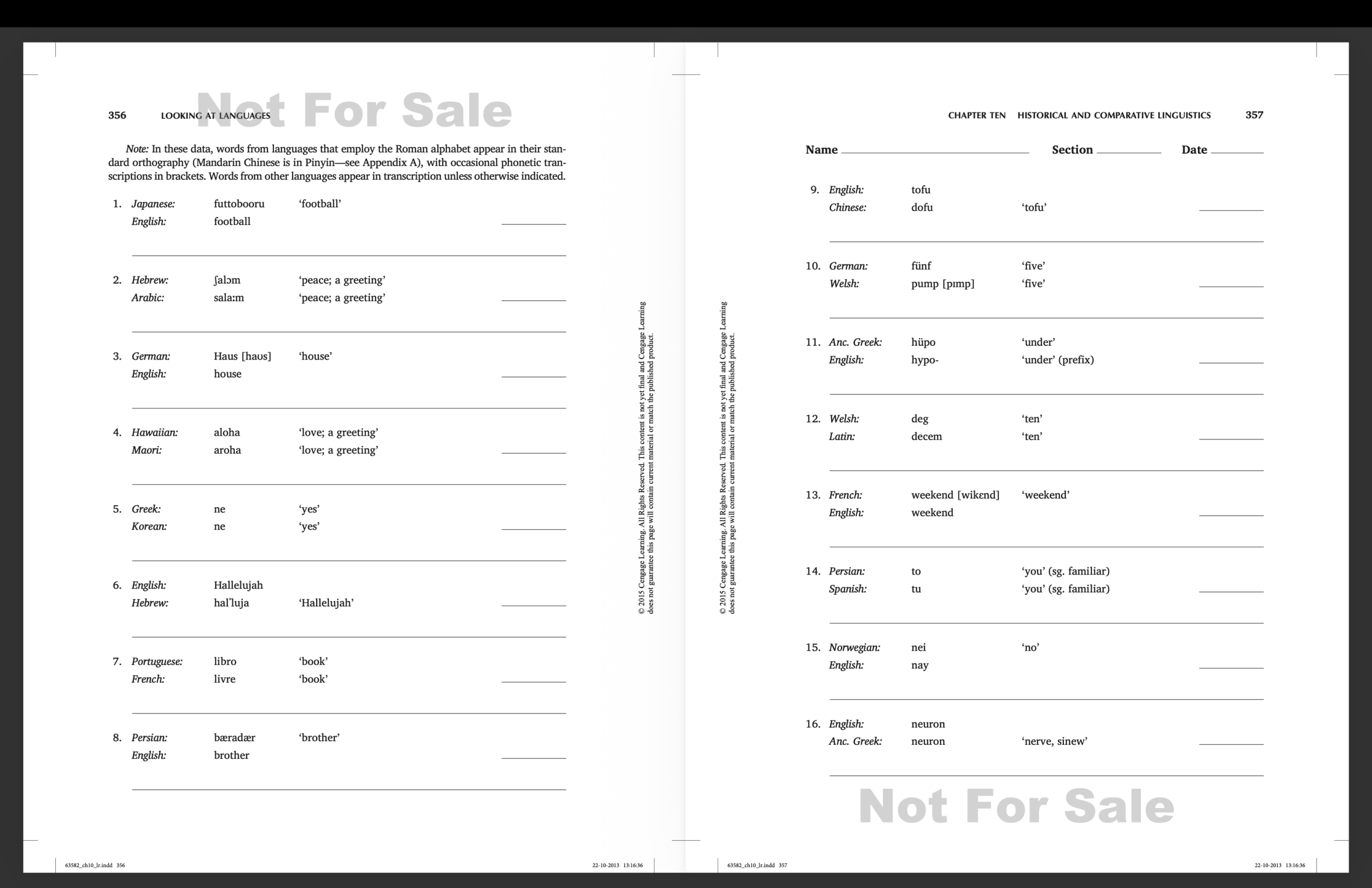
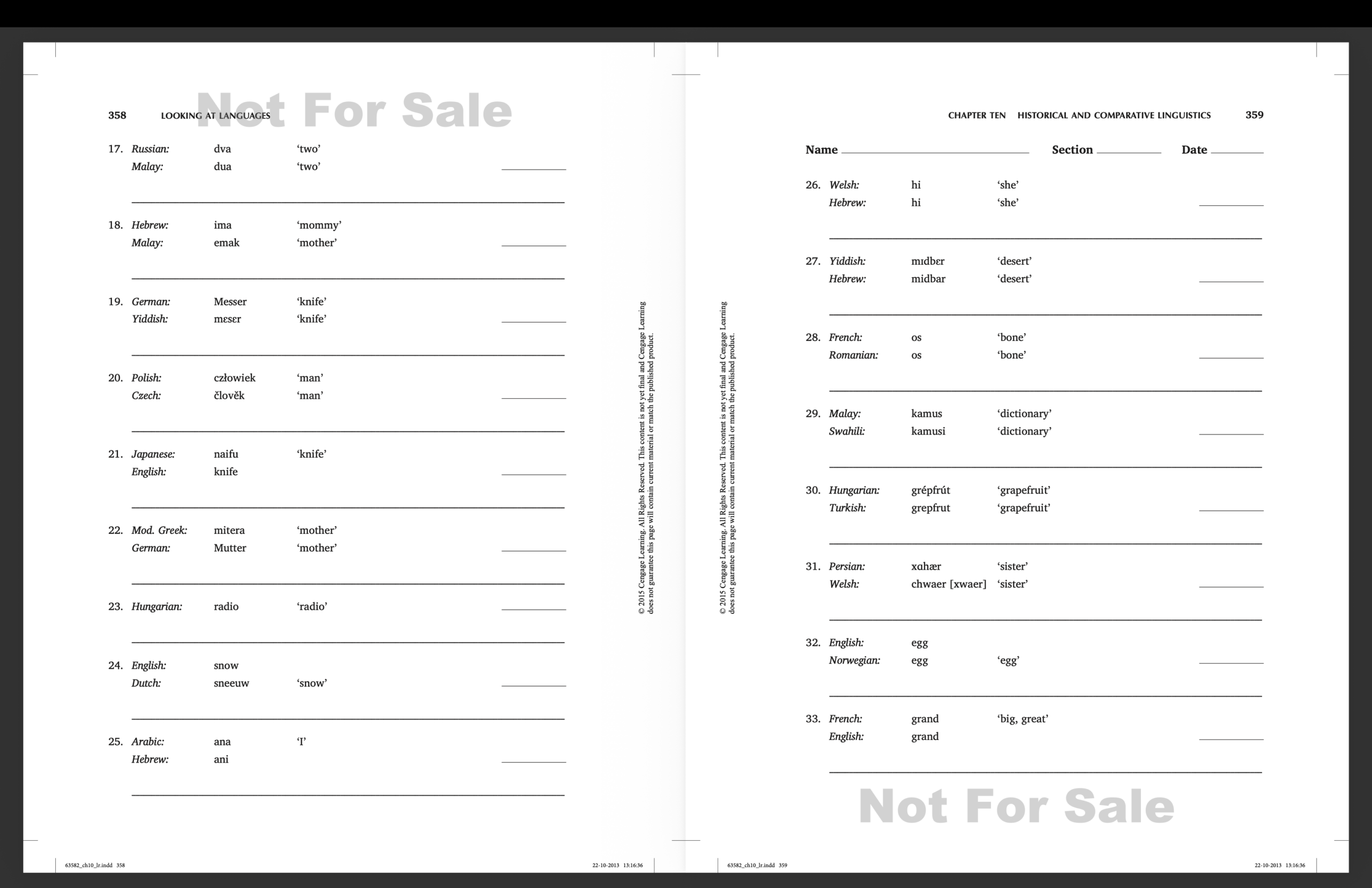
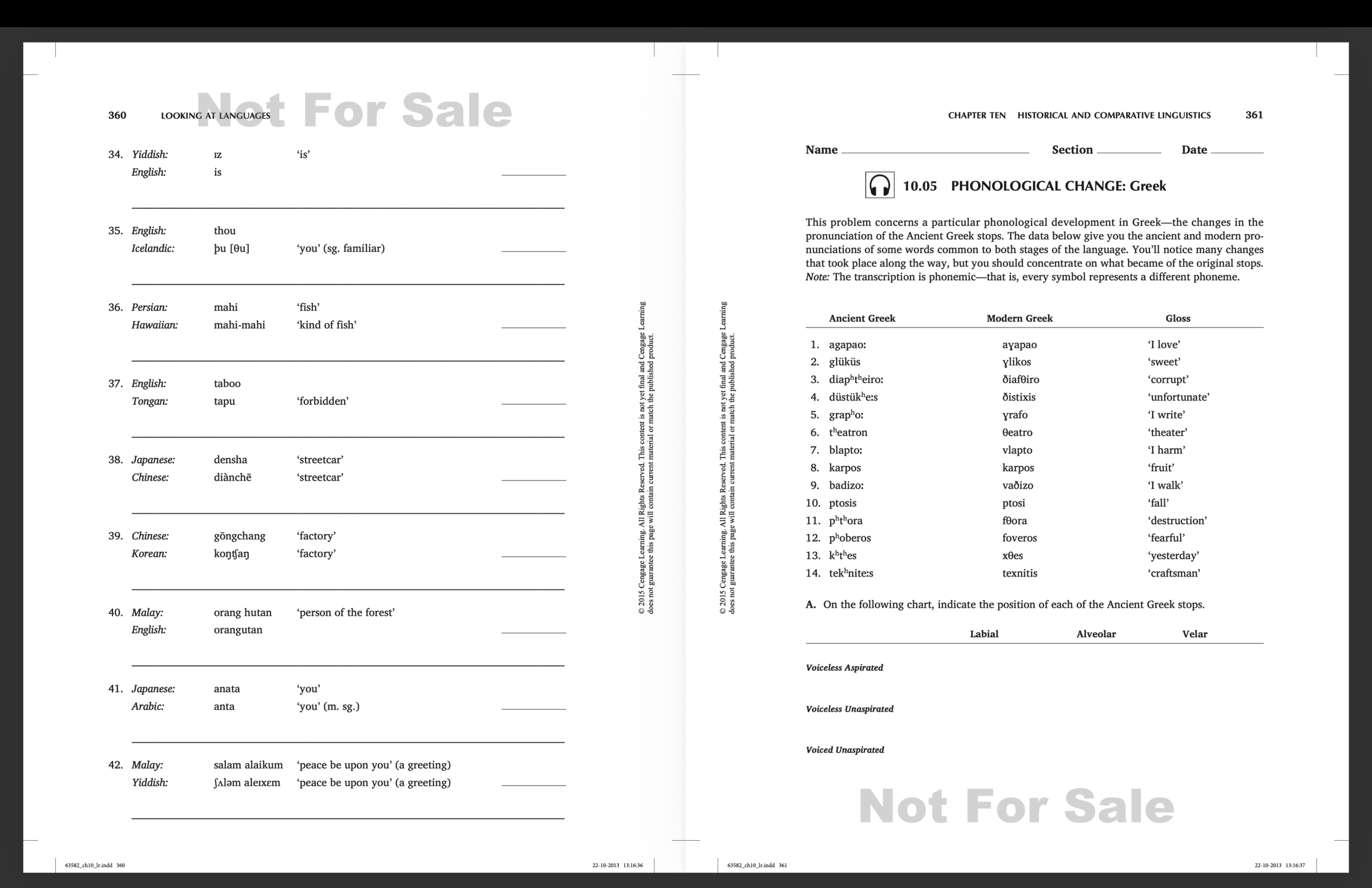
I thought I’d share this exercise with you from the linguistics workbook I wrote years ago with Edward Finegan, Looking at Languages. The idea is for students to look at similarities in different languages and decide how to explain them. Are the languages related, so that you would expect to see lots of similar things? Did one language borrow from the other? Could there be some universal tendency involved? Or is the similarity merely a coincidence? If you’re interested and you have some time, take a look! Make sure to read the introduction first. I’ve included the answer key, but don’t be tempted to check it until you’ve completed the whole exercise. Have fun!
Introduction
Items 1 – 16
Items 17 – 33
Items 34 – 42
1. B Japanese borrowed from English. 2. GR 3. GR 4. GR 5. C 6. B English borrowed from Hebrew. 7. GR 8. GR 9. B English borrowed from Chinese. 10. GR 11. B English borrowed from Greek. 12. GR 13. B French borrowed from English. 14. GR 15. B English borrowed from the ancestor of Norwegian. 16. B English borrowed from Greek. 17. C 18. UT 19. GR 20. GR 21. B Japanese borrowed from English. 22. GR 23. B Both borrowed from a third source. 24. GR 25. GR 26. C 27. B Yiddish borrowed from Hebrew. 28. GR 29. B Both borrowed from a third source (Arabic). 30. B Both borrowed from English. 31. GR 32. B English borrowed from the ancestor of Norwegian. 33. B English borrowed from French. 34. GR 35. GR 36. C 37. B English borrowed from Tongan. 38. B Japanese borrowed from Chinese. 39. B Korean borrowed from Chinese. 40. B English borrowed from Malay 41. C 42. B/GR Malay borrowed from Arabic, Yiddish borrowed from Hebrew. Hebrew and Arabic are genetically related.
Hayalovay!
ta P.

I’d like to elaborate a bit more on sru vs. through. Most English speakers don’t use a true [u], so none of the sounds really match up at all!
I’m from Southern California, and for most American English speakers the /u/ vowel is fronted and usually unrounded at least partly. It’s definitely not the back, deep, tight-lipped Na’vi [u].
British and Australian speakers tend to keep it rounded but still front it.
Point well taken. [u] was a broad transcription only; the phonetic details differ in different dialects. Although I’ve lived in So. Cal. for most of my life, I’m originally from New York City, and my native dialect has a backer, rounder /u/ than most other American dialects.
Mesìeyngìri irayo nìdan!
That reminds me about a Reddit thread about words in conlangs that look like words in natural languages. To narrow down the list from Na’vi, I decided to list the “external contronyms” there (Natural language words which are antonyms to the Na’vi words that look like them)
Mal: “Bad” in Spanish
Mal: “Trustworthy” in Na’vi
‘Oe: “You” in Hawaiian
Oe: “I” in Na’vi
Nitram: 2021 Australian movie which isn’t happy at all
Nitram: “Happy” in Na’vi
Srane: Polish swear word (conjugated from srać)
Srane: “Yes” in Na’vi
Eltur tìtxen si nìngay, ma Txonpay–nìfrakrr! I had no idea there was a movie titled “Nitram”! (But I can assure you that my creation of that word many years ago had nothing at all to do with the fact that my brother is named Martin. 😉 )
As a second-language speaker of English, I’ve never been taught the distinction between “healthy” and “healthful”. Seems like that distinction is gone even in the weird, fossilized variant of English they teach in school 🙂
Healthy/healthful vs. lefpomtokx/fpomtokxnga’ reminded me of a related question. As you mention, in English we can say “the tomato is healthy” meaning the plant is growing beautifully, and “the tomato is healthful” if eating it would provide health to me.
Does this mean we can make a similar distinction in Na’vi (‘ewll lu lefpomtokx vs. ‘ewll lu fpomtokxnga’)? To me this would feel quite natural, but as lefpomtokx is marked ofp and ‘ewll is not a person, I’m not sure if this makes sense.
Well, keep in mind that I was in elementary school in the 1950s! Things have changed a lot since then. However, this little article indicates that the distinction between “healthy” and “healthful” goes back to an arbitrary rule imposed in 1880 that never really caught on. So maybe I had a particularly prescriptive teacher. 🙂
https://www.merriam-webster.com/grammar/healthy-or-healthful
>>>Does this mean we can make a similar distinction in Na’vi (‘ewll lu lefpomtokx vs. ‘ewll lu fpomtokxnga’)? To me this would feel quite natural . . .
I don’t see why not!
Kosman! As an anecdote, the only place outside of linguistic circles where I heard the word healthful is the 1959 Westinghouse commercial “Total Electric Home” 😁 (my parents don’t use the word healthful either)
As a kid in the 90s, the one place I heard ‘healthful’ was in in the negative, ‘unhealthful’ – in the context of air quality reports. It felt dated even then, and they changed it to ‘unhealthy’ by 2000 or so.
Irayo tsamesìeyngìri, ma karyu!
A question about the transcription of «sru»: is the rhotic in fact a trill [r] as per the transcription above, or is it a tap [ɾ] as our past information would indicate?
Thanks for catching that. You’re right–it should have been the tapped r, [ɾ]. I’ll correct the post.
That’s a very interesting post, Irayo nìtxan!
Pretty much the same thing like Wllìm wrote here, as 3rd-language speaker of English, I can’t remember the “healthy” and “healthful” was a thing at school.
As Romanian speaker, there is one word that looks very similar like the sru/through one:
sì [sɪ] and – Na’vi
și [ʃi] and – Romanian
Just the IPA is more different.
Interesting about Romanian “and”! I didn’t know that.
In fact I thought tstew made more sense than tìtstewnga because even if ’ur itself is obviously not people, in this case it’s the appearance of *people* so the association is very easily made.
Regarding coincidences, there is of course English _bad_ and Persian _bad_, which also happen to have the same meaning without any connection. And as an aside, I’ll never be not amused by the Na’vi word furia, which means wrath in Spanish 😀
I’ve often thought about “bad” in English and Persian. But you know, there is a connection between those two languages: they’re both Indo-European! So it’s correct to say that English and Persian are related, albeit distantly. Whether that relationship is actually the source of the similarity between the two bads, though, is unclear to me.
“bad” in farsi means… bad.
Dorost-e! 🙂
By the way, I realized that there is no Na’vi word for recombinant. Will we get one?